filter_list Showing 6 results for "Visual Arts Commission" close Clear
dashboard All 6 museum exhibitions 6
date_range Range Today This Week This Month All
Subscribe

dana awartani venice biennale 2026 saudi arabia 1234760850

Palestinian Saudi artist Dana Awartani has been selected to represent Saudi Arabia at the 2026 Venice Biennale. Her pavilion will be curated by Antonia Carver, director of Art Jameel, with assistance from Hafsa Alkhudairi. Awartani, known for her material interpretations of conflict in the Middle East, draws on Saudi Arabia's craft and cultural legacies, often collaborating with local artisans or displaced craftspeople. Her recent works include a response to heritage site destruction at the 2024 Diriyah Contemporary Art Biennale and an archive of recreated stone carvings at the 15th Sharjah Biennial.
Why the inaugural Art Week Riyadh was a fair in everything but name

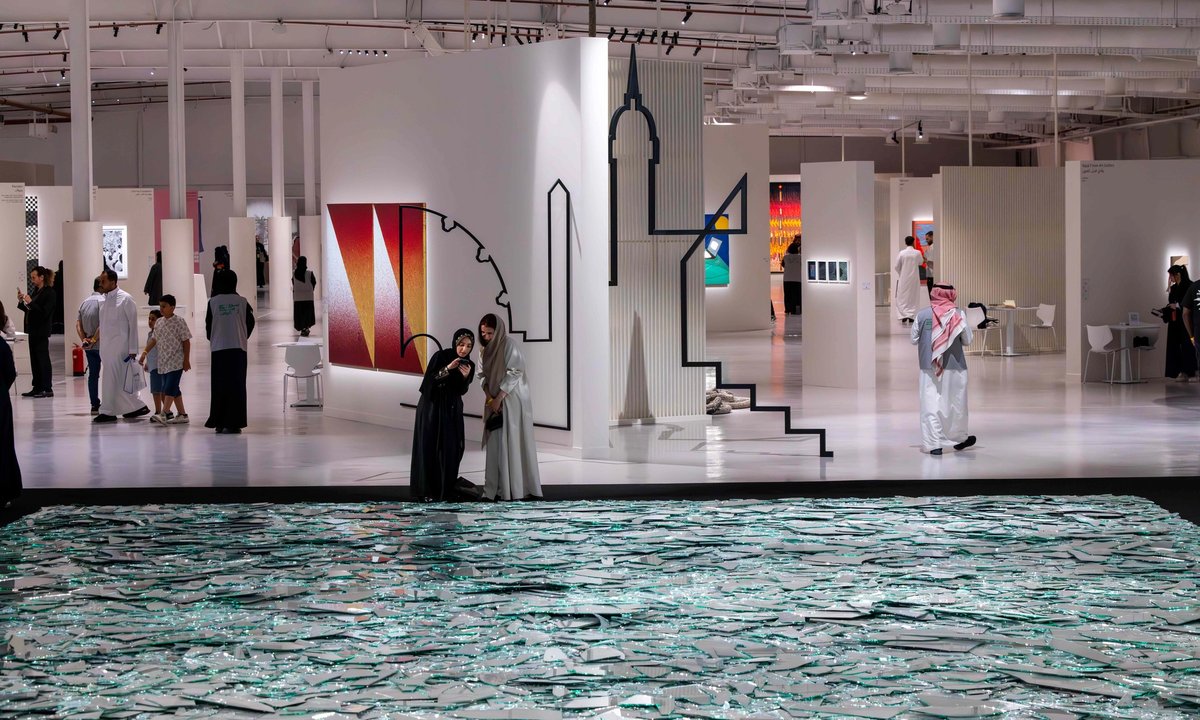
The inaugural Art Week Riyadh (AWR), organized by Saudi Arabia's Visual Arts Commission, took place from April 6-13 in the Jax district of Diriyah. Though officially billed as a non-commercial curated exhibition, the event functioned much like an art fair, with 32 galleries displaying available works, price lists visible on stands, and sales conducted throughout the week. The main exhibition, titled "At The Edge," was curated by Vittoria Matarrese with associate curators Basma Harasani and Victoria Gandit Lelandais, featuring galleries from Saudi Arabia and the wider region. Standout presentations included works by Ayesha Sultana, Mohamed Bourouissa, Mohammed Al Resayes, and Miramar Al Nayyar, alongside a moving image section and a satellite program of open studios and gallery shows.

With Nearly 30,000 Clay Earth Bricks, Dana Awartani Remakes History in the Saudi Arabia Pavilion

Dana Awartani, a Jeddah- and New York-based artist of mixed Palestinian, Saudi, Jordanian, and Syrian descent, has created the Saudi Arabia Pavilion at the Venice Biennale using nearly 30,000 clay earth bricks. The installation, titled "May your tears never dry, you who weep over stones," replicates traditional mosaic motifs sourced from over 20 cultural heritage sites across the Arab world that have been destroyed by human conflict. Awartani emphasizes collaboration, crediting numerous skilled craftsmen—economic migrants to Saudi Arabia—who worked alongside her, and her practice blends formal training at Central St. Martins with Islamic geometry and illumination studies in Turkey.

Saudi Arabia looks to its Modern art history as the art world eyes up the Gulf

Saudi Arabia is actively showcasing its Modern art history through major exhibitions and sales. The 'Beginnings of Saudi Art Movement' at the National Museum in Riyadh features over 250 works by 73 artists from the 1960s-1980s, highlighting pioneering figures like Mounirah Mosly and Safeya Binzagr. Simultaneously, the Desert X AlUla exhibition is displaying monumental, long-unseen sculptures by Modernist artist Mohammed AlSaleem.

bedayat beginnings of saudi art movement 2747952

The National Museum of Saudi Arabia in Riyadh has launched "Bedayat: Beginnings of Saudi Art Movement," a landmark survey exhibition documenting the evolution of the country’s art scene from the 1960s through the 1980s. Curated by Qaswra Hafez and commissioned by the Visual Arts Commission, the show features a vast array of paintings, sculptures, and never-before-seen archival materials. The exhibition is organized into three sections that explore the foundations of the movement, the influence of modernization on daily life, and the specific contributions of four modernist pioneers: Mohammed Al-Saleem, Safeya Binzagr, Mounirah Mosly, and Abdulhalim Radwi.

Saudi pavilion at Venice Biennale turns fractured heritage into monumental art installation

Saudi Arabia has unveiled a large-scale installation by artist Dana Awartani at the 61st Venice Biennale, held at the Arsenale. Titled "May your tears never dry, you who weep over stones," the work covers the entire floor of the Saudi national pavilion and incorporates over 29,000 sunbaked clay bricks and mosaic patterns inspired by Islamic geometric art. The installation references 23 heritage sites across the Arab world that have been damaged or destroyed by conflict, and was produced over nearly 30,000 artisan hours with 32 craftspeople at a studio outside Riyadh. Curated by Antonia Carver with assistant curator Hafsa Alkhudairi, the piece emphasizes traditional craftsmanship and collective skill-sharing.