filter_list Showing 18 results for "Marco Zorzanello" close Clear
search
dashboard All 18 museum exhibitions 11article news 3article culture 2rate_review review 2
date_range Range Today This Week This Month All
Subscribe

claudia alarcon silat weaving venice biennale james cohan

Claudia Alarcón, a Wichí artist from Argentina, learned the traditional yica stitch from her mother and grandmother at age 12. Her weavings, created in collaboration with the all-female collective Silät, were a standout at the 2024 Venice Biennale, earning critical praise from Barry Schwabsky in The Nation. The works are now featured in a solo show at James Cohan Gallery in New York, as well as in Brazil’s Bienal do Mercosul, and will travel to the De La Warr Pavilion in England, the Museo de Arte de São Paulo, and the Guggenheim Bilbao.

bona de mandiargues

The article profiles Bona de Mandiargues, an overlooked Italian Surrealist artist whose work is finally gaining international recognition. Her major debut occurred at the 2024 Venice Biennale, and her first U.K. solo show is now on view at Alison Jacques gallery in London through June 28. The exhibition focuses on her mature period (1975–1995), featuring dark, erotic, and occult-inspired collages and assemblages that challenge gender norms.

The Big Review | Venice Biennale 2026: In Minor Keys ★★★½

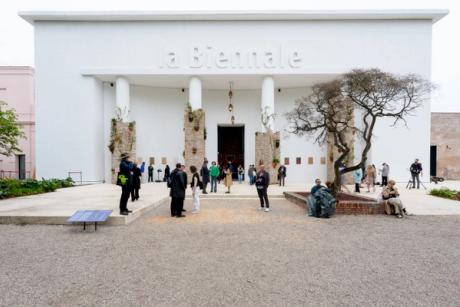
The Venice Biennale 2026, titled "In Minor Keys," was curated posthumously following the death of artistic director Koyo Kouoh in May 2025. A team of five curators and advisors—Gabe Beckhurst Feijoo, Marie Hélène Pereira, Rasha Salti, Siddhartha Mitter, and Rory Tsapayi—executed her vision across the Giardini and Arsenale venues. The exhibition features 110 artists, with a strong emphasis on new commissions, and is structured around themes of procession, resistance, and joy. Key works include Big Chief Demond Melancon's "Amistad Takeover" (2026), Nick Cave's "Amalgam (Origin)" (2025), and Otobong Nkanga's rewilded columns at the Central Pavilion.

5 Trends Shaping the 2026 Venice Biennale

The 2026 Venice Biennale has opened to the public, featuring the main exhibition 'In Minor Keys' conceived by the late Cameroonian Swiss curator Koyo Kouoh, who died unexpectedly in May 2025. Kouoh, the first African woman appointed to lead the Biennale, had her curatorial team—including Rasha Salti, Marie Hélène Pereira, and Gabe Beckhurst Feijoo—carry forward her vision of art as a 'shared and sustaining force.' The opening was weighted with politics and emotion.

Five shows to see during Singapore Art Week

Singapore Art Week features five notable exhibitions, including a retrospective of Basoeki Abdullah at the National Gallery Singapore, which explores his role as a high-society painter and cultural diplomat during his time in Singapore from 1958 to 1960. Other highlights include STPI's The Print Show, a new platform for printmaking featuring 27 artists and international publishers, and a collaborative project between Rockbund Art Museum and Art SG titled Wan Hai Hotel: Singapore Strait, which presents maritime-themed works by artists across Asia.

Venice Biennale 2026: How Do You Critique a Posthumous Exhibition?

The article, published by ArtReview, examines the upcoming 61st Venice Biennale (2026), titled *In Minor Keys*, which was conceived by artistic director Koyo Kouoh before her death from cancer in May 2025 at age 57. The exhibition, based on Kouoh's drafted concept and completed by a curatorial team including Rory Tsapayi, Siddhartha Mitter, Marie Hélène Pereira, Gabe Beckhurst Feijoo, and Rasha Salti, adopts a musical metaphor of "minor-ness" and aims to avoid the pitfalls of previous Biennales by focusing on soul frequencies and dissonant harmony rather than direct commentary on world crises. The author, Martin Herbert, questions how critics will respond to a posthumous exhibition of this unprecedented scale, noting that previous artistic directors like Robert Storr, Cecilia Alemani, Christine Macel, and Adriano Pedrosa have faced varied critical receptions.

Review: The Good, The Bad and The Venice Biennale

The article reviews the 2024 Venice Biennale, focusing on controversies over Russia's and Israel's participation. Protests erupted during opening week, leading the EU to cut funding and the International Jury to resign. As a result, awards like the Golden Lion and Silver Lion will be decided by public vote, with many pavilions and artists withdrawing in protest. The main exhibition, curated under the theme 'Minor Keys,' features standout works by Alfredo Jaar and Carrie Schneider, alongside national pavilions like Austria's provocative entry by Florentina Holzinger.

25 of 2025: 5 Trailblazing Performance Artists to Know

Artnet News spotlights five trailblazing performance artists defining 2025, including Geumhyung Jeong, whose work "Toys, Selected" (2025) at Canal Projects in New York explores the uncanny relationship between humans and robots through intimate, choreographed interactions with machine parts she built herself. Jeong, who studied acting, dance, and film animation in South Korea, has performed at Kunsthalle Basel, the 2022 Venice Biennale, and London's ICA, and is currently unrepresented by a gallery. The article also profiles Maja Malou Lyse, who was tapped to represent her country at the Venice Biennale.

A Poetic and Material Institutional Critique: Gala Porras-Kim at kurimanzutto and the Venice Biennale

UNA CRÍTICA INSTITUCIONAL POÉTICA Y MATERIAL: GALA PORRAS-KIM EN KURIMANZUTTO Y LA BIENAL DE VENECIA

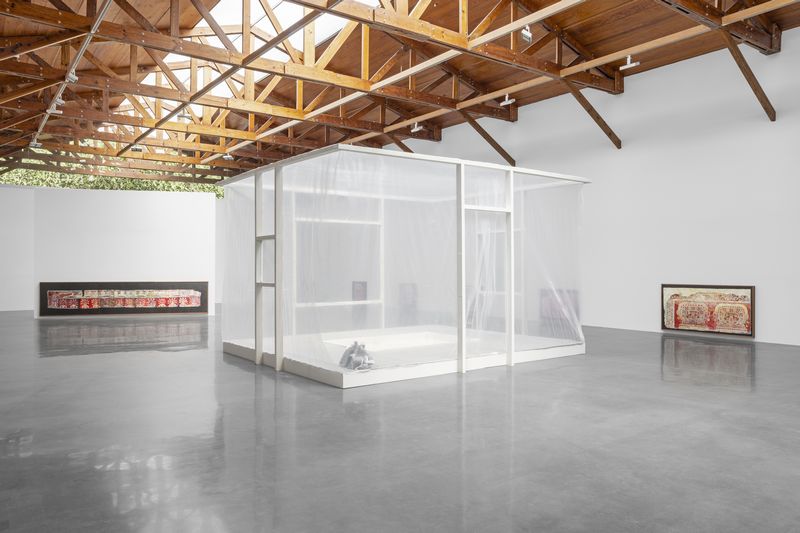
Colombian artist Gala Porras-Kim presents her first solo exhibition at kurimanzutto gallery in Mexico City, titled "Espacios del futuro replican los del pasado" (2026), alongside her participation in the 2026 Venice Biennale. The show critically examines how museum conservation protocols transform objects by detaching them from their original material, ritual, and spiritual contexts. Central to the exhibition is "The Motion of an Alluvial Record" (2024), a greenhouse that recreates the humidity and temperature of Yucatecan mangroves, allowing clay and sediment to shift continuously, resisting the linear, stratified time of Western archives and evoking cyclical Maya cosmologies. Another series, "Uprooted" (2026), reproduces fragments of looted Teotihuacan murals from Techinantitla, now held by the Metropolitan Museum of Art and the Ethnological Museum of Berlin, reinstalling them near the floor to restore their original architectural scale and orientation.

Welcome to Venice: the shows you won’t want to miss at the 61st Biennale

The 61st Venice Biennale, titled "In Minor Keys," opens with a keynote exhibition conceived by the late Koyo Kouoh and realized by her team after her sudden death in May 2025. The show spans the Central Pavilion in the Giardini and the Arsenale, featuring 110 artists and collectives. Highlights include Bracha L. Ettinger's installation at the Hotel Metropole, where she transforms a room where Sigmund Freud wrote part of *The Interpretation of Dreams* into a feminist 'borderspace,' and works by artists such as Arthur Jafa, Richard Prince, Issa Samb, Beverly Buchanan, and Daniel Lind-Ramos. The exhibition explores themes of history, colonialism, war, and environmental destruction, aiming for a 'sotto voce' tone that nonetheless delivers powerful, liberating statements.

LATIN AMERICA AT THE VENICE BIENNALE: A VISUAL TOUR OF THE CENTRAL EXHIBITION

LATINOAMÉRICA EN LA BIENAL DE VENECIA: UN RECORRIDO VISUAL POR LA MUESTRA CENTRAL

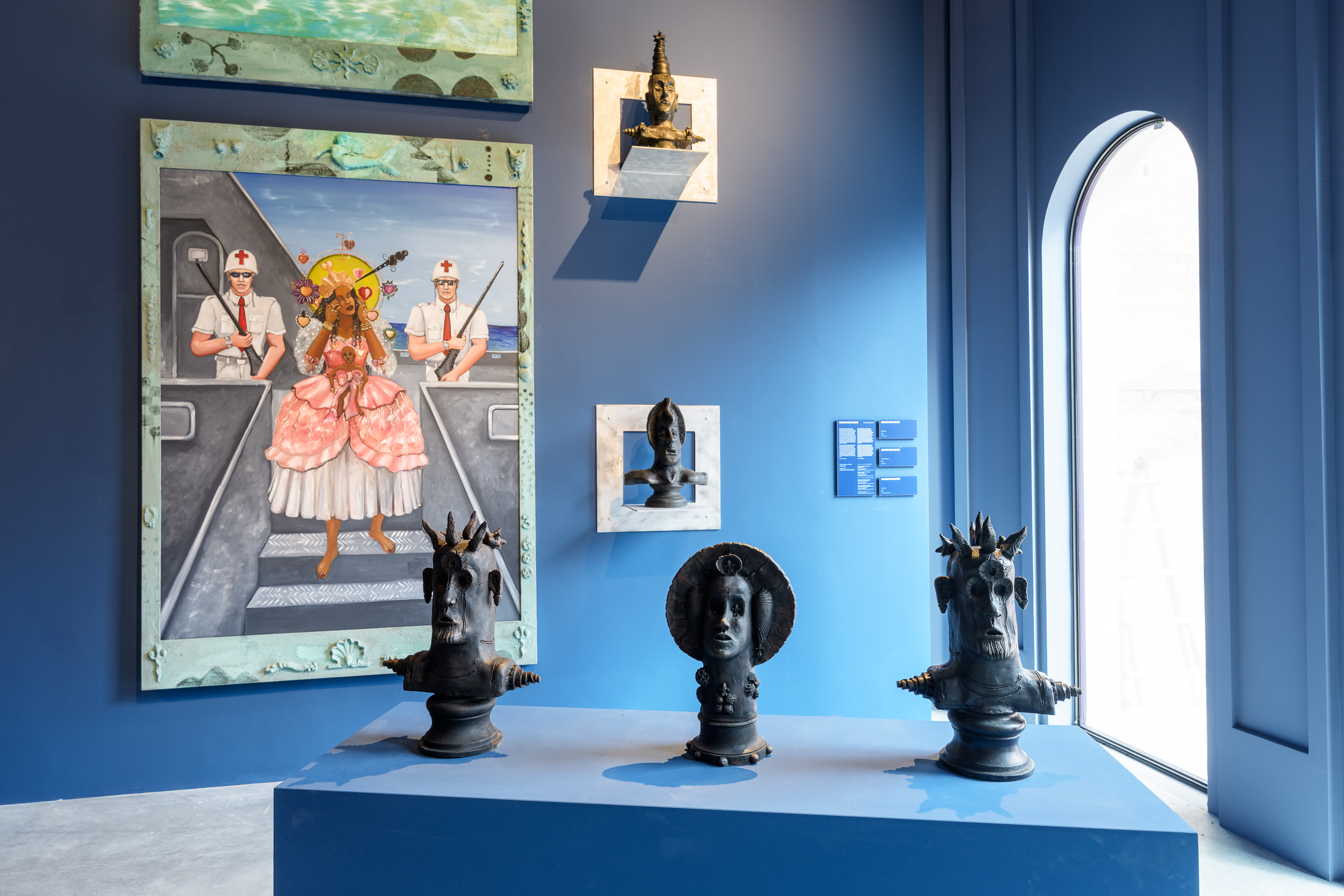
The 61st Venice Biennale, titled "In Minor Keys," opened its preview days on May 8, 2025, curated by the late Koyo Kouoh (1967–2025). The central exhibition, realized by a team she selected before her death, features 110 participants from around the world, with a strong Latin American presence of 15 artists, collectives, and organizations. The show explores themes of colonial history, plantation economies, geological memory, and environmental crisis through works that emphasize shared materials, politics, and poetics across geographies from Dakar to San Juan.

Boats and trains, not planes: reflections on a greener—but sometimes greenwashed—Venice Biennale

The article recounts the author's train journey from London to Venice for the 61st Venice Biennale, highlighting the environmental benefits and pleasant experience of traveling by rail versus flying, despite higher costs and longer duration. It then focuses on the Biennale's central exhibition "In Minor Keys" curated by the late Koyo Kouoh, which foregrounds environmental themes through works that engage with earth, nature, and ecological stakes, featuring artists like Otobong Nkanga, Célia Vasquez Yui, Theo Eshetu, Linda Goode Bryant, and Annalee Davis.

At this year's Venice Biennale, a clash of politics and art exposes the need for a rethink

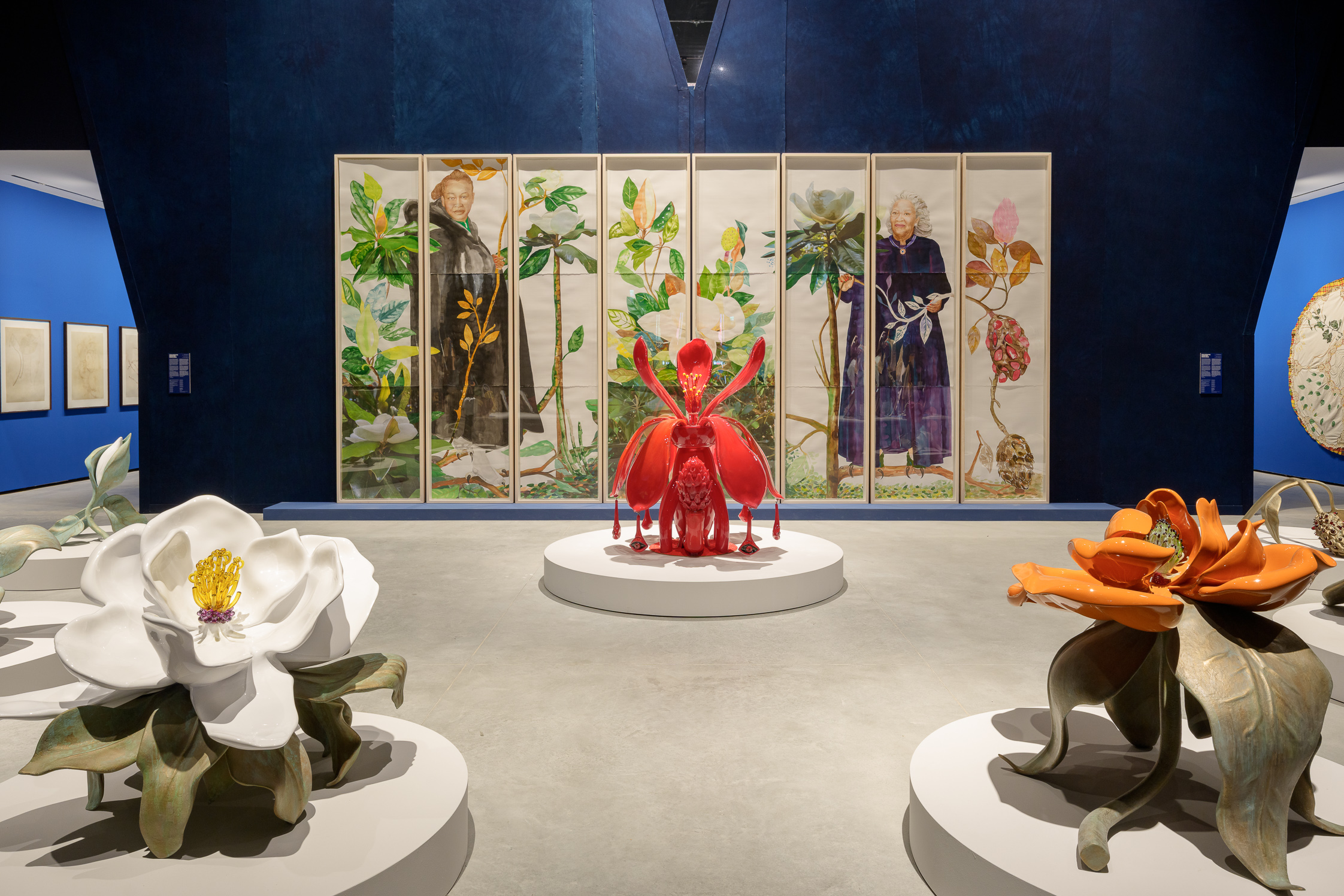
The 2026 Venice Biennale is plagued by controversy and structural issues. Curator Koyo Kouoh died of cancer in 2025, leaving her team to execute the main exhibition "In Minor Keys" without her. The Biennale's jury resigned after refusing to judge entries from countries charged with war crimes, and media coverage during preview week focused on protests against the Israeli and Russian pavilions rather than the art. The sprawling exhibition features 96 national pavilions and 110 artists, with works ranging from Daniel Lind-Ramos's found-material figures to María Magdalena Campos-Pons's tribute to Toni Morrison and Kouoh.

Koyo Kouoh’s Venice Biennale Looks to Ancient Wisdom to Mend a Fractured Present

Koyo Kouoh's Venice Biennale, titled after ancient wisdom, opens with a focus on healing and historical reimagination. The exhibition features works by artists such as Alexa Kumiko Hatanaka, Khaled Sabsabi, Daniel Lind-Ramos, Guadalupe Maravilla, Kennedy Yanko, and Ayrson Heráclito, alongside a strong emphasis on artist-led schools and institutions like Denniston Hill, blaxTARLINES KUMASI, and RAW Material Company. During the opening, the Koyo Kouoh Foundation was announced, set to launch in Basel to support Pan-African cultural infrastructure. The show includes Refaat Alareer's poem "If I Must Die" and addresses political realities, blending spiritual, ecological, and technological themes to explore collective care and restoration.

THE VENICE BIENNALE IN AN EDITION MARKED BY POLITICAL GAMES

The Venice Biennale's 2024 edition is embroiled in political controversy surrounding its national pavilions, particularly those of Russia, South Africa, and Israel. The Russian pavilion's readmission amid the war in Ukraine drew sharp criticism from the artistic community and led the European Union to withdraw approximately two million euros in funding. The Israeli pavilion, which remained empty in 2024 to protest hostage situations, now features a proposal by sculptor Belu-Simion Fainaru, prompting protests from the Art Not Genocide Alliance and over 200 artists demanding its exclusion. The curatorial team, appointed by the late curator Koyo Kouoh, resigned collectively nine days before the opening, and the Biennale's directorship canceled the opening ceremony, postponing awards to November. Demonstrations led by Art Not Genocide Alliance, Pussy Riot, and FEMEN surrounded the Russian pavilion during the press opening, and a strike by cultural workers is planned for May 8th.

6 Artworks That Define the 2026 Venice Biennale’s Main Exhibition

The 2026 Venice Biennale's main exhibition opens this week, curated by Koyo Kouoh—the first African woman to hold the role—who was announced in 2024 but passed away suddenly in 2025. The article highlights six artworks that define her curatorial vision, which connected the international art world to artists and institutions from Africa and the Global South.

Biennale, rules announced for Visitor's Lion. But dozens of artists withdraw

The Venice Biennale has announced the voting rules for the new Visitors' Lion awards, which replace the traditional Golden Lions after the original jury resigned before the opening. On the same day the popular voting opened, dozens of artists from the central exhibition 'In Minor Keys' and several National Pavilions announced their withdrawal from the competition in solidarity with the resigned jury, releasing a statement via e-flux on May 9, 2026. The voting system requires visitors to have attended both the Giardini and Arsenale venues, with anonymous voting open until November 22, 2026.

Spain: Oriol Vilanova and the Abolition of the Museum and the Archive

ESPANA ORIOL VILANOVA Y LA ABOLICION DEL MUSEO Y EL ARCHIVO

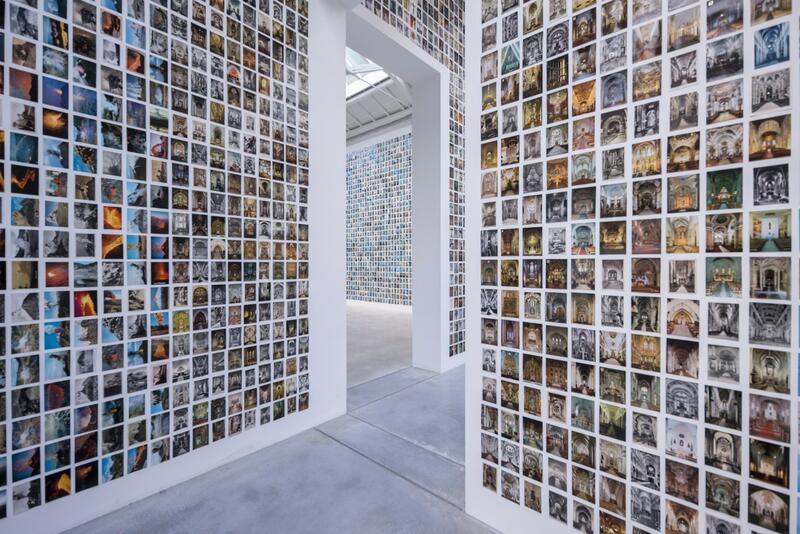
The Spanish Pavilion at the 61st Venice Biennale presents "Los restos," a project by Catalan artist Oriol Vilanova, curated by Carles Guerra. The installation transforms the pavilion into an anti-museum or pseudo-museum, featuring over twenty years of postcards collected from flea markets, arranged in a wall-based accumulation that challenges linear narrative and archival hierarchy. The project also includes a publication and a performative action titled "El fantasma de la libertad" (2026), inspired by Luis Buñuel, which will take place across the Giardini and Arsenale through unannounced encounters.