
filter_list Showing 5 results for "Viennese Actionism" close Clear
dashboard All 5 candle obituary 4rate_review review 1
date_range Range Today This Week This Month All
Subscribe

Valie Export, Groundbreaking Feminist Artist Who Questioned the Nature of Art, Dies at 85

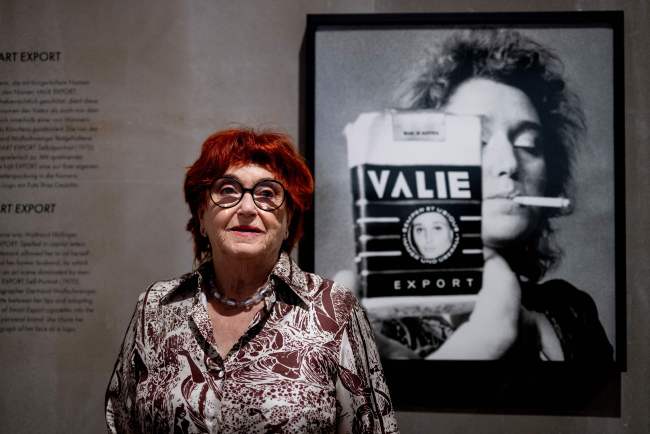
Valie Export, the pioneering Austrian feminist artist known for challenging the conventions of art and cinema through body-centered, tactile works, died on May 14 at age 85, three days before her birthday. Her death was confirmed by Thaddaeus Ropac Gallery, which represents her. Over six decades, Export created influential works such as "TAP and TOUCH CINEMA" (1968) and "Action Pants: Genital Panic" (1968), using her own body to question gender norms and the nature of film. Born Waltraud Lehner in Linz, she reinvented herself as VALIE EXPORT in 1967, a name symbolizing her exportation of personal ideas. She was associated with the Viennese Actionists but developed her own expanded cinema practice, producing works like "Abstract Film No. 1" (1967–68) that redefined the medium.

VALIE EXPORT, Icon of Feminist Art, Dead at 85

VALIE EXPORT, the radical Austrian performance artist, filmmaker, and sculptor widely regarded as the most significant feminist artist of the postwar era, died in Vienna on May 14, just three days before her 85th birthday. Her death was confirmed by Thaddaeus Ropac gallery, which represents her. Known for provocative works such as *Tapp und Tastkino* (1968), in which she invited passersby to touch her bare breasts through a miniature theater, EXPORT faced hate mail, death threats, and indecency charges but remained undeterred in her mission to challenge patriarchal norms through the female body and sexual agency.

Valie Export ist tot

Valie Export, the pioneering Austrian media and performance artist, has died at age 85 in Vienna. Born Waltraud Lehner in Linz in 1940, she adopted the name Valie Export in the late 1960s, derived from a cigarette brand, and became internationally known for provocative works such as "Tapp- und Tastkino" (1968) and "Aktionshose: Genitalpanik." Her practice critically examined gender roles, power structures, and the representation of the female body through film, video, photography, and performance. She participated in major exhibitions including Documenta, the Centre Pompidou, and the Museum of Modern Art, and represented Austria at the Venice Biennale in 1980 alongside Maria Lassnig. She also taught as a professor of media and performance art in Berlin and Cologne, and the VALIE EXPORT Center opened in Linz in 2017.

Artist Valie Export, Who Saw Right Through the Male Gaze, Dies at 85

Austrian artist Valie Export, a pioneering feminist performance and media artist, died on May 14, three days before her 86th birthday. Her death was confirmed by Thaddaeus Ropac Gallery. Export, born Waltraud Lehner in 1940, rejected traditional domestic roles and adopted her iconic all-uppercase name from a cigarette brand. She created guerrilla-style performances and films that directly confronted the male gaze and patriarchal society, often using her own body as a medium. Key works include “Genital Panic” (1968), in which she walked through a Munich cinema in crotchless pants, and “Tapp und Tastkino (Tap and Touch Cinema)” (1968), where she invited strangers to touch her bare breasts through a stage strapped to her chest.

The Politics of In-action: Review of In-action: Viennese Actionism and the Passivities of Performance Art

Caroline Lillian Schopp's new book *In-action: Viennese Actionism and the Passivities of Performance Art* (2025) offers a revisionist history of Viennese Actionism, a movement retroactively named in 1970 by Peter Weibel and Valie Export. Schopp introduces the term "in-action" to describe a politics of artistic action that emphasizes intimacy, hesitation, and vulnerability rather than the violent or liberatory extremes typically associated with the movement. She expands the canon to include women artists such as Anna Brus, Hanel Koeck, and Ingrid Wiener, and reexamines the work of Rudolf Schwarzkogler, whose death was mythologized as a suicide by self-castration but was actually a fall from a window. Through close readings of photographs, Schopp argues that Schwarzkogler's performances were characterized by passivity and "in-sincerity," challenging the dominant narrative of actionism as aggressive or heroic.