filter_list Showing 5 results for "palestine museum us" close Clear
search
dashboard All 5 museum exhibitions 4article news 1
date_range Range Today This Week This Month All
Subscribe

Across Venice, Artists Defy Censorship to Mourn and Memorialize Gaza

The 2026 Venice Biennale, titled “In Minor Keys,” features numerous artworks that mourn and memorialize the destruction of Gaza, despite censorship pressures. The main exhibition opens with a poem by slain Palestinian poet Refaat Alareer, and includes works by artists such as Theo Eshetu, Mohammed Joha, Manuel Mathieu, and Avi Mograbi that directly or indirectly address the conflict. Outside the official Biennale, South African artist Gabrielle Goliath’s performance series “Elegy” was censored by her country’s culture minister after she proposed a version honoring murdered Palestinian poet Hiba Abu Nada, leading her to present the work independently at a church in Venice.

THE VENICE BIENNALE IN AN EDITION MARKED BY POLITICAL GAMES

The Venice Biennale's 2024 edition is embroiled in political controversy surrounding its national pavilions, particularly those of Russia, South Africa, and Israel. The Russian pavilion's readmission amid the war in Ukraine drew sharp criticism from the artistic community and led the European Union to withdraw approximately two million euros in funding. The Israeli pavilion, which remained empty in 2024 to protest hostage situations, now features a proposal by sculptor Belu-Simion Fainaru, prompting protests from the Art Not Genocide Alliance and over 200 artists demanding its exclusion. The curatorial team, appointed by the late curator Koyo Kouoh, resigned collectively nine days before the opening, and the Biennale's directorship canceled the opening ceremony, postponing awards to November. Demonstrations led by Art Not Genocide Alliance, Pussy Riot, and FEMEN surrounded the Russian pavilion during the press opening, and a strike by cultural workers is planned for May 8th.

Now we open a Palestinian Pavilion at the Biennale. Interview with Tomaso Montanari

“Ora apriamo un Padiglione Palestina in Biennale”. Intervista a Tomaso Montanari

Tomaso Montanari, a member of the scientific committee for the exhibition "Gaza, il futuro ha un cuore antico. Materie e memorie del Mediterraneo" at Fondazione Merz in Turin, discusses the show's aim to highlight Gaza's 5,000-year history beyond the current war imagery. The exhibition, organized in collaboration with the Museo Egizio and the MAH – Musée d’art et d’histoire de Genève, juxtaposes ancient artifacts with contemporary artworks to assert the cultural and historical significance of Palestine. Montanari also addresses the upcoming Venice Biennale, criticizing the lack of a Palestinian pavilion and suggesting that the Turin exhibition itself serves as a de facto Palestinian pavilion, while calling for accountability for Israel's actions.

The ECC Italy’s Venice Exhibition Demonstrates the Power of ‘Conscious Intermingling’

The ECC Italy has opened a new exhibition in Venice titled 'Conscious Intermingling,' showcasing works that explore cross-cultural dialogue and artistic exchange. The show brings together contemporary artists from diverse backgrounds, emphasizing collaborative and hybrid creative practices that transcend national and cultural boundaries.

How Do You Curate an Exhibition on Genocide? Faisal Saleh and the Palestinian Question That Crosses the Venice Biennale

“Come si cura una mostra sul genocidio?”: Faisal Saleh e la domanda palestinese che attraversa la Biennale di Venezia

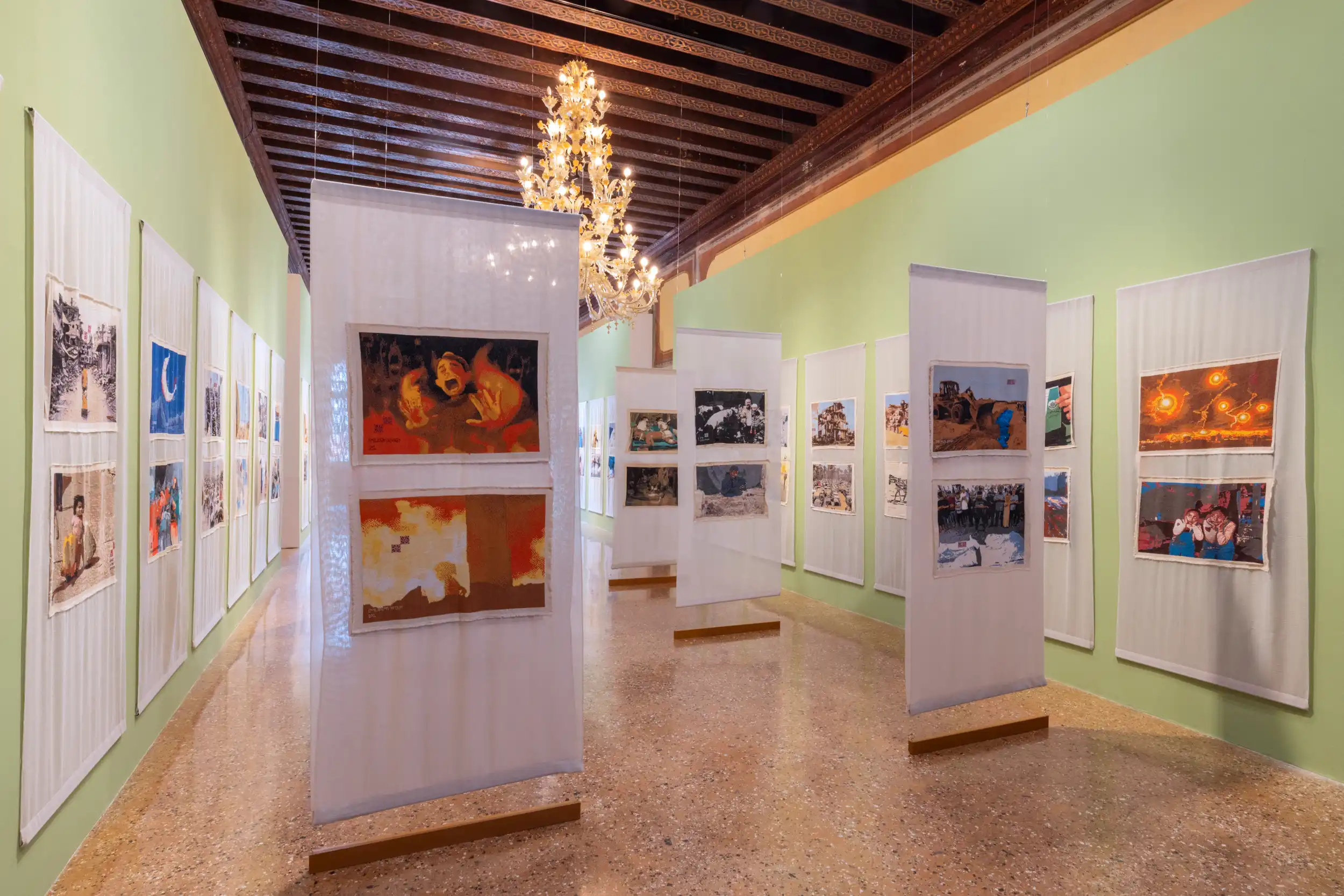
At the 2026 Venice Biennale, a collateral exhibition titled “Gaza – No Words – See the Exhibit” presents 100 embroidered works using the traditional Palestinian technique of Tatreez. Curated by artist Faisal Saleh, founder of the Palestine Museum US, the show transforms embroidery from decoration into political testimony, reconstructing scenes from Gaza over the past two and a half years: shrouded bodies, killed children, mothers bidding farewell, bombed hospitals. The exhibition is housed at Palazzo Mora and has been called by many visitors “the real Palestinian Pavilion” of the Biennale, though it is not an official national pavilion.