
arrow_back Back to all stories

person Nicolás Subía

newspaper Artishock Revista article 3 articles

AGAINST "SEX AND THE CITY": FÉLIX GONZÁLEZ-TORRES, BORIS TORRES, CARLOS MOTTA AND RAÚL DE NIEVES AGAINST THE MYTH OF NEW YORK

EN CONTRA DE “SEX AND THE CITY”: FÉLIX GONZÁLEZ-TORRES, BORIS TORRES, CARLOS MOTTA Y RAÚL DE NIEVES FRENTE AL MITO DE NUEVA YORK

This essay examines how four queer Latin American artists—Félix González-Torres, Boris Torres, Carlos Motta, and Raúl de Nieves—experienced New York City as a complex, ambivalent space, contrasting their realities with the glamorous, aspirational myth popularized by the TV series *Sex and the City*. For these migrants, New York was neither a promised land nor merely a site of exploitation; it was a place where desires suppressed in their home countries could find expression, yet also a terrain of constant negotiation with identity, precarity, exclusion, and belonging. The article traces how each artist navigated the city's social, economic, and political tensions while producing work that kept Latin America present as memory, materiality, and conflict.

GEORGE FEBRES: TRANSLATION, IRONY, AND LIBERATION. AN ECUADORIAN ARTIST IN THE DIASPORA

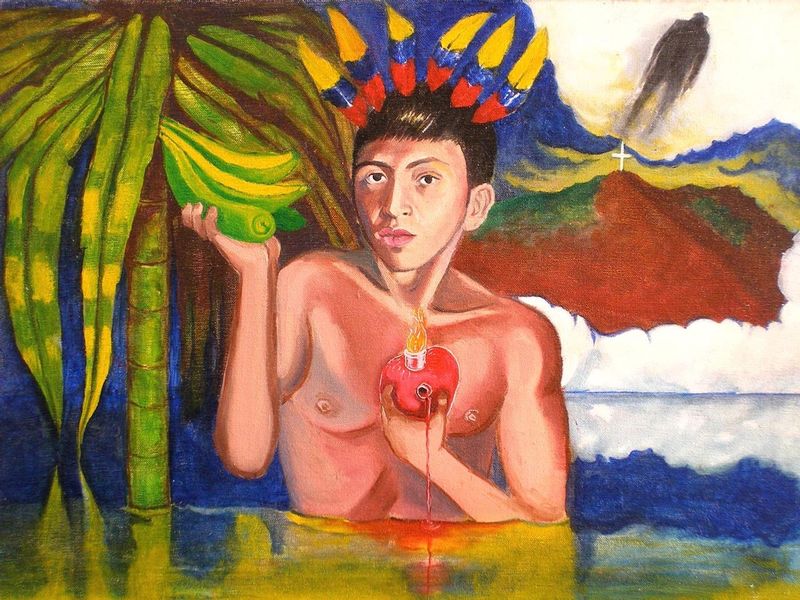
The article examines the life and work of George Febres (1943–1996), an Ecuadorian artist who spent most of his career in the United States, primarily in New Orleans. Febres’s practice blends Pop Art, Neo-Surrealism, and Southern US culture with his experiences as a migrant and queer subject, using bilingualism and ironic tropical imagery to create a hybrid, irreverent body of work. Despite his significance, no works by Febres exist in Ecuadorian public collections, and no major retrospective has been held in his home country, reflecting a broader erasure of queer narratives from national art history.

GEORGE FEBRES: TRADUCCIÓN, IRONÍA Y LIBERACIÓN. UN ARTISTA ECUATORIANO EN LA DIÁSPORA

George Febres (Guayaquil, 1943 – New Orleans, 1996) was an Ecuadorian artist whose work blended pop art, neo-surrealism, and Southern U.S. culture, shaped by his experience as a migrant and queer individual. The article traces his life from a privileged but unstable childhood in Ecuador to his migration to the United States, where he was drafted during the Vietnam War and eventually settled in New Orleans. Febres used bilingualism and ironic appropriation of tropical imagery to create a hybrid, irreverent body of work that challenges the official historiography of Ecuadorian art.