
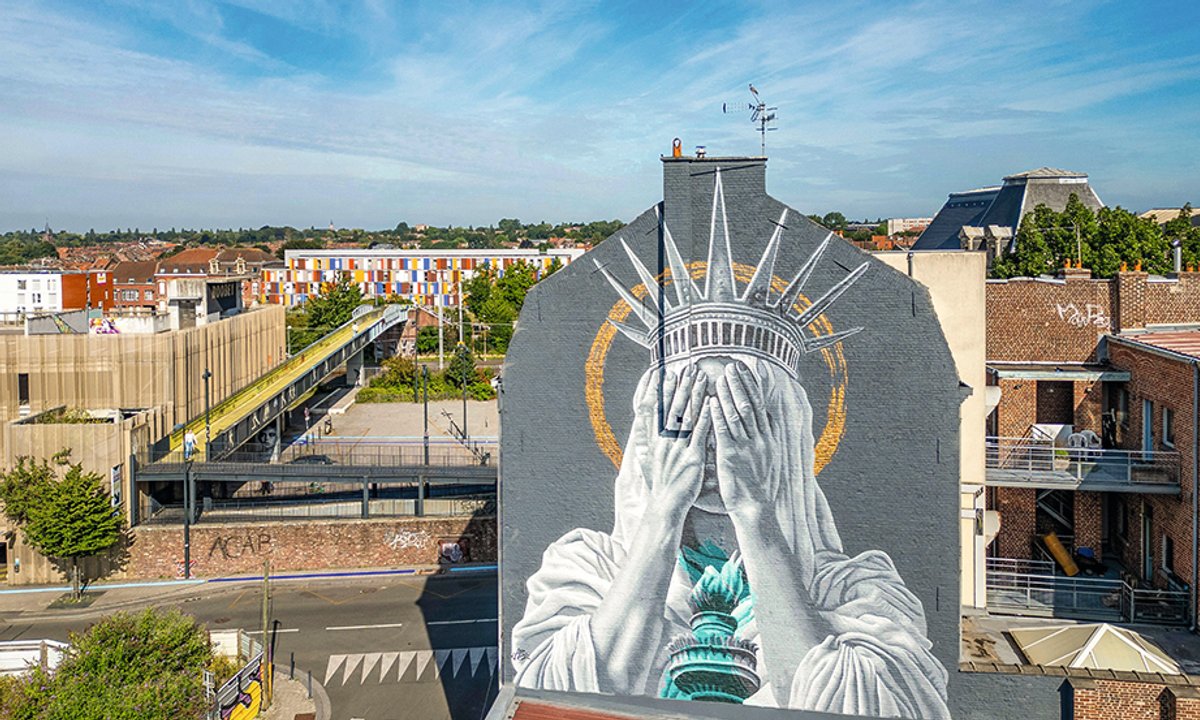
The article reports on the growing censorship of politically charged art in the US, focusing on the case of artist Amy Sherald. In August, the White House under President Donald Trump issued a statement criticizing the Smithsonian Institution for including Sherald's painting *Trans Forming Liberty* (2024), which depicts a transgender person as the Statue of Liberty, in a planned solo exhibition at the National Portrait Gallery. After the Smithsonian considered removing the work, Sherald canceled the entire show, citing a loss of institutional integrity. The Smithsonian subsequently announced a review of its holdings to align with Trump's vision of "American exceptionalism." Separately, the article highlights a monumental street mural by Dutch artist Judith de Leeuw in Roubaix, France, showing the Statue of Liberty covering its eyes in shame, as a direct response to global migrant injustice.
This matters because it underscores the vulnerability of state-funded cultural institutions under authoritarian political pressure, and raises urgent questions about the future of art that seeks to tell "full, complex truths." Sherald's self-censorship—despite her elite status and market success—signals a chilling effect on even established artists. The contrast with de Leeuw's unaffiliated street art suggests that truly political, truth-telling art may increasingly find its home outside traditional museums and galleries, in public spaces where institutional gatekeeping is bypassed.