
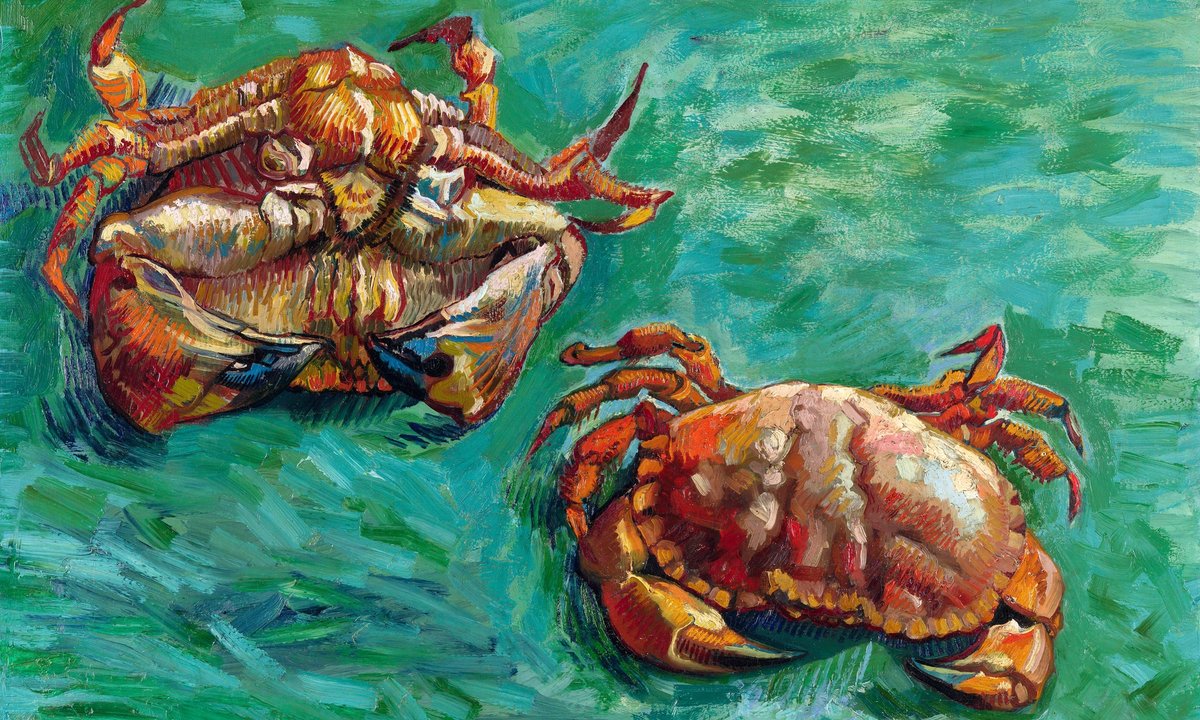
An article explores the story behind Vincent van Gogh's still life "Two Crabs," revealing that the two crabs are likely the same individual—a female Cancer pagurus missing its first pair of walking legs. Paul Clark, a crustacean specialist at London's Natural History Museum, confirmed the sex based on the broad abdomen visible in the painting. The work is on long-term loan to London's National Gallery, where it was recently redisplayed as part of the gallery's major rehang ahead of the Sainsbury Wing reopening on May 10. The article also traces the painting's provenance: it was the first Van Gogh bought by a British collector, William Cherry Robinson, in 1893 for 200 guilders, later sold at auction in 1906 for half that amount, and eventually resold at Sotheby's in 2004 for £5.2 million to an anonymous collector who lent it to the National Gallery.
The article matters because it combines art historical research with scientific analysis to shed light on a lesser-known Van Gogh work, highlighting how interdisciplinary expertise can inform our understanding of an artist's methods and subjects. It also underscores the evolving market value of Van Gogh's paintings, from a modest early sale to a multi-million-pound auction, and raises a dating puzzle between the National Gallery and the Van Gogh Museum over whether "Two Crabs" was painted in Arles in 1889 or in Paris in 1887—a distinction crucial to tracking Van Gogh's stylistic development.