
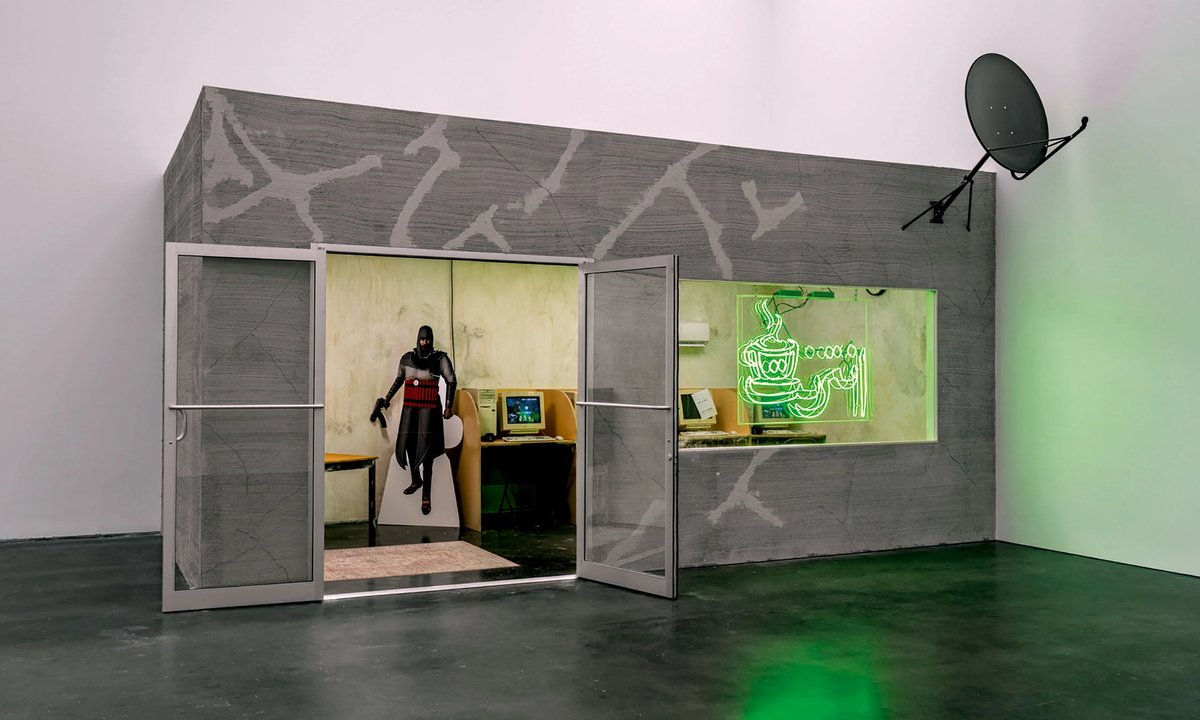
The article profiles Iraqi American artist Wafaa Bilal through his survey exhibition "Indulge Me" at the Museum of Contemporary Art Chicago, running until October 19. The show highlights his career-spanning works including the 2007 performance "Domestic Tension," where he lived in a gallery while online participants could shoot him with a paintball gun; "3rdi" (2010-11), featuring a camera surgically affixed to his head; and "Virtual Jihadi" (2008), a video game critiquing war's sanitization. Recent works like "Thumbsat Model" (2024), a golden bust of Saddam Hussein on a satellite to be launched into orbit, are also featured. Bilal, who fled Iraq in 1991 after arrest for anti-regime art, discusses his journey from refugee to NYU professor.
This matters because Bilal's work offers urgent reflections on democracy's erosion in both Iraq and the United States, drawing direct parallels between Saddam Hussein's regime and Donald Trump's political climate. The exhibition arrives at a moment when Bilal's themes of surveillance, censorship, and authoritarianism feel increasingly relevant. His experiences with censorship—including the shutdown of "Virtual Jihadi" at Rensselaer Polytechnic Institute—underscore ongoing tensions around political art in America. The show's interactive, participatory nature also highlights how art can engage audiences in critical dialogue about democracy's fragility.