
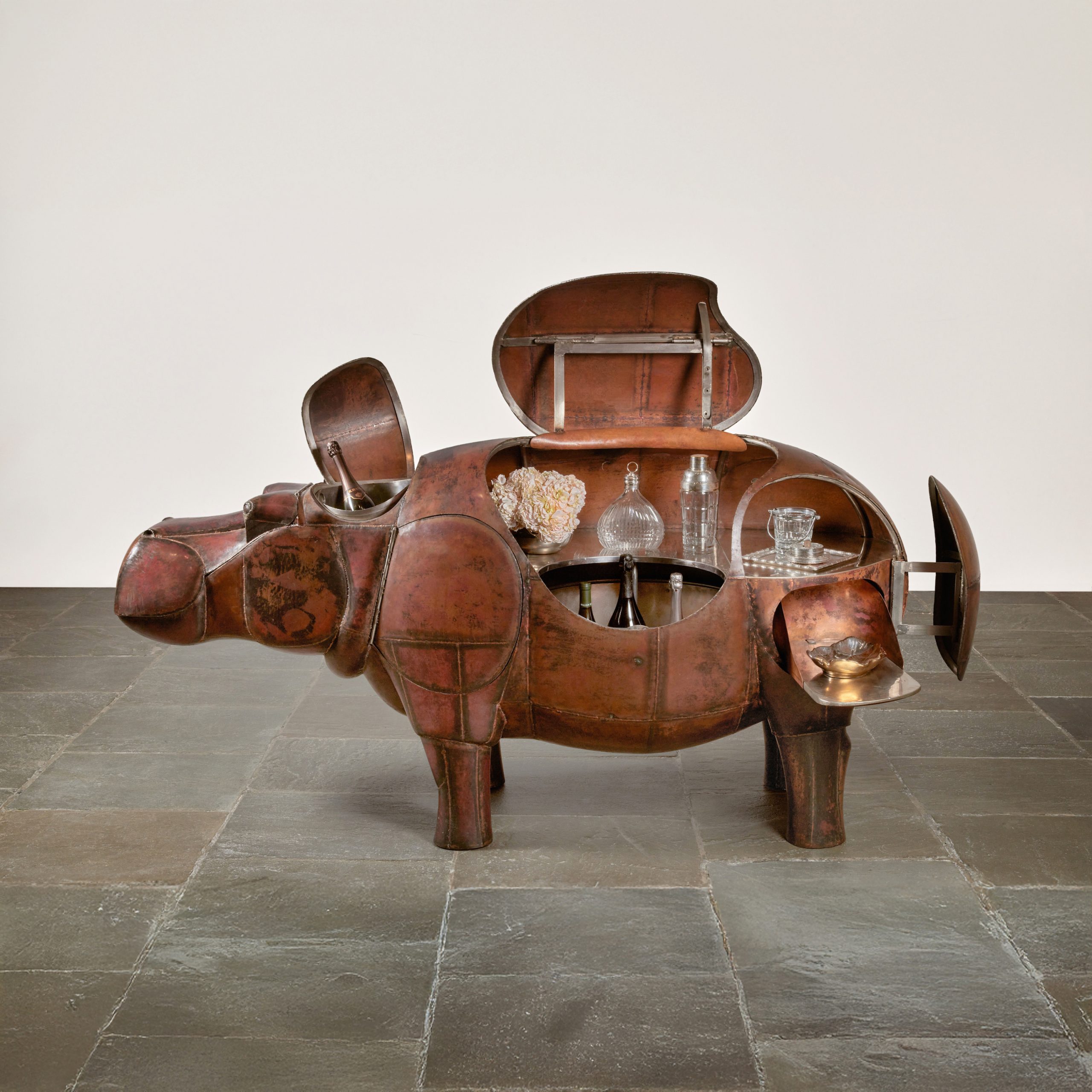
Sales in the decorative-art category—including design objects, furniture, jewelry, and watches—reached approximately $3.9 billion in 2025, a 7.1% increase from 2024 but still well below the 2023 peak of $5.7 billion. The number of lots sold fell by 11.9%, yet the average price rose 21.6% to $15,247, indicating a shift toward trophy buying. A standout was François-Xavier Lalanne's 1976 Hippopotamus bar, which sold for $31.4 million at Sotheby's after a 26-minute bidding war, setting an auction record. Sotheby's led the category with $1.1 billion in sales, followed by Christie's at $1 billion and Phillips at $369.7 million. Europe remained the largest market at $1.4 billion, while North America overtook Asia for second place with $1.2 billion.
This data matters because it reveals a bifurcation in the decorative-art market: while overall volume is shrinking, high-end trophy pieces are driving value growth, suggesting that wealthy buyers are concentrating on top-tier, rare objects rather than mid-range works. The shift has implications for auction houses and dealers, who may need to adjust their sourcing and marketing strategies to cater to this demand. The geographic reshuffling—with North America gaining ground on Asia—also signals changing collector bases and economic priorities in the global art market.