
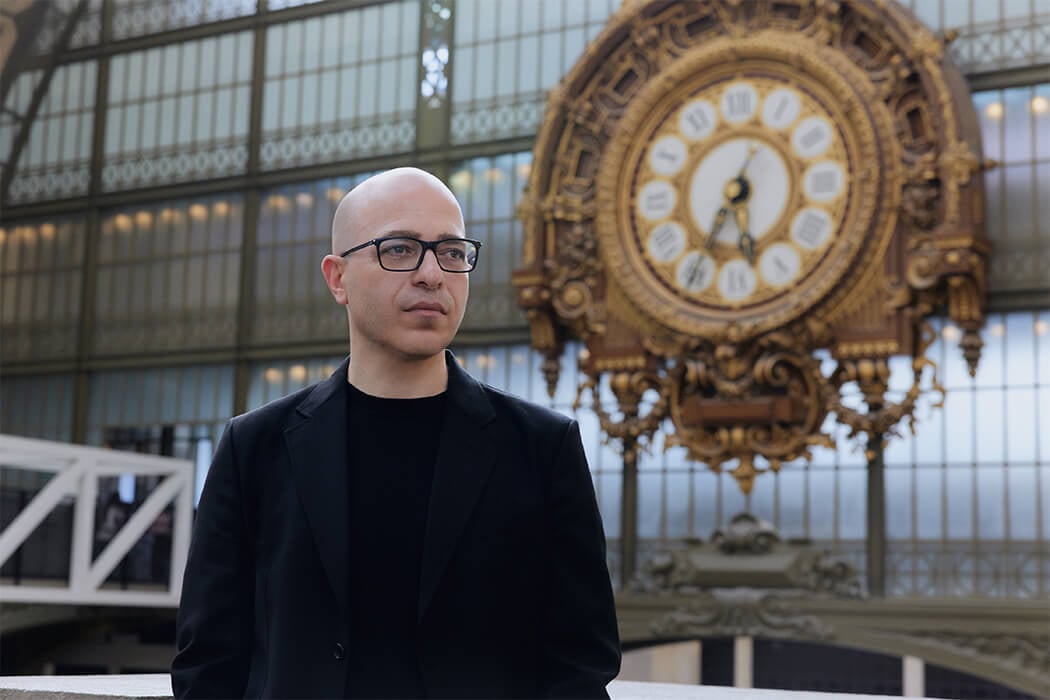
Youssef Nabil, an Egyptian artist born in 1972, has been invited to present his first solo exhibition by a living artist at the Musée d'Orsay in Paris. Titled "De rêver encore," the show runs from May 19 to September 13, 2026, and pairs Nabil's hand-colored black-and-white photographs and videos with the museum's Orientalist paintings from the 19th century. Nabil's work, which he began developing in the 1990s, uses a manual colorization technique inherited from mid-20th-century Egyptian photo studios, creating dreamlike, velvety tones. The exhibition traces an intimate journey through themes of childhood, exile, and fantasy, with Nabil's images—such as "Memory of a Happy Place" (2021) and "I Will Go To Paradise, Self-Portrait, Hyères" (2008)—dialoguing with works by Pierre Puvis de Chavannes, Odilon Redon, Alphonse Osbert, Étienne Dinet, and Eugène Fromentin.
The exhibition matters because it marks a historic moment for the Musée d'Orsay, which rarely invites living artists to intervene in its permanent collection. More significantly, it challenges the legacy of Orientalist painting by offering a contemporary, non-Western perspective. Where 19th-century European artists projected a fantasized and dominated Orient, Nabil reclaims a free, sensual, and borderless Mediterranean imagination rooted in his own autobiography and Egyptian cinema. The show thus becomes a subtle act of restitution—not of objects, but of narrative authority—allowing a living artist from the region once depicted by Orientalists to speak back to the museum's own history.