
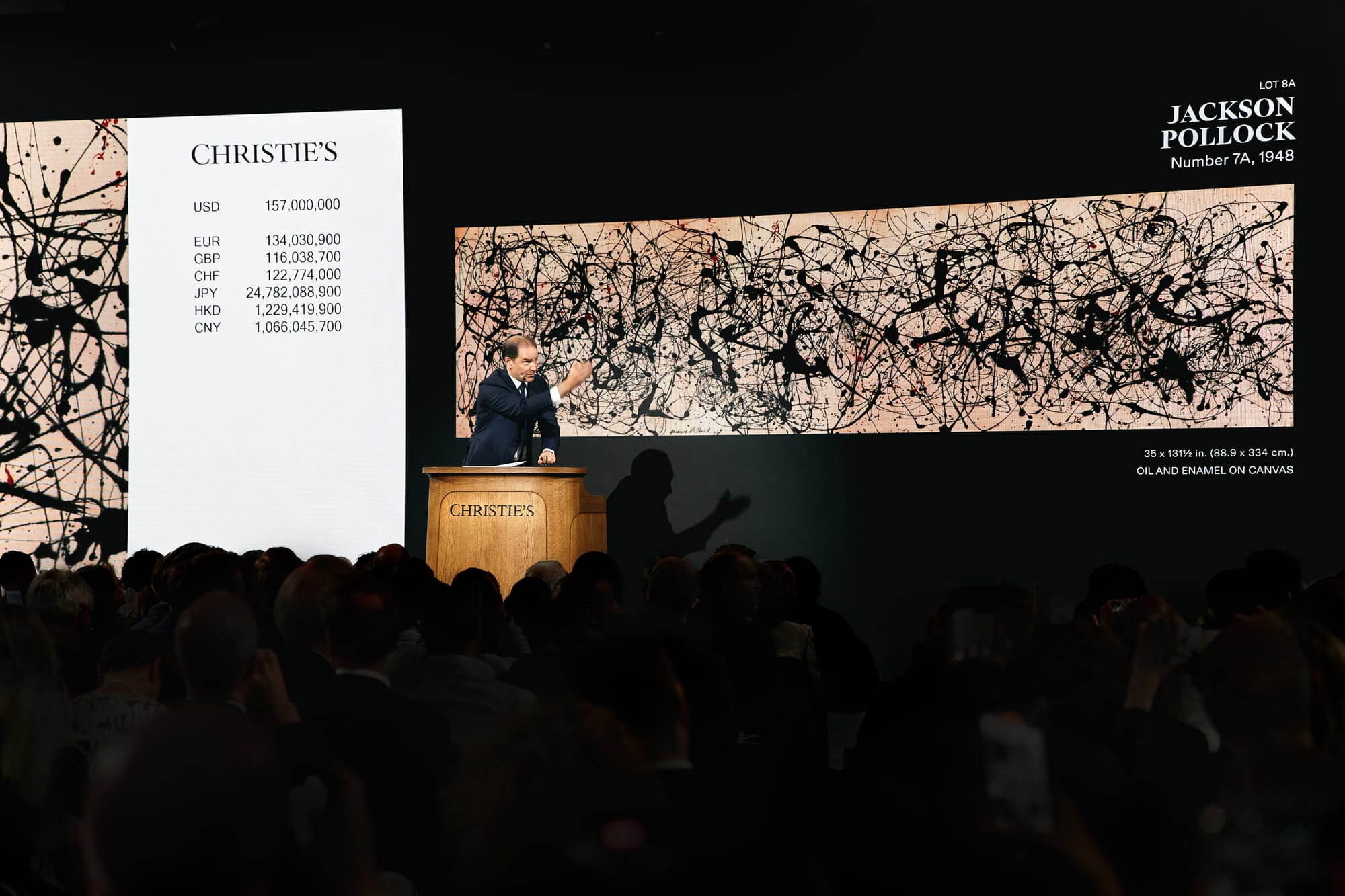
The article critiques the narrative of a thriving art market following spring's marquee auctions, using Christie's $181.2 million sale of Jackson Pollock's "Number 7A" (1948) as a misleading headline. Despite a $1.1 billion evening sale, roughly 30% of lots sold below low estimate or went unsold, including high-profile works like Agnes Gund's Twombly. Similar patterns emerged at Phillips and Sotheby's evening sales, where over a third of lots performed at or below estimate. The author argues that auction houses engineer low estimates to ensure sell-through rates, but the resulting hammer prices often fall short of gallery prices for comparable works, while buyer's premiums and consignor fees create disappointment for sellers.
This matters because it exposes the gap between headline-grabbing trophy sales—like the Pollock and a $107.6 million Brancusi—and the broader market's fragility. The analysis suggests that only top-tier artworks from prestigious estates (S. I. Newhouse, Agnes Gund, Weis, Pritzker, Leonard Lauder) reliably perform, while the rest face muted demand. The absence of once-hyped artists whose prices collapsed signals a market correction. Christie's succeeded through curation and presentation, but the overall data challenges the perception of a healthy market, raising questions about valuation, transparency, and the sustainability of current auction practices.