
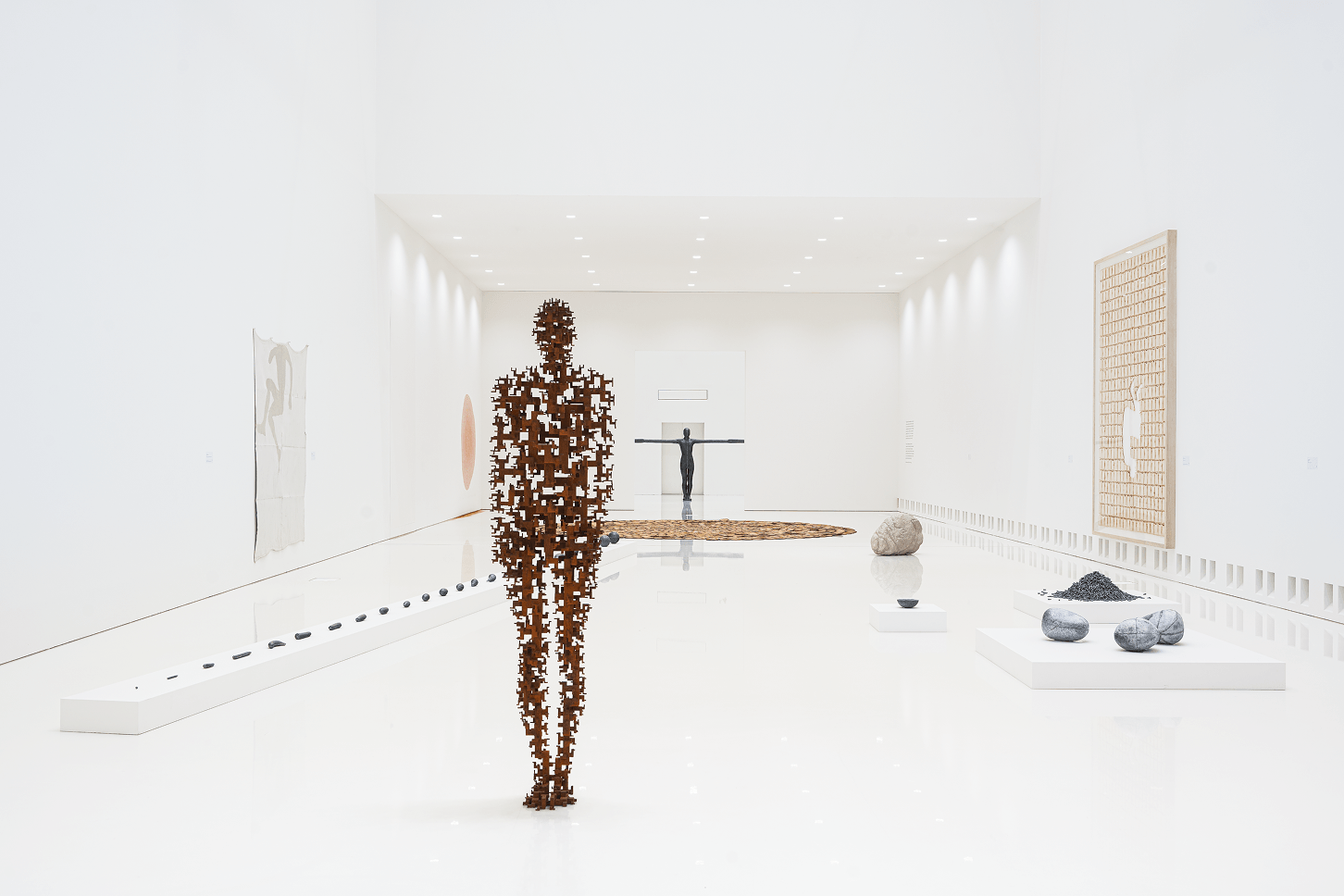
The article reviews "Geestgrond," a major retrospective of British sculptor Antony Gormley at the Royal Museum of Fine Arts Antwerp (KMSKA). Curated by Carolyn Christov-Bakargiev, the exhibition moves beyond a traditional chronological survey, instead presenting Gormley's four-decade career as a field of interconnected ideas, philosophical thought, and material conditions. It features works like "Orbit Field III" (2026), "Attend" (2025), and earlier pieces such as "Blanket Drawing I" (1983) and "Flat Tree" (1978), with the gallery layout reconfigured around the human body.
The exhibition matters because it reframes how a retrospective can function, treating sculpture not just as finished objects but as a means of thinking through consciousness, matter, memory, and space. The title "Geestgrond"—a Dutch compound meaning spirit/ground—captures Gormley's central concern with locating the immaterial within the material, transforming the museum into an open site for intellectual and sensory exploration. This approach challenges conventional exhibition formats and deepens the dialogue between art, philosophy, and the body.