
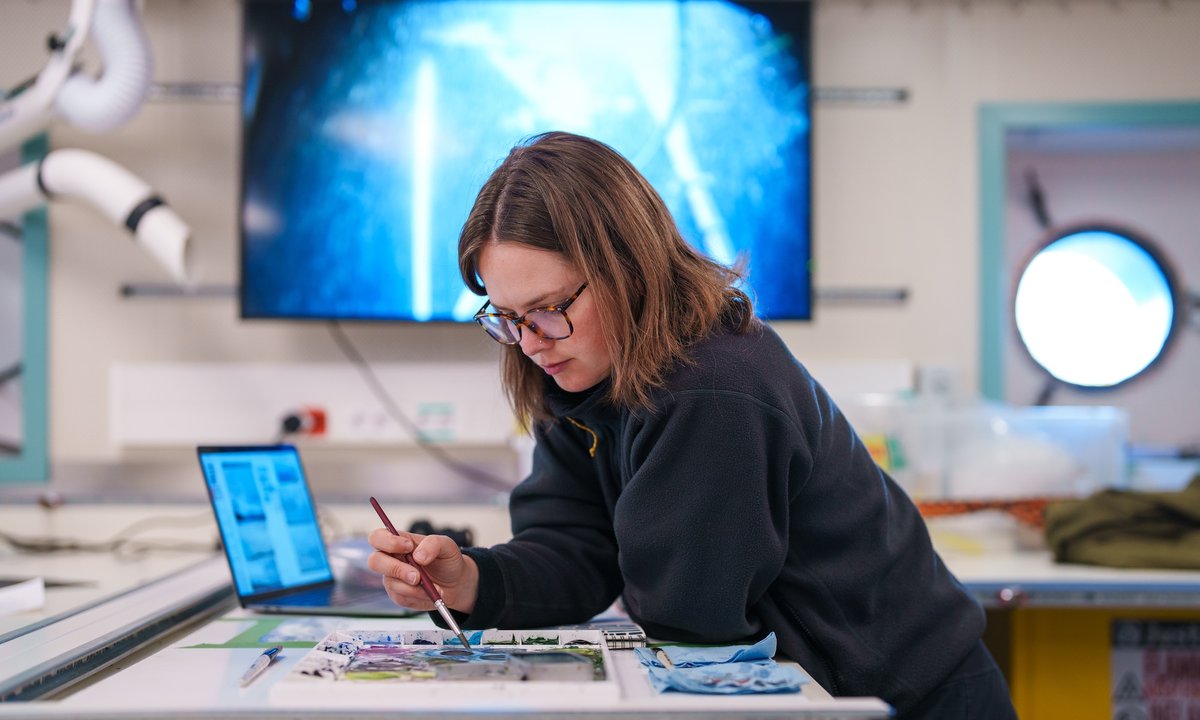
The article argues that art and science are deeply interconnected, both relying on freedom of thought and cross-disciplinary collaboration. It cites examples like birds' colorful feathers being explained by a study supported by Schmidt Sciences, which found that birds use a layer of white and black feathers to accentuate color—a technique painters have used for centuries. The piece highlights the Artist-at-Sea programme aboard the Schmidt Ocean Institute's research vessel Falkor (too), where artists like Constance Sartor and Jill Pelto collaborate with scientists to communicate marine science to broader audiences. The author, who works with scientists and is married to one, emphasizes that both disciplines pursue truth through different but complementary methods, from Leonardo da Vinci's anatomical studies to medieval Islamic tilework and Alexander von Humboldt's naturalist drawings.
This matters because both art and science face severe US federal funding cuts, leading to organizational closures, layoffs, and talent loss. The article calls for advocates in public and private sectors to recognize that these fields are not opposites but connected ways of understanding the world that work best in concert. It underscores the urgency of supporting cross-disciplinary efforts, such as the Eric and Wendy Schmidt Environment and Art Prize at the Museum of Contemporary Art in Los Angeles, to foster innovation and public engagement. By framing art and science as mutually reinforcing, the piece challenges the polarization of these disciplines and argues for integrated funding and collaboration to address complex global issues like climate change.