
filter_list Showing 6 results for "Dürer" close Clear
dashboard All 7 museum exhibitions 6article culture 1
date_range Range Today This Week This Month All
Subscribe

New Met Gala fashion exhibit seeks to ‘reclaim’ body types that art history has ignored

The Metropolitan Museum of Art's Costume Institute will launch a new fashion exhibition titled "Costume Art" at the 2026 Met Gala, curated by Andrew Bolton. The show features 400 items across sections exploring body types historically marginalized in art, including the corpulent, disabled, pregnant, and aging body. It debuts in the newly renovated Conde M. Nast galleries on the museum's main floor, with custom mannequins modeled on real individuals such as Sinéad Burke, Aariana Rose Philip, and Goddess Bunny. The exhibition pairs fashion garments with art objects to argue that fashion is art, and will be open to the public from May 10 for eight months.

What Is the 2026 Met Gala Exhibit “Costume Art” All About?

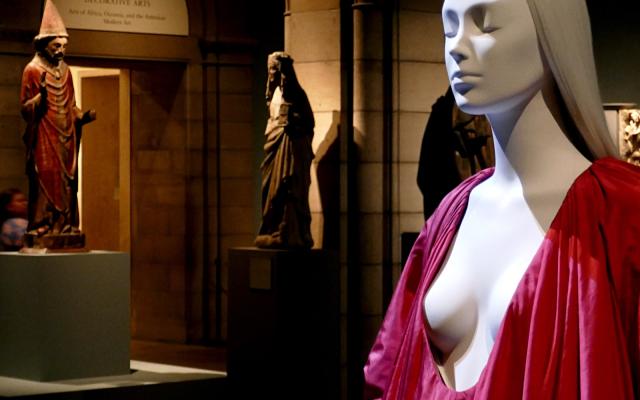
The Metropolitan Museum of Art's Costume Institute will unveil its 2026 exhibition, “Costume Art,” on May 4, 2026, coinciding with the Met Gala. Curated by Andrew Bolton, the show explores the relationship between fashion and the human body, juxtaposing garments like Rei Kawakubo's bulbous Comme des Garçons ensemble with artworks such as Hans Bellmer's “La Poupée” and Albrecht Dürer's “Adam and Eve.” Mannequins cast from real bodies and mirrored heads by artist Samar Hejazi will enhance the immersive experience. The exhibition runs from May 10, 2026, to January 10, 2027, in the new Condé M. Nast Galleries.

Is Fashion Art? The Met and Sotheby’s Answer

The Metropolitan Museum of Art's annual Costume Institute Benefit (The Met Gala) kicked off this past Monday with the theme "Fashion is Art," coinciding with the opening of the Met's new Condé M. Nast Galleries. The inaugural exhibition, titled "Costume Art," spans nearly 12,000 square feet and pairs pieces from the Costume Institute with objects from the museum's broader collection, juxtaposing items such as a Greek vessel from 460 BCE with a 1920s Fortuny gown, and Albrecht Dürer's "The Man of Sorrows" with Vivienne Westwood's "Martyr to Love" jacket.

A History of the Human Body at “Costume Art,” the New Costume Institute Exhibit

The Metropolitan Museum of Art's Costume Institute has announced its latest exhibition, "Costume Art," opening May 10. Curated by Andrew Bolton, the show brings together garments and objects from across the museum's curatorial departments to explore the relationship between fashion and the human body. The exhibition is organized into thematic sections including the Naked & Nude Body, Classical Body, Abstract Body, Reclaimed Body, Pregnant Body, Corpulent Body, and Disabled Body, featuring works by designers such as Walter Van Beirendonck, LÛCHEN, Georgina Godley, Ann-Sofie Back, Di Petsa, Alessandro Michele for Gucci, and Vivienne Westwood, alongside historical art objects from Greek ceramics to Mesopotamian sculptures.

Beyond Body-Con: In the the Met’s Spectacular New Exhibition, “Costume Art,” the Human Form Connects Fashion and Art

The Metropolitan Museum of Art has opened a new fashion exhibition titled "Costume Art" in its newly established Condé M. Nast Galleries. Curated by Andrew Bolton, the show features faceless mannequin heads by sculptor Samar Hejazi that reflect visitors' own images, encouraging self-reflection and empathy. The exhibition is structured around a typology of bodies, using mannequins of diverse body types modeled after named individuals to challenge traditional beauty standards. It explores the connection between fashion and the human form, positioning the dressed body as a unifying thread across the museum's collections.

Sorcières !

The article previews an upcoming exhibition titled "Sorcières !" at the Château des ducs de Bretagne – Musée d'histoire de Nantes, running from February 7 to June 28, 2026. It traces the historical debate around witchcraft in 16th-century Europe, focusing on key figures such as Heinrich Kramer, author of the *Malleus maleficarum* (1486), who argued that witchcraft was a female-specific evil requiring extermination, and Jean Bodin, who supported this view. In contrast, Johann Weyer and Michel de Montaigne challenged the persecution, suggesting accused women were mentally ill or elderly and deserved humane treatment rather than execution.