filter_list Showing 10 results for "Disruption" close Clear
search
dashboard All 110 museum exhibitions 34article news 28article policy 12trending_up market 10article local 8article culture 7person people 4rate_review review 4candle obituary 1article events 1gavel restitution 1
date_range Range Today This Week This Month All
Subscribe

'Reflection of resilience': Art Dubai's war-postponed edition opens to healthy sales

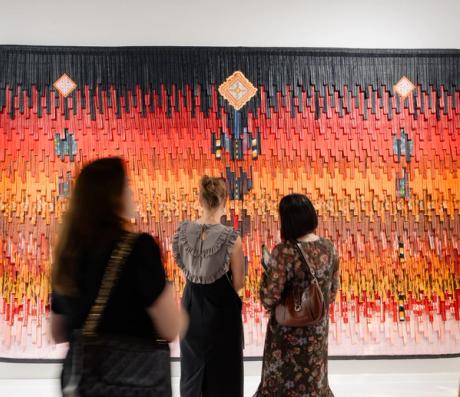
Art Dubai's 20th anniversary edition opened at Madinat Jumeirah after being postponed from April to May due to the US-Israel war in Iran and regional missile threats. Around 75 exhibitors dropped out, leaving roughly 50 participants, mostly from the region. The fair was reorganized in just eight weeks under executive director Benedetta Ghione and new director Dunja Gottweis, who created a new floor plan in a day and a half. The scaled-back format includes an embedded digital section, and initial sales have been strong, with works by Samira Badran, Mostafa Al Hallaj, Safeya Sharif, Alyazia Al Nahyan, Roudhah Al Mazrouei, and Nabil Anani selling at prices ranging from $3,500 to $360,000.
A $433 Million Boost for the Market

Sotheby's May 2026 auctions in New York generated $433.1 million in sales over under three hours, a 132.7 percent increase compared to the same period last spring, despite offering fewer lots. This strong performance signals a top-heavy recovery in the art market after three years of contraction. Separately, the Neue Galerie will merge with the Metropolitan Museum of Art in 2028, and Art Dubai continues despite disruptions from the U.S.-Iran war.

re air why no one trusts art prices anymore 2711783

Artnet News revisits a podcast episode featuring editor-in-chief Naomi Rea, who examines the breakdown of traditional art pricing logic amid a cooling market. The episode explores how the rules that once governed art valuation have eroded, leaving dealers, advisors, and collectors struggling to navigate a market described as being in a "danger zone." Rea discusses how mega-galleries, emerging dealers, and advisors are quietly recalibrating their strategies as speculation dries up and confidence wanes.

the view from paula tsai 2647042

Paula Tsai, a key figure in Asia's art market, discusses the evolving landscape of collecting in the region, focusing on mainland China and Korea. She notes a surge of new buyers from China, many of whom are young entrepreneurs, while the Korean market remains more mature and stable. Tsai addresses the impact of tariffs on importing art, particularly for Chinese collectors, but asserts that passionate collectors will continue to buy, adjusting timing rather than abandoning purchases. She also highlights the growing Thai market and the complexity of the Chinese market, where established collectors are cautious but new entrants keep activity high.

US-Israel war on Iran disrupts art transport routes as prices surge

The ongoing US-Israel war on Iran has severely disrupted global art logistics, causing oil prices to surge and key shipping routes to close. Air freight costs for fine art have skyrocketed by 70% to 300%, and critical corridors like the Strait of Hormuz have become impassable, leaving exhibitions stranded at airports and shipments stuck at sea.

tefaf new york art fair trump tariffs impact 1234740253

New tariffs imposed under the Trump administration are causing significant disruptions for art professionals shipping works to major New York art fairs, particularly TEFAF New York. Shipping companies report a 'torturous road' as galleries navigate complex import taxes—including 7.5% on Chinese artworks, 25% on steel and aluminum sculptures, and 10% on jewelry, furniture, and design pieces—while many original artworks, antiques over 100 years old, and collector's pieces remain exempt. Galleries are modifying operations by renting booth furniture, showing items already stored in the US, and avoiding shipments from China, with some classifying antiquities broadly as 'sculpture' to simplify customs clearance.

year ahead fire horse 2744885

Artnet Pro's Asia Pivot newsletter consulted feng shui masters and artists versed in Chinese metaphysics to forecast trends for the 2026 Year of the Fire Horse. Predictions include high volatility in financial markets and the art sector, a potential slowdown in traditional Western markets like Europe and North America, and continued growth in emerging regions such as Southeast Asia, South Asia, and the Gulf. A 'big disruption' from the Global South is anticipated in the first half of the year, followed by market growth in the latter half.

why no one trusts art prices anymore 2666290

Artnet News editor-in-chief Naomi Rea joins Kate Brown on The Art Angle podcast to discuss the unraveling of traditional art pricing logic. The art market has cooled beyond a typical downturn, entering what Rea calls a "danger zone" where dealers and advisors are quietly recalibrating as speculation dries up and confidence wanes. The episode examines how pricing mechanisms that once held the market together have broken down, affecting everyone from mega-galleries to emerging dealers.

art shipping in turmoil as tariffs trigger delays 2636325

President Trump's tariff policies are causing significant disruption in the art shipping industry, despite artworks themselves remaining largely exempt from import taxes under U.S. law. While Section 1702(b) of the IEEPA protects artworks, books, and films from presidential trade restrictions, antiques and design objects are subject to a 10 percent universal tariff, creating confusion for customs officers. Meanwhile, changes to de minimis rules—lowering the threshold for formal customs processing from $2,500 to $800—have forced DHL to temporarily suspend certain shipments and caused multi-day delays. Smaller art dealers relying on global logistics firms are particularly affected, as bespoke fine-art shippers like Crozier, UOVO, and Cadogan Tate are often too expensive for lower-value works under $10,000.

TikTok Shop adds ‘fine art’ category—will it disrupt the art market?

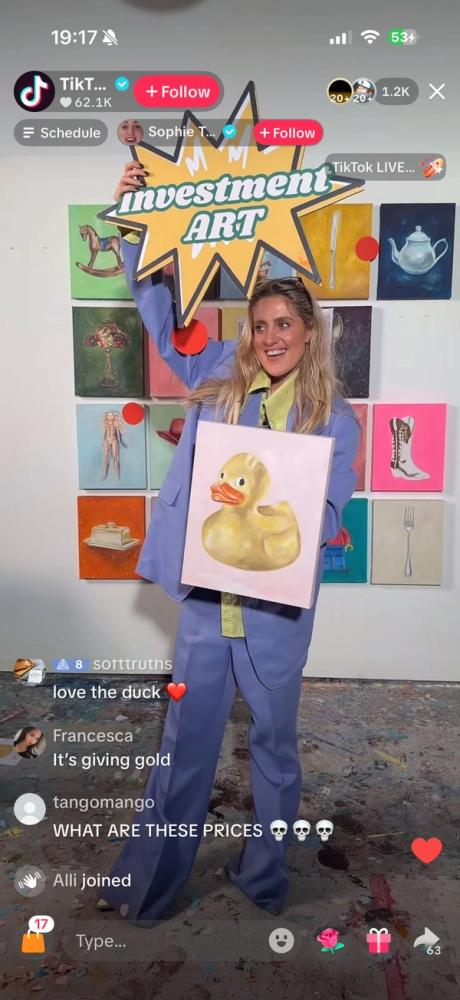
TikTok Shop has launched a new "fine art" category within its collectibles section, allowing artists to sell original artworks directly through shoppable videos, photographs, and livestreams. The category debuted with a three-hour live sale by artist Sophie Tea, who created a series of 20 oil paintings titled *Bric-a-Brac* and sold them for £2,800 each. The sale faced technical glitches—items added to baskets were prematurely marked as sold, causing confusion—and required workarounds for TikTok's pricing caps, automatic discounts, and shipping policies.