filter_list Showing 6 results for "Impact" close Clear
dashboard All 50 museum exhibitions 23article local 7article news 6article culture 4person people 3trending_up market 2candle obituary 2article policy 2rate_review review 1
date_range Range Today This Week This Month All
Subscribe

King Charles Visits Christie’s in New York, After White House Dinner

King Charles III and Queen Camilla made a surprise visit to Christie’s headquarters in New York on April 29, 2026, following a White House dinner and address to Congress. They attended a gala for the King’s Trust, a charity supporting young people from disadvantaged backgrounds, rather than bidding on auction lots like a $100 million Jackson Pollock or a $60 million Roy Lichtenstein. The event, co-chaired by Lionel Richie, drew guests including Martha Stewart and Anna Wintour, and featured a dinner in the James Christie Room. Christie’s CEO Bonnie Brennan curtsied to the king, and the royals viewed the new rostrum designed by Jony Ive, set to debut in New York during Christie’s May marquee week.
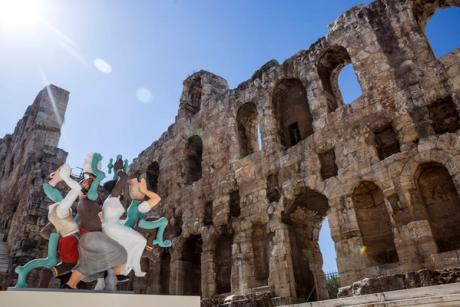
Major Greek contemporary art non-profit Neon to close after 14 years

Neon, a major Greek contemporary art non-profit founded by businessman and patron Dimitris Daskalopoulos, is closing after 14 years, stating it has fulfilled its cultural and social mission. Between 2012 and 2026, the organization presented 44 exhibitions across museums, historical sites, and public spaces, commissioning 105 works by Greek and international artists. Notable projects include donating Antony Gormley's sculpture 'RULE II' (2019) to the island of Delos—the first contemporary work permanently installed at an ancient site—and funding the €1.4m renovation of the Lenorman Street Tobacco Factory in Athens into a cultural center. Neon will present its final exhibition, the third installment of 'Michael Rakowitz & Ancient Cultures,' later this year at the Old Acropolis Museum.

Why London’s Whitechapel Gallery Hired an Economist

London's Whitechapel Gallery has appointed economist Mariana Mazzucato as its first economist-in-residence, a three-year role aimed at rethinking how museums generate revenue and demonstrate social value. The gallery faces a £880,458 deficit, a 325% increase from the previous year, due to declining exhibition income, reduced trust and foundation funding, and cuts in Arts Council England grants. Mazzucato, a professor at University College London and director of the Institute for Innovation & Public Purpose, will advocate for treating culture as a strategic public investment.

Venice Biennale Jury Resigns in the Wake of Controversial Prize Ban

The jury for the 2026 Venice Biennale has resigned just days before the public opening on May 9, after announcing on April 22 that it would not consider artists from countries accused of crimes against humanity for the Golden and Silver Lion prizes. The jury, consisting of Solange Oliveira Farks (president), Zoe Butt, Elvira Dyangani Ose, Marta Kuzma, and Giovanna Zapperi, cited its earlier statement of intention in its resignation, which directly impacted the participation of Russia and Israel—both subject to International Criminal Court warrants. In response, the Biennale postponed the awards ceremony from May 9 to November 22 and replaced the traditional jury with a public vote for best participant and best national participation, framing the move as upholding openness and rejecting censorship.

Statement of Resignation

The international jury for the 61st edition of La Biennale di Venezia, titled “In Minor Keys” and curated by Koyo Kouoh, has resigned as of April 30, 2026. The jury members—Solange Oliveira Farkas, Zoe Butt, Elvira Dyangani Ose, Marta Kuzma, and Giovanna Zapperi—cite their earlier Statement of Intention issued on April 22, 2026, as the basis for their collective resignation.

Aristophil : Gérard Lhéritier reconnaît sa culpabilité et obtient une peine réduite

Gérard Lhéritier, founder of the art investment firm Aristophil, has pleaded guilty in a French court under a procedure known as comparution sur reconnaissance préalable de culpabilité (CRPC), effectively a plea bargain. On April 14, he admitted responsibility for fraud and deceptive commercial practices after more than a decade of denial. This late admission, made just before his expected incarceration, reduces his sentence from the five years of imprisonment handed down in December 2025 to two years under electronic monitoring. The case stems from Aristophil’s collapse, which involved selling shares in manuscripts and historical documents as attractive investments, leaving thousands of investors heavily impacted.