filter_list Showing 9 results for "Amina" close Clear
dashboard All 9 museum exhibitions 5article news 3article culture 1
date_range Range Today This Week This Month All
Subscribe

Jimmy Tsutomu Mirikitani, a New Sort of Street Artist, Rises from Art History’s Margins

Jimmy Tsutomu Mirikitani, a late Japanese American collagist who lived and worked as a street artist in New York City, is the subject of a new solo exhibition at the Spencer Museum of Art in Kansas City, on view through June. Co-curators Maki Kaneko and Kris Imants Ercums organized the show thematically rather than chronologically, reflecting Mirikitani's fragmented life—from surviving the atomic bombing of Hiroshima and incarceration at Tule Lake to arriving in New York in the 1950s. The exhibition draws on years of research, including visits to the parks where he lived and to Hiroshima, and builds on Linda Hattendorf's 2006 documentary *The Cats of Mirikitani*.

Leaky Berlin Modern Museum’s Opening Delayed Until 2030

The opening of the Berlin Modern Museum, a planned extension of the Neue Nationalgalerie, has been delayed until 2030 due to significant moisture damage and microbial contamination in its foundation, floors, roof coverings, and exterior walls. Originally laid in February 2024 with a projected 2027 opening, the museum's construction costs have surged from 200 million to 507 million euros, according to Monopol. A spokesperson for the Prussian Cultural Heritage Foundation stated that repairs are underway but will push completion back by approximately eight months.

What Brakes Through: “Teresa Tyszkiewicz. Stories That Tell Themselves” at Profile Foundation.

Teresa Tyszkiewicz's exhibition "Stories That Tell Themselves" at Profile Foundation in Warsaw showcases the Polish artist's process-driven practice spanning video, performance, and relief-like paintings made with pins, nails, metal plates, ropes, and fabrics. Curated by Bożena Czubak, the show highlights Tyszkiewicz's use of the body as a medium—often naked and immersed in organic materials—to explore emotions, intuition, and unconscious desires, as seen in works like the 1980 film "Grain." The artist, who began her career in the late 1970s alongside Polish neo-avantgarde filmmakers but rejected their conceptual tendencies, developed a tactile, laborious approach that invites sensory engagement.

morocco debuts national pavilion at the venice biennale with monumental asǝṭṭa installation

Morocco will debut its first-ever national pavilion at the 2026 Venice Art Biennale, presenting a monumental installation titled "Asǝṭṭa" by multidisciplinary artist Amina Agueznay. Curated by Meriem Berrada, the project is housed in the Arsenale's Artiglierie and explores themes of traditional craftsmanship, shared memory, and the symbolic threshold (âatba). The installation, which involves 166 Moroccan artisans and two Venetian collaborators, is conceived as a porous, liminal space that engages with the Biennale's theme "In Minor Keys," curated by Koyo Kouoh.

Venice Biennale 2026: What are the major trends that will mark the 99 national pavilions?

Biennale de Venise 2026 : quelles sont les grandes tendances qui vont marquer les 99 pavillons nationaux ?

The article previews the 2026 Venice Biennale, highlighting key trends across its 99 national pavilions. Major themes include the hybridization of theater, dance, and performance, particularly in pavilions from Austria, Luxembourg, Belgium, and Lithuania, where artists like Florentina Holzinger, Aline Bouvy, Miet Warlop, and Eglė Budvytytė use radical, body-centric works. Geopolitical engagement is also central, with the Ukrainian pavilion featuring Zhanna Kadyrova's work on resistance and the British pavilion exploring themes of exile and migration. Other notable pavilions include Spain's focus on imagery, a sound installation for the Vatican, a polyphonic piece for Romania, and a film on sign language song for Poland.

7 Books We’re Looking Forward to in May

ARTnews has published a list of seven art books to look forward to in May 2026, covering a wide range of topics from contemporary theory and AI imagery to historical biographies and the Venice Biennale. Featured titles include Dena Yago's collected writings 'That Figures,' Victoria Johnson's biography of Frederic Church 'Glorious Country,' Trevor Paglen's 'How to See Like a Machine,' Nicholas Fox Weber's 'Anni Albers: A Life,' Massimiliano Gioni's 'High Waters: An Oral History of the Venice Biennale,' Rennie McDougall's 'Nonstop Bodies: How Dance Shaped New York City,' and Paul Elie's 'Last Supper: Art, Faith, Sex and Controversy in the 1980s.'

Israel’s foreign ministry accuses Venice Biennale's jury of ‘politicising’ exhibition

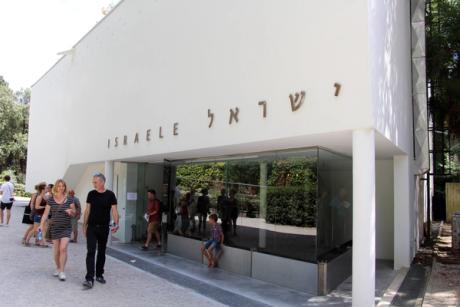
Israel’s foreign ministry has accused the Venice Biennale's jury of politicizing the exhibition after jurors announced they would not consider for prizes countries whose leaders face International Criminal Court charges for crimes against humanity. The jury’s statement, which did not name specific nations, is broadly understood to apply to Israel and Russia, both returning to the Biennale for the first time since the Gaza war and the Ukraine invasion, respectively. The Israeli ministry posted on X that the jury had decided to 'boycott' Israeli sculptor Belu-Simion Fainaru, calling it 'a contamination of the art world.' The Biennale distanced itself from the jury’s announcement, stating the jury acts autonomously, while the Russian pavilion is reportedly set to open only for a limited pre-opening period due to budget constraints amid sanctions.

Israel Addresses Venice Biennale Jury’s ‘Boycott’ of Pavilion: ‘A Contamination of the Art World’

Israel’s foreign ministry has condemned a statement by the Venice Biennale jury, in which the five curators declared they would not consider pavilions from countries charged with crimes against humanity by the International Criminal Court. The jury’s decision effectively boycotts Israel and Russia, whose leaders face ICC arrest warrants. Israel called the move a “contamination of the art world,” while the artist representing Israel, Belu-Simion Fainaru, also denounced the jury for creating a hostile environment. The Biennale’s organizers have distanced themselves from the jury, stating they cannot exclude any recognized state from the exhibition.

Appropriation Culture: Richard Prince and Arthur Jafa

An upcoming exhibition at ArtReview pairs artists Richard Prince and Arthur Jafa to explore the ethics and aesthetics of image appropriation. Jafa's work, such as the video "Love is the Message, The Message is Death" (2016), uses found footage of police violence and Black cultural icons, while Prince's "Girlfriends" series rephotographs amateur snapshots from biker magazines. Jafa has cited Prince as a key influence on his own practice of transposing images across contexts.