filter_list Showing 6 results for "Making Visible" close Clear
dashboard All 6 museum exhibitions 4rate_review review 2
date_range Range Today This Week This Month All
Subscribe

Beware the technology rat trap: Cooper Jacoby’s standout contribution to New York’s Whitney Biennial

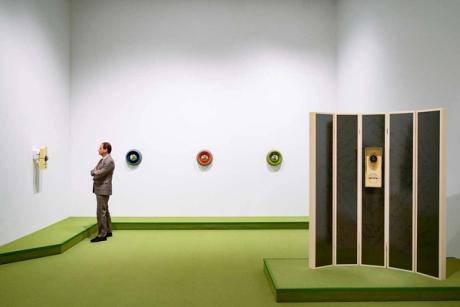
Cooper Jacoby's sculptures at the Whitney Biennial explore how AI corporations and other companies turn personal data into financial assets. His five works, displayed in a green-carpeted space he describes as "almost like a rat trap," include the 2026 piece *Estate (July 10, 2022)*—a folding screen with an intercom that uses AI trained on social media posts from deceased creatives to generate vocal outputs. Another series, *Mutual Life*, features eye-like sculptures with clock hands that spin based on the biological age of anonymous individuals in the artist's network. Jacoby's work highlights the lack of regulation around digital life and death, and the opaque nature of AI systems.

Ruminations on Rashid Johnson’s “A Poem for Deep Thinkers”

The article is a reflective review of Rashid Johnson's exhibition "A Poem for Deep Thinkers" at the Modern Art Museum of Fort Worth. The author describes standing before Johnson's work "Falling Man" (2016), a piece incorporating broken mirrors, burned wood, and personal objects like a copy of Harry Haywood's "Black Bolshevik" and shea butter, which prompts meditations on visibility, identity, and Frantz Fanon's "Black Skin, White Masks." The review also examines Johnson's large-scale installation "Antoine's Organ" (2016/2026), which fills a gallery typically reserved for Ellsworth Kelly's minimalist canvases, transforming the space with scaffolding, plants, books, and video monitors.

Kim Dacres Revitalizes Sleek Tires, Chains, and Gears in Defiant Sculptures

Kim Dacres transforms discarded auto and bicycle rubber into sculptural portraits that celebrate Black hairstyles and community. Her new exhibition "Lost on a Two Way Street" at Charles Moffett in New York features busts with braided buns and gear-like crowns, alongside flat wall works evoking Victorian cameos. The show also includes reimagined U.S. flags with Black and brown figures, addressing the current political climate and the gap between national symbols and lived reality.

Blank Spaces. Sung Tieu by Sarah Johanna Theurer

Sung Tieu's installations, characterized by austere, bureaucratic surfaces, explore the hidden architectures of power embedded in everyday systems. The article examines her series of works that deconstruct administrative forms used in asylum procedures, reducing them to blank spaces and quantified grids to expose how institutional power operates through seemingly neutral documents. Her exhibition "In Cold Print" at Nottingham Contemporary physically manifests these themes by using steel fences to control viewer movement, drawing direct parallels between minimalist sculpture and the dehumanizing design of border controls.

Monopol Gives Away 5 x 2 Tickets for Photo Exhibition at Museum Rietberg

Monopol verlost 5 × 2 Tickets für Foto-Ausstellung im Museum Rietberg

The Museum Rietberg in Zurich is presenting the exhibition "Fast ein Paradies" (Almost a Paradise), which critically examines colonial-era photography as an instrument of power. The show juxtaposes historical photographs with contemporary artworks that recontextualize this material, featuring artists like Sasha Huber, Sammy Baloji, Raphaël Barontini, and Andrea Chung, who intervene in the archival images to challenge colonial narratives and restore agency to the subjects.

Art exhibition shines light on Romani persecution during Holocaust

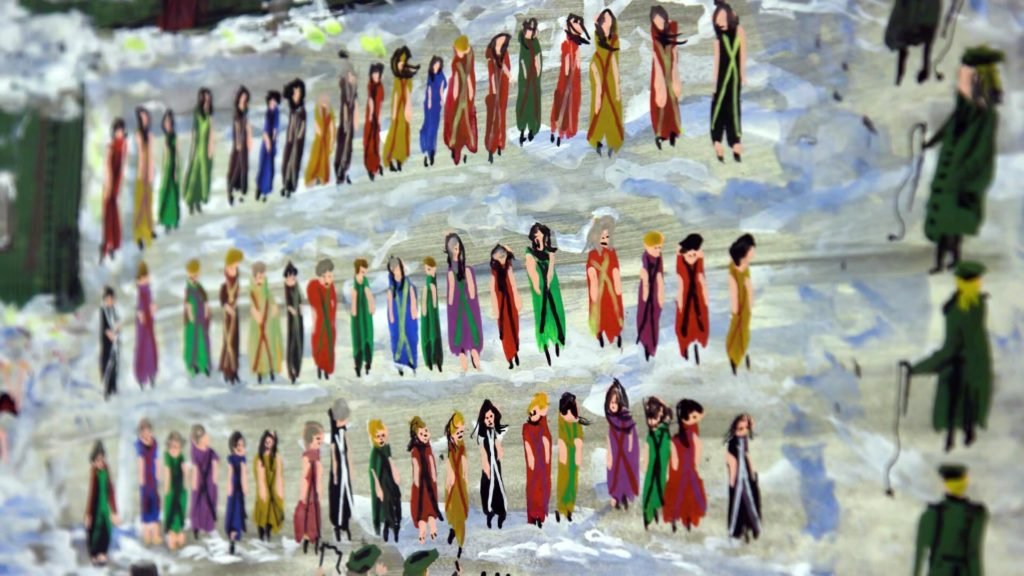
An exhibition titled "Ceija Stojka: Making Visible" at The Drawing Center in New York City highlights the persecution of Roma and Sinti people during the Holocaust, a lesser-known chapter of Nazi atrocities. The show features paintings and drawings by Ceija Stojka, a Romani artist, writer, and activist who survived the genocide and died in 2013 at age 79. Her works, described as acts of memory and imagination rather than documentary, depict her experiences and stories passed down to her, with the exhibition also including documentary films by Karin Berger and Stojka's writings, such as her 1988 memoir "We Live in Secrecy."