
filter_list Showing 4 results for "The Washington Post" close Clear
dashboard All 4 article news 2article culture 1museum exhibitions 1
date_range Range Today This Week This Month All
Subscribe

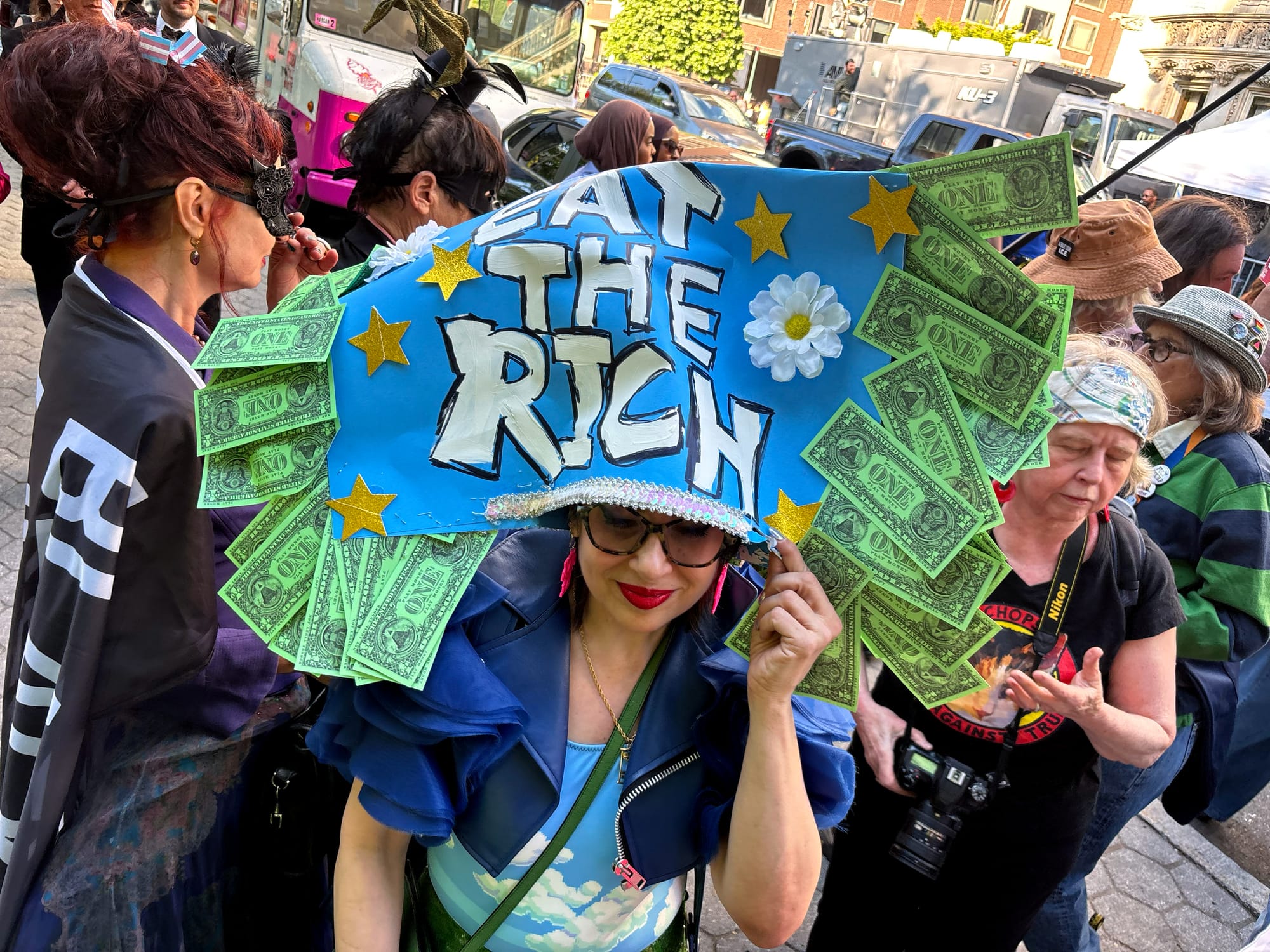
Rollicking Protest Against Bezos's Met Gala Erupts in Manhattan

On May 4, 2026, a small but spirited protest organized by the advocacy group Rise and Resist erupted near the Metropolitan Museum of Art during the Met Gala. Dozens of costumed demonstrators gathered on a makeshift "Resistance Runway" to denounce billionaire Jeff Bezos, who co-chaired the event with his wife Lauren Sánchez Bezos. Participants held signs addressing trans rights, fascism, and wealth inequality, and danced to ABBA's "Money, Money, Money." The protest highlighted Bezos's role as co-chair, with activists criticizing his company Amazon's profits from immigration crackdowns and layoffs at the Washington Post. Bezos reportedly did not attend the gala, while his wife walked the red carpet alone.

How Fatinha Ramos Channels ‘Visual Activism’ in Her Richly Layered Illustrations

Fatinha Ramos, a Portuguese artist and illustrator based in Antwerp, describes her work as 'visual activism,' creating richly layered illustrations that give voice to minorities and address social issues. She collaborates with major clients including The New York Times, The Washington Post, Tate, Scientific American, the Anne Frank Museum, and MoMA, which commissioned her to illustrate an essay about being compared to Frida Kahlo. Born with osteogenesis imperfecta (brittle bone disease), Ramos spent much of her childhood in hospitals, where drawing became an escape. After 12 years as an art director in advertising and publishing, she now focuses on her own practice, which challenges stereotypes around disability, climate crisis, sexism, and racism. She is currently working on a graphic novel and a series of anatomical glass sculptures based on brittle bone disease.

The US pavilion's curator on the controversial choice of Alma Allen for the Venice Biennale

The US pavilion at the Venice Biennale has selected Alma Allen, a Utah-born, Mexico-based sculptor, as its representative artist—a controversial and surprising choice given his relative obscurity compared to past pavilion artists. The selection process was unusually fraught: the first artist chosen was dropped before official announcement, and the announcement was delayed by the US government shutdown. The pavilion's curator, Jeffrey Uslip, discusses the exhibition titled "Call Me the Breeze," which will feature Allen's sculptures in stone, bronze, and wood that appear to defy their own weight, emphasizing artistic autonomy despite the State Department's framing of the choice as showcasing "American excellence."

US Border Wall Construction Damages 1,000-Year-Old Indigenous Land Art in Arizona

Construction crews building a barrier between the United States and Mexico have damaged a 200-foot-long etching of a fish embedded in the land in Arizona, known as the Las Playas Intaglio, which is thought to be 1,000 years old. According to a report in the Washington Post, workers destroyed a 60-to-70-foot portion of the ancient Indigenous land art as part of President Donald Trump’s $46.5 billion border-wall project. Satellite imagery confirmed the destruction, showing bulldozer marks running through about a third of the fish formation. U.S. Customs and Border Protection acknowledged the incident, stating that a contractor inadvertently disturbed the cultural site on April 23, 2026, and that the remaining portion has been secured.