
filter_list Showing 3 results for "ecuadorian art" close Clear
dashboard All 3 article culture 2museum exhibitions 1
date_range Range Today This Week This Month All
Subscribe

GEORGE FEBRES: TRANSLATION, IRONY, AND LIBERATION. AN ECUADORIAN ARTIST IN THE DIASPORA

The article examines the life and work of George Febres (1943–1996), an Ecuadorian artist who spent most of his career in the United States, primarily in New Orleans. Febres’s practice blends Pop Art, Neo-Surrealism, and Southern US culture with his experiences as a migrant and queer subject, using bilingualism and ironic tropical imagery to create a hybrid, irreverent body of work. Despite his significance, no works by Febres exist in Ecuadorian public collections, and no major retrospective has been held in his home country, reflecting a broader erasure of queer narratives from national art history.
GEORGE FEBRES: TRADUCCIÓN, IRONÍA Y LIBERACIÓN. UN ARTISTA ECUATORIANO EN LA DIÁSPORA

George Febres (Guayaquil, 1943 – New Orleans, 1996) was an Ecuadorian artist whose work blended pop art, neo-surrealism, and Southern U.S. culture, shaped by his experience as a migrant and queer individual. The article traces his life from a privileged but unstable childhood in Ecuador to his migration to the United States, where he was drafted during the Vietnam War and eventually settled in New Orleans. Febres used bilingualism and ironic appropriation of tropical imagery to create a hybrid, irreverent body of work that challenges the official historiography of Ecuadorian art.

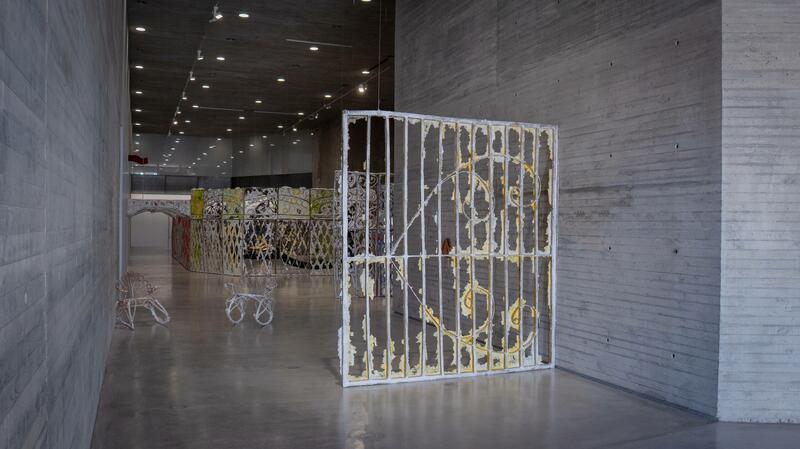
AFFECTIVE CARTOGRAPHIES AND ARCHITECTURES BY SOFIA SALAZAR AT C3A

Ecuadorian artist Sofía Salazar Rosales has debuted a site-specific solo exhibition titled "Travesías de una lágrima" at the Centro de Creación Contemporánea de Andalucía (C3A) in Córdoba, Spain. The installation-heavy showcase utilizes sculpture and architecture to explore themes of migration, memory, and colonial legacies. Through materials like wax, charcoal, and iron grilles, Salazar Rosales transforms the gallery into a performative space where visitors navigate physical representations of borders, displacement, and the historical weight of territory.