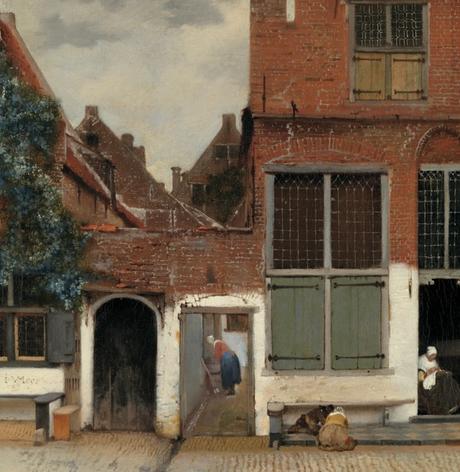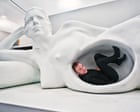
filter_list Showing 6 results for "vermeer" close Clear
dashboard All 6 museum exhibitions 3article culture 1person people 1article news 1
date_range Range Today This Week This Month All
Subscribe

‘Money! Glamour! Yachts! But not for me!’ Adrian Searle relives 30 glorious years as our chief art critic

Adrian Searle, the outgoing chief art critic for The Guardian, reflects on his 30-year career by recounting a vivid, personal montage of the art he has witnessed. He describes unforgettable encounters with works ranging from Vermeer's intimate paintings to Fiona Banner's suspended jet fighter, Roger Hiorns's crystal-filled flat, and Emily Jacir's poignant project on Palestinian displacement, highlighting how these experiences blend memory, story, and direct observation into a critic's life.
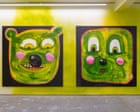
Shreg the green ogre, a grey obsessive and Vermeer’s boiled egg – the week in art

This week's art roundup from The Guardian highlights a range of exhibitions across the UK, including Bruce Asbestos's 'Bootleg Shreg 2' at Exeter Phoenix Gallery, a playful show featuring a green ogre that parodies copyright rules. Other notable shows include Roy Oxlade's primitive paintings at Alison Jacques, May Morris's craft legacy at Lady Lever Art Gallery, a 30-year anniversary group show at Timothy Taylor, and Alan Charlton's monochrome grey works at Annely Juda Fine Art. The article also features an image of a naturally sculpted rock on Kangaroo Island, a review of the Turner Prize nominees, and a masterwork analysis of Vermeer's 'The Guitar Player' at Kenwood House, which was stolen in the 1970s and recovered with the help of a clairvoyant.

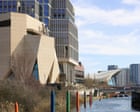
V&A East architecture review – from ceramics to codpieces, this is a honey-coloured treasure trove of human ingenuity

V&A East has officially unveiled its new museum building in London’s Olympic Park, a striking architectural addition to the city's burgeoning 'East Bank' cultural district. Designed by O’Donnell + Tuomey, the structure features a faceted, honey-colored concrete exterior inspired by the intricate folds of a sleeve in a Vermeer painting and the structural tailoring of Cristóbal Balenciaga. The interior houses a diverse collection of human ingenuity, ranging from Leigh Bowery’s sequined codpieces to historical ceramics, all organized within a framework that emphasizes the process of making.

An Era Ends When the Illusions Underlying It Are Exhausted

"Eine Ära endet, wenn die ihr zugrunde liegenden Illusionen erschöpft sind"

A media roundup covers several art world stories. The Art Newspaper reports that the ongoing Middle East conflict is unsettling the Gulf art market, causing fair postponements and shaking Dubai's image as a stable luxury hub, though galleries emphasize they continue to work. Meanwhile, the search for a new director for Germany's Kulturstiftung Dessau-Wörlitz continues after a protracted legal battle, with applications open until May 31. The New Yorker presents a reading of Johannes Vermeer's quiet scenes as fragile refuges from a violent historical context, while the Berliner Zeitung critiques the global commercialization of Frida Kahlo into a licensed brand.

Views from Behind. A Figure Without a Portrait

Vu[e]s de dos. Une figure sans portrait

The exhibition "Vu[e]s de dos. Une figure sans portrait" at Les Franciscaines in Deauville, running from February 28 to May 31, 2026, explores the artistic motif of figures seen from behind. Curated by director Annie Madet-Vache, the show was inspired by a small painting from the museum's own collection, André Hambourg's *L'Enterrement de Poincaré*. Unable to secure loans of iconic works such as those by Friedrich, Delacroix, Ingres, or Vermeer, Madet-Vache instead displays large black-and-white reproductions of these masterpieces alongside contemporary works they inspired, turning the absence of the originals into a conceptual strength.

Keep it in the family: how Johannes Vermeer’s paintings remained out of view for so long

A new biography by art historian Andrew Graham-Dixon reveals that nearly two-thirds of Johannes Vermeer's known works were commissioned and owned by a single family, the Van Ruijvens, and later inherited by their daughter Magdalena and her husband Jacob Dissius. The collection of 20 Vermeer paintings remained intact within this family for nearly 40 years after the artist's death, only being dispersed after Jacob's death in 1695.