arrow_back Back to all stories

person Eddy Frankel

newspaper The Guardian article 23 articles

Don’t: Camille Henrot review – surreal sexual psychodrama for the digitally overwhelmed

The Guardian reviews Camille Henrot's latest exhibition "Don't" at a private museum in London, marking a shift from her earlier grand-scale works about the origins of humanity and the universe. The show features two bodies of work: a series of layered digital-abstract paintings titled "Dos and Don'ts" that blend screenshots, collaged paper, and brushstrokes, and a set of erotic drawings depicting surreal sexual psychodramas. Henrot, who won the Silver Lion at the Venice Biennale in 2014, turns inward here, exploring the mundane, personal, and intimate aspects of everyday life.
‘I lived near a serial killer’: Steven Shearer on turning teen angst and death metal into high art

Canadian artist Steven Shearer, known for his reclusive nature, discusses his first UK exhibition since 2007 at David Zwirner Gallery in London. The show spans 40 years of his work, including paintings of long-haired teens, collages of appropriated images, and billboard-sized poetry inspired by heavy metal lyrics. Shearer, who grew up near serial killer Robert Pickton in Port Coquitlam, Vancouver, draws on suburban teenage angst, death metal iconography, and art historical references to create a unique visual language.

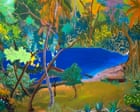
Hulda Guzmán review – lizards and ghosts gather for an art freakout in the rainforest

Hulda Guzmán's first institutional exhibition in Europe, "Please Awake – Asked Nature Kindly," is on view at Turner Contemporary in Margate, UK. The show features the Dominican artist's ultra-colorful, psychedelic jungle paintings that blend art historical references—from Japanese ukiyo-e prints to pointillism and symbolism—with personal mythology, demons, spirits, and lush tropical landscapes. The works are drawn from her life in the Dominican rainforest, where she lives and works in a studio built by her architect father.

Christo: Air review – surprisingly profound manifestation of the wrapper’s impossible dream

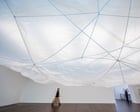
Christo's posthumous exhibition "Air" at Gagosian in London finally realizes a 1960s concept to contain air within a room, using a massive polyethylene sack suspended from the ceiling that forces visitors to physically engage with the space. The show also includes early wrapped bubble works and a preserved wrapped Volvo, tracing the artist's lifelong fascination with making the invisible tangible.

V&A Rising Voices review – can decades of stunning global art really be squished into three rooms?

The V&A Museum in London has mounted an exhibition titled "Rising Voices" that attempts to summarize three decades of the Asia Pacific Triennial, a vast survey of contemporary art from Asia, Australia, and the Pacific organized by Queensland Art Gallery. The show crams works from multiple continents, island nations, and Indigenous cultures into just three rooms, featuring bark cloth paintings from Papua New Guinea, Indigenous Australian abstracts, shark sculptures from the Torres Strait, and Tahitian textiles. Many works address colonialism, political oppression, and tyranny, with artists like Elisabet Kauage, Pala Pothupitiye, and Svay Ken using art as resistance. The exhibition includes pieces by Maryam Ayeen, Abbas Shahsavar, Lila Warrimou, Pennyrose Sosa, Aline Amaru, Brenda V Fajardo, and Heri Dono.

The car park that changed British art: Bold Tendencies at 20

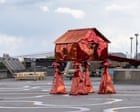
Bold Tendencies, the pioneering arts organization that transformed a multi-storey car park in Peckham, London, into a vibrant cultural venue, is celebrating its 20th summer season. Founded by gallerist Hannah Barry in 2007, the project has hosted over 3 million visitors, commissioned dozens of new artworks, and built an auditorium and concert hall within the concrete structure. It began as a low-budget experiment in using derelict urban spaces for art, featuring sculptures, performances, and a rooftop bar that predated the experiential art boom.

What does a woman swimming in urine tell us about the state of the world? Lots! – Venice Biennale review

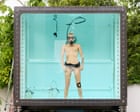
The 2026 Venice Biennale, curated by the late Koyo Kouoh under the theme "In Minor Keys," has been plagued by months of turmoil including countries withdrawing, artists being fired, exhibitions cancelled, funding pulled, and protests during the preview. A five-person curatorial team took over after Kouoh's death, resulting in what the critic describes as a disjointed, committee-driven exhibition that prioritizes quiet contemplation and healing over direct political engagement. The central shows in the Giardini and Arsenale feature a vast, poorly explained array of art from the global south, with installations of ceramics, textiles, slide projectors, and serene natural scenes that the critic finds anachronistic and dull.

Lubaina Himid’s British pavilion at the Venice Biennale review – alienation in a green and pleasant land

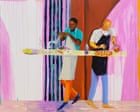
Lubaina Himid's installation at the British pavilion of the Venice Biennale presents monumental paintings and a wall of painted oars depicting tailors, cooks, architects, gardeners, and sailors—figures who shape Britain. The work is accompanied by an audio piece of bucolic country sounds, but the black figures in the paintings exchange sideways glances of discomfort, questioning whether they truly belong. The exhibition is anchored by 26 philosophical questions on the wall, such as "Can flies settle here?" and "Can poison taste delicious?"

‘We are complicit’: Austrian artist Florentina Holzinger’s immersive Venice Biennale pavilion brings apocalypse to the city

Austrian artist Florentina Holzinger has created 'Seaworld Venice,' an immersive and confrontational installation for the Austrian Pavilion at the 2024 Venice Biennale. The work explores climate change, technology, and a dystopian flooded future, drawing comparisons to the 1995 film 'Waterworld'—though neither Holzinger nor curator Nora-Swantje Almes had seen it. Known for extreme performance art involving nudity, blood, live piercing, and heavy machinery, Holzinger's previous works have caused audience members to faint or require medical treatment. The pavilion marks a significant platform for her radical, hybrid practice that blends theatre, dance, opera, and performance art.

Rose Finn-Kelcey review – flying puns, smart pranks and prayers for 20p

The Guardian reviews "Rose Finn-Kelcey: House Rules," a posthumous exhibition at the new Arts Collective in Northampton, UK. The show features works by the British conceptual artist (1945–2014), including her 1972 flag installation "Power for the People" at Battersea Power Station, a prayer vending machine titled "It Pays to Pray," and pieces exploring permission, spirituality, and societal restrictions. The exhibition is presented as a homecoming for Finn-Kelcey, who was born in Northampton.

Genuine Fake Premium Economy review – brilliantly obnoxious millennial rage at a rigged financial world

The exhibition "Genuine Fake Premium Economy" at a London gallery features works by American artists Jenna Bliss, Buck Ellison, and Jasmine Gregory, all born in the mid-1980s. Their pieces—including Bliss's shaky videos of New York's financial district, Ellison's fictional bank advertisements pairing classical paintings with cynical taglines, and Gregory's luxury watch ads stripped of watches—collectively express millennial rage at a rigged financial system and the aftermath of the 2008 crash.

Nancy Holt review – cosmic thrills as the universe’s hidden power is unleashed

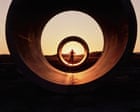
The Guardian reviews a major UK exhibition of land artist Nancy Holt (1938-2014) at Goodwood in West Sussex, the largest show of her work to date. The exhibition features two large outdoor installations—Ventilation System, a metallic tubular structure resembling building lungs, and Hydra’s Head, six concrete pools arranged like the Hydra constellation in a chalk quarry—alongside indoor photographs, diagrams, and light works. The review praises the cosmic scale and bodily connection of the outdoor pieces but finds the indoor works less effective at conveying Holt’s themes of universal vastness and interconnectedness.

Shreg the green ogre, a grey obsessive and Vermeer’s boiled egg – the week in art

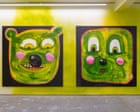
This week's art roundup from The Guardian highlights a range of exhibitions across the UK, including Bruce Asbestos's 'Bootleg Shreg 2' at Exeter Phoenix Gallery, a playful show featuring a green ogre that parodies copyright rules. Other notable shows include Roy Oxlade's primitive paintings at Alison Jacques, May Morris's craft legacy at Lady Lever Art Gallery, a 30-year anniversary group show at Timothy Taylor, and Alan Charlton's monochrome grey works at Annely Juda Fine Art. The article also features an image of a naturally sculpted rock on Kangaroo Island, a review of the Turner Prize nominees, and a masterwork analysis of Vermeer's 'The Guitar Player' at Kenwood House, which was stolen in the 1970s and recovered with the help of a clairvoyant.

Playing it safe: this year’s Turner prize nominees lack the anger – and joy – of previous years

The 2026 Turner Prize nominees have been announced, featuring artists Marguerite Humeau, Tanoa Sasraku, Kira Freije, and Simeon Barclay. The shortlist is notably lacking in painting, video art, and overtly political work, instead offering sci-fi utopianism, jazz performance poetry, ephemeral sculpture, and anti-corporate satire. Critics describe the selection as timid and safe compared to previous years, missing the anger, radicalism, and transformative joy of past editions.

Racheal Crowther review – unnerving installation attacks your mind … and your nostrils!

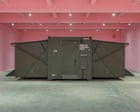
London-based artist Racheal Crowther has transformed the Chisenhale Gallery into a sensory-heavy, paranoid environment for her first institutional solo exhibition. The installation centers on a decommissioned U.S. military mobile health unit, once used during the 2018 Novichok decontamination efforts, set against walls painted in "drunk tank pink." The experience is defined by an aggressive olfactory component—a chemical cocktail of powdered milk scents and hexadecanal, a molecule found on infants' heads known to manipulate human aggression.

Petal passion, super-surreal Polaroids and Billy Childish’s California – the week in art

This week’s art roundup highlights several major exhibitions across the UK, including a floral-themed survey at Kettle’s Yard featuring artists from Henri Rousseau to Lubaina Himid. Other notable openings include Billy Childish’s expressionistic California desert paintings at Carl Freedman Gallery, Katharina Grosse’s site-specific installations at White Cube, and Steve McQueen’s new photography book, 'Bounty', which explores the colonial history of Grenada through its flora.

Filthy fossil fuels, a dizzying debut and the ominous side of the moon – the week in art

The Guardian’s weekly art roundup highlights the opening of 'Extraction' at Jupiter Artland, an exhibition featuring artists like Marguerite Humeau and John Gerrard that explores the environmental impact of fossil fuels. Other notable UK openings include Michaela Yearwood-Dan’s museum debut at The Whitworth, a survey of Paula Rego’s drawings at Victoria Miro, and a showcase of Thérèse Oulton’s textured landscapes at Vardaxoglou.

Megamurals, Guerrilla Girls and something rotten in the Oval Office – the week in art

The Guardian's weekly art roundup highlights several exhibitions, including Wilhelm Sasnal's politically charged paintings at Sadie Coles HQ in London, a Joan Eardley retrospective in Edinburgh, and a Guerrilla Girls show in East Sussex. It also reports on Art UK's digitization of over 6,700 UK murals, the theft of Impressionist paintings from an Italian museum, and the discovery of a stolen ancient gold helmet.

Veronica Ryan review – the seeds are sensational but the detritus is distracting

A major retrospective of Turner Prize-winning artist Veronica Ryan has opened, showcasing her career-long exploration of organic forms and repurposed materials. The exhibition features new works made from plastic bottles, bandages, and avocado trays, alongside earlier sculptures in bronze and lead that reference seed pods and fruit.

Nature by the uncool YBA, armoured ceramics and dizzying Aussie abstraction – the week in art

The article is a weekly art roundup highlighting several major exhibitions opening in London and Cambridge. It spotlights a new show of nature-themed paintings by Cecily Brown at the Serpentine Gallery, ceramics by Phoebe Collings-James at Pitzhanger Manor, a career survey of Turner Prize-winner Veronica Ryan at the Whitechapel Gallery, a Frank Bowling retrospective at The Fitzwilliam Museum, and a presentation of Aboriginal Australian art at Edel Assanti. The piece also features a powerful war photograph from Iraq and includes brief news items on topics ranging from a Matisse retrospective to potential museum entry fees.

Angela de la Cruz review – wonky chairs and busted pianos are monuments to resilience

Angela de la Cruz's solo exhibition "Upright" at Birmingham's Ikon gallery presents a collection of broken and mended artworks. Her canvases are crumpled, folded, and snapped, while sculptures are assembled from precarious junk like a three-legged chair on a stool and a piano stacked atop another. The works, though appearing on the verge of collapse, are all repaired and propped back up, reflecting a state of post-collapse resilience.

Ten must-see works in Art Basel Hong Kong's new section

Art Basel Hong Kong has launched a new curated section called 'Echoes,' dedicated to presenting works created within the past five years. The section features focused presentations from galleries worldwide, highlighting ten standout works by artists such as Hyun Nahm, Leelee Chan, and Tiffany Chung, who explore themes from digital consumption to colonial histories through diverse mediums.

Matisse, 1941-1954 review – hit after glorious hit in a show of life-enhancing genius

A major exhibition at the Centre Pompidou and the Grand Palais focuses on the final, revolutionary period of Henri Matisse's career, from 1941 to 1954. The show charts his artistic reinvention following a life-threatening surgery, beginning with obsessive, reworked paintings from his Nice studio during the war and culminating in the radiant, large-scale cut-outs for which he is widely celebrated.

A Painter Faces His Biggest Show, and the Truth About Success

Hurvin Anderson is preparing for a major retrospective of his work at Tate Britain, a significant milestone in his career. Despite this achievement, the artist expresses a complex and uncertain relationship with his own success, reflecting on his journey and the meaning of recognition.