arrow_back Back to all stories

person Jonathan Jones

newspaper The Guardian article 9 articles

James McNeill Whistler review – a luscious, seductive blockbuster for the painter who scandalised Britain

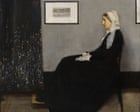
Tate Britain has opened a major retrospective dedicated to James McNeill Whistler, the American painter who scandalized Victorian Britain. The exhibition centers on his iconic work *Arrangement in Grey and Black No. 1* (commonly known as *Whistler's Mother*), lent by the Musée d'Orsay, and traces his evolution from raw realist scenes of London's docks to radical, abstract celebrations of color and pattern. It includes a reconstruction of *The Peacock Room* and highlights his rivalry with critic John Ruskin, who accused him of 'flinging a pot of paint in the public's face.'
Queer eyes in focus, sculpture hits pay dirt and Whistler’s world – the week in art

This week's art roundup from The Guardian highlights a major exhibition of James McNeill Whistler at Tate Britain, showcasing the American artist's impact on Victorian Britain with avant-garde influences from Paris and Japan. Other notable exhibitions include "Gender Stories" at the Walker Art Gallery in Liverpool, featuring works by David Hockney and Grayson Perry; Delcy Morelos's earthy sculptures at the Barbican Centre; and Henry Moore's sculptures at Kew Gardens. The article also covers news of a Nazi-looted portrait found in the home of a Dutch SS leader's family, protests at the Venice Biennale over Israel's inclusion, and the unveiling of Zineb Sedira's film installation at Tate Britain.

Artists v fascists, Khmer Rouge horrors, fab flowers and an eye-popping nude – the week in art

This week's art roundup from The Guardian features a major exhibition at Towner Eastbourne titled 'Comrades in Art: Artists Against Fascism,' which examines how artists, poets, and intellectuals used their work to resist the rise of extremism in 1930s Europe, drawing on the history of the Artists International Association (AIA). Other highlights include 'Hidden: Photography and Displacement Under the Khmer Rouge' at The Wiener Holocaust Library in London, a show of early Netherlandish drawings at the British Museum, Katharina Grosse's colorful installations at White Cube, and a flower-themed survey at Kettle's Yard. The image of the week is Sylvia Sleigh's 1963 portrait 'The Bridge (Johanna Lawrenson),' part of a new exhibition of the Welsh artist's work. The article also covers news items such as Lydia Ourahmane's Venice Biennale installation, a Holbein portrait mystery, a restored stained-glass window by Edward Burne-Jones and William Morris, and Anish Kapoor's call to exclude the US from the Venice Biennale due to 'politics of hate.'

A mind-bending Spaniard, an imagistic Puerto Rican and a lush Latvian – the week in art

This week's art roundup from The Guardian features a major exhibition on Spanish painter Francisco de Zurbarán at the National Gallery in London, described as a mind-bending and revelatory show with loans from the Prado and other top museums, positioning him alongside Goya and Picasso. Other highlights include Gilbert & George's tribute to their late homeless friend at their London centre, outdoor sculptures by Lynn Chadwick at Houghton Hall, thickly built-up paintings by Angel Otero at Hauser & Wirth Somerset, and abstract works by Latvian sculptor Daiga Grantina at Warwick Arts Centre. The article also covers a new Banksy statue in central London depicting a man marching with a flag, and a Masterpiece of the Week feature on Guido Reni's 'Saint Mary Magdalene'.

‘In every drop of paint he slurped, you see the Holocaust’: the genius and torments of Georg Baselitz

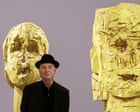
Georg Baselitz, the German painter and sculptor known for his provocative confrontations with Nazi history, has died. Born in 1938, he was one of the last living artists with direct childhood memories of the Third Reich. His early works, such as *Die große Nacht im Eimer* (1961) and his upside-down German eagles, deliberately shocked postwar West Germany by depicting obscene, shameful images of a society trying to forget the Holocaust. He famously exhibited a zombie Hitler woodcarving at the 1980 Venice Biennale alongside Anselm Kiefer, insisting on confronting rather than ignoring the Nazi heritage of the German Pavilion.

Zurbarán review – ecstatic visions, primitive surrealism … and the finest loincloths ever painted

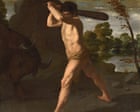
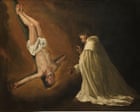
The Guardian reviews a major exhibition of 17th-century Spanish painter Francisco de Zurbarán, highlighting his visionary and surrealist qualities. The show features works such as "The Apparition of Saint Peter to Saint Peter Nolasco" (1629), newly attributed paintings including a giant mask, and iconic pieces like "The Crucified Christ" and "Saint Serapion," all drawn from collections including the Prado and the National Gallery, London. The review emphasizes Zurbarán's ability to paint supernatural subjects with naturalistic conviction, his exquisite rendering of fabrics—especially loincloths—and his influence on modern artists like Salvador Dalí.

Konrad Mägi review – these bland, blobby paintings are expressionism without expression

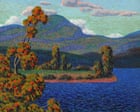
A new exhibition of early 20th-century Estonian painter Konrad Mägi at Dulwich Picture Gallery has received a scathing critical review. The reviewer finds Mägi's colorful, modernist-influenced landscapes and portraits to be bland, derivative, and devoid of the emotional depth or urgency found in the great modernists or the gallery's own Old Master collection.

Estonia exports a modernist, Glasgow gets poetic and Leonora Carrington goes wild – the week in art

The article is a weekly roundup of art events and news highlights. It spotlights several upcoming exhibitions, including a showcase of Estonian modernist Konrad Mägi in London, a poetic conceptual art show by Fiona Banner in Glasgow, lyrical paintings by Turner Prize-shortlisted Hurvin Anderson at Tate Britain, and a surrealist exhibition of Leonora Carrington's work at London's Freud Museum. It also mentions films by Rehana Zaman and features an image story about a unique, family-run trompe l'oeil painting school in Brussels.

In Bloom review – this riproaring history of botanical adventurers disturbs and delights

A major exhibition titled "In Bloom" explores the intertwined history of botanical science, colonialism, and human obsession with flowers. It features works and stories from figures like Mary Somerset, Carl Linnaeus, and Joseph Hooker, tracing how global plant collecting transformed European gardens and culture.