
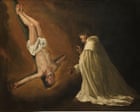
The Guardian reviews a major exhibition of 17th-century Spanish painter Francisco de Zurbarán, highlighting his visionary and surrealist qualities. The show features works such as "The Apparition of Saint Peter to Saint Peter Nolasco" (1629), newly attributed paintings including a giant mask, and iconic pieces like "The Crucified Christ" and "Saint Serapion," all drawn from collections including the Prado and the National Gallery, London. The review emphasizes Zurbarán's ability to paint supernatural subjects with naturalistic conviction, his exquisite rendering of fabrics—especially loincloths—and his influence on modern artists like Salvador Dalí.
This review matters because it positions Zurbarán not merely as a religious painter of the Spanish Golden Age but as a proto-surrealist whose work resonates with contemporary audiences. The exhibition challenges conventional art-historical narratives, showing how Zurbarán's mystical realism and attention to material detail created art that was both spiritually profound and accessible to the masses. It also underscores the enduring relevance of Baroque religious painting in today's secular art world, offering a fresh lens on an artist often overshadowed by contemporaries like Velázquez.