
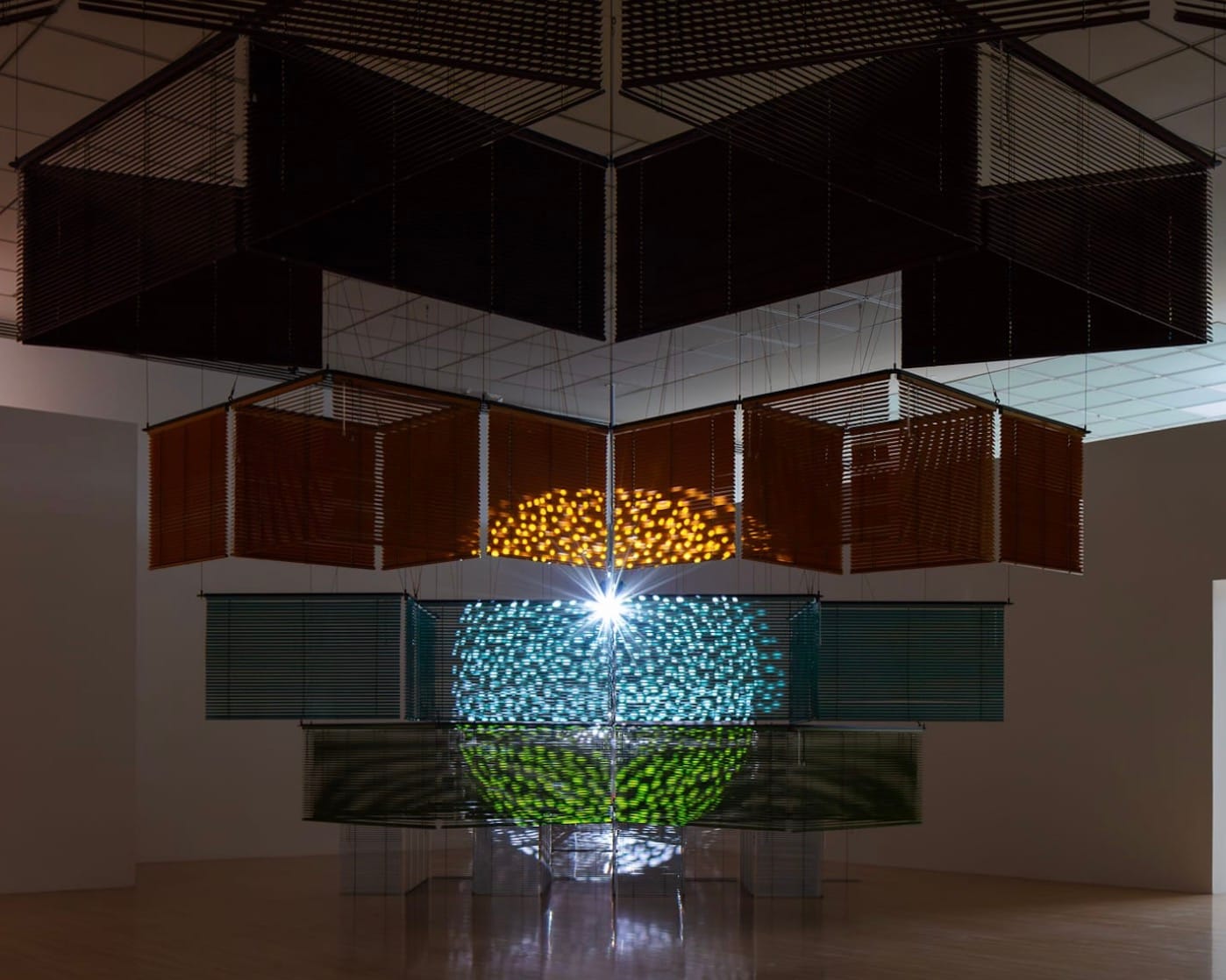
Haegue Yang's exhibition "Star-Crossed Rendezvous" at the Museum of Contemporary Art in Los Angeles features two large-scale Venetian blind installations that explore themes of division, exile, and reunification. The works draw on the arbitrary 1945 division of Korea by U.S. military officers and the life of composer Isang Yun, who was tortured and imprisoned by South Korean authorities. One installation mirrors and inverts a cube of white blinds inspired by Sol LeWitt, while the other uses colored blinds, projections, and Yun's "Double Concerto" to create a fragmented, shadow-filled meditation on longing and separation.
This exhibition matters because it demonstrates how abstract art can carry deep political and historical weight, using formal elements like light, shadow, and geometry to address the ongoing trauma of Korea's division. Yang's work connects personal narratives of exile and family separation to broader geopolitical realities, offering a poignant commentary on borders and the human cost of political decisions. It also highlights the continued relevance of artists engaging with diasporic experiences and the legacy of Cold War divisions in contemporary art.