
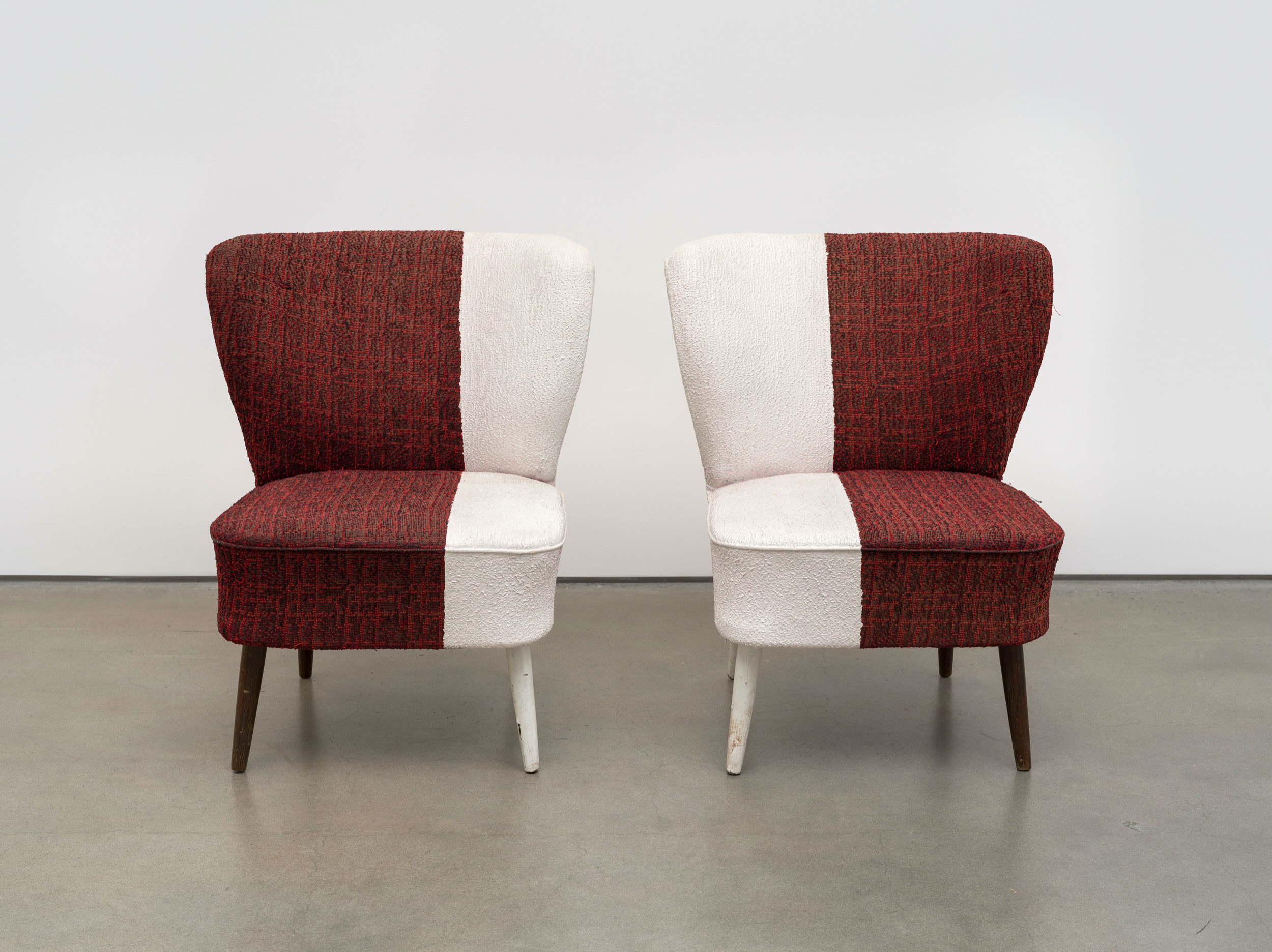
The article reviews John Armleder's exhibition "Ripple: Furniture Sculpture and Painting after 1982" at David Kordansky Gallery in New York, running from May 7 to June 13, 2026. It examines Armleder's practice from his Fluxus-influenced anti-art gestures of the 1960s and '70s to his poured and striped paintings, surrogates, and furniture sculptures of the 1980s and '90s. The Swiss artist uses chance, indifference, and ambient conditions—informed by John Cage—to create works that function as loosely scored situations, blurring boundaries between art and furnishing, contemplation and domestic comfort.
This exhibition matters because it positions Armleder's work as a critical intervention into the politics of display, value, and commerce. By treating the gallery as a provisional showroom rather than a neutral destination, Armleder implicates the entire chain of sites through which art circulates—gallery, museum, domestic interior—as overlapping, semi-fictional environments. His postmodern critique of originality and stable meaning, achieved through self-consciously derivative paintings and functional objects, challenges hierarchies of taste and class while keeping avant-garde legacies in play.