filter_list Showing 9 results for "Hammer" close Clear
dashboard All 227 museum exhibitions 77trending_up market 69article news 24person people 19rate_review review 10article culture 9candle obituary 8article local 7article policy 3article event 1
date_range Range Today This Week This Month All
Subscribe

ceramics artists 2626757

The article examines the resurgence of ceramics as a fine art medium, tracing its history from ancient Chinese and Greek pottery to the record-breaking $36 million sale of a Ming Dynasty chicken cup in 2014. It highlights influential figures like Peter Voulkos, who established ceramics departments at major institutions, and artists such as Ken Price, Ron Nagle, and Betty Woodman. Recent major museum exhibitions—including 'Strange Clay' at London’s Hayward Gallery, 'Funk You Too!' at New York’s Museum of Arts and Design, and 'Ceramics in the Expanded Field' at MASS MoCA—showcase a new generation of artists pushing the medium beyond traditional craft.
collector questionnaire interiors most shocking works of art

Cultured magazine asked 12 collectors to name the single work in their home that most stops guests in their tracks. Responses include Wolfgang Tillmans’s camera-less photograph *Freischwimmer 153* (2010), a medieval illuminated *Book of Hours* (ca. 1480/90), Jordan Wolfson’s robotic installation *(Female figure)* (2014), Julie Curtiss’s hair-covered sculpture *Spider* (2018), and Haegue Yang’s kinetic bell sculpture *Sonic Rotating Geometry Type E – Brass Plated #23* (2014). Each collector explains why the piece provokes awe, laughter, discomfort, or deep conversation.

simon de pury photos art 2725895

The author recounts a visit to the Prado in Madrid, where his attempt to photograph a portrait by Alonso Sánchez Coello was blocked by a guard enforcing a strict no-photography policy. This experience leads him to reflect on the evolution of museum mementos, from postcards—which he used to buy and even had his children select as a curatorial exercise—to the role of social media in sharing art. He recalls his time as curator of the Thyssen-Bornemisza Collection, where postcard sales were a key revenue and popularity gauge, and notes that Instagram now serves as a virtual window into exhibitions and art fairs like Art Basel Miami.

the critics table best art books of the year

Johanna Fateman and Blakey Bessire share their picks for the best art books of the year. Fateman highlights a new edition of Claude Cahun's anti-memoir "Cancelled Confessions or Disavowals" from Siglio Press, featuring photomontages by Cahun and Marcel Moore, and the first monograph on Greer Lankton, "Could It Be Love," edited by Francis Schichtel, Jordan Weitzman, and Nan Goldin with an essay by Hilton Als. Bessire selects "Voice of Space: UFOs and Paranormal Phenomena," a catalog from the Drawing Center exhibition exploring UFOs and altered states, and "Alice Coltrane, Monument Eternal," a Hammer Museum catalog edited by Erin Christovale that examines Coltrane's sonic and spiritual work.

Korean artists are taking the world by storm—but why does their work resonate so widely?

Korean artists are gaining unprecedented global recognition, with figures like Haegue Yang, Do Ho Suh, Lee Bul, and Mire Lee leading a shift from traditional Dansaekhwa abstraction to more conceptual and contemporary practices. The article highlights how K-pop and Korean soap operas have boosted cultural awareness, drawing new audiences to events like Frieze Seoul and prompting major international galleries such as White Cube, Perrotin, and Pace to open in Seoul. Curators and scholars note that Korean art now engages deeply with globalization, historical trauma, and sociopolitical change, facilitated by biennials in Gwangju, Busan, and Seoul, as well as a surge in art institutions.

25 of 2025: 5 Groundbreaking Fiber Artists You Need to Know

Artnet News profiles five groundbreaking fiber artists as part of its "25 of 2025" series, highlighting Diedrick Brackens and Melissa Joseph among them. Brackens, born in 1989, has seen his textile works exhibited at major institutions including the Museum of Modern Art, the National Gallery of Art, and LACMA, with a solo show "the shape of survival" at the SCAD Museum of Art and a U.K. debut at the Holburne Museum in 2025. Melissa Joseph, who only began working with felt in 2020, has rapidly gained attention through solo exhibitions and major public commissions, including a 2024 installation at Rockefeller Center and the 2025 UOVO Prize-winning work "Tender" at the Brooklyn Museum.

cannupa hanska luger mascot jordan peele horror film him 1234756028

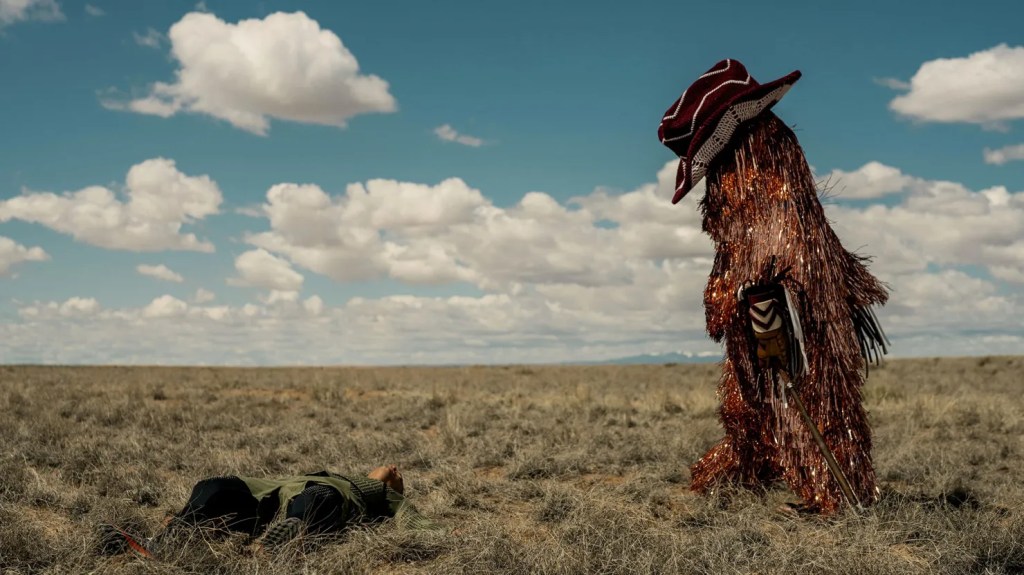
Cannupa Hanska Luger collaborated with the filmmakers of the horror film *Him*, directed by Justin Tipping and produced by Jordan Peele, to create a sports mascot named “Tinsel Larry.” The mascot appears in the film as the symbol for the fictional San Antonio Saviors team. Luger worked with lead costume designer Dominique Dawson on the design, which evolved from a “Conquistador Larry” concept into a “razzle-dazzle rose gold glitter monster.” Luger explained on Instagram that the mascot incorporates Indigenous references as a deliberate commentary on the racist history of sports mascots, calling it “an act of reclamation.”

Comment | The greatest failure of PST Art: its successes are not travelling

The article critiques PST Art (formerly Pacific Standard Time), a $20 million Getty-funded initiative in Southern California, as its current edition wraps up. It highlights the closure of key exhibitions like "For Dear Life: Art, Medicine and Disability" at the Museum of Contemporary Art San Diego before major art events like Frieze Los Angeles, and notes that only 7 of the 72 exhibitions are traveling to other institutions. The piece questions the initiative's purpose and effectiveness in reaching broader audiences.

photographer documents her changing body with stunning self portraits 190007

British photographer Polly Penrose documented her changing body over seven years in a nude self-portrait series titled "A Body of Work." The project involved physically demanding poses taken on self-timer, leaving her bruised and aching, as she hammered her body into various spaces. Penrose described the process as a punishing, repetitious fight to fit into each setting, with the resulting images capturing both visible physical transformations and concealed emotional changes.