filter_list Showing 16 results for "Financial Times" close Clear
search
dashboard All 105 trending_up market 37museum exhibitions 18article culture 16article news 16article policy 10person people 5rate_review review 1candle obituary 1gavel restitution 1
date_range Range Today This Week This Month All
Subscribe

Alma Allen Speaks Out on Backlash Over U.S. Pavilion Commission: ‘A Little Stressful’

Sculptor Alma Allen has spoken out for the first time about the backlash he faced after accepting the commission to represent the United States at the Venice Biennale. In a rare interview on the podcast *Time Sensitive*, recorded at his home in Tepotzlán, Mexico, Allen described the response as “a little stressful” but said he never hesitated when curator Jeffrey Uslip invited him last fall. His selection sparked controversy because the State Department’s requirement that proposals “reflect and promote American values” while not promoting DEI initiatives led higher-profile artists like William Eggleston and Barbara Chase-Riboud to refuse. Allen’s former galleries, Mendes Wood and Olney Gleason, dropped him after he accepted, though he has since joined Perrotin. He also hinted that his exhibition, “Call Me the Breeze,” will include work about conflict and surveillance.

Why London’s Whitechapel Gallery Hired an Economist

London's Whitechapel Gallery has appointed economist Mariana Mazzucato as its first economist-in-residence, a three-year role aimed at rethinking how museums generate revenue and demonstrate social value. The gallery faces a £880,458 deficit, a 325% increase from the previous year, due to declining exhibition income, reduced trust and foundation funding, and cuts in Arts Council England grants. Mazzucato, a professor at University College London and director of the Institute for Innovation & Public Purpose, will advocate for treating culture as a strategic public investment.

can you insure a national treasure bayeux tapestry loan sparks 1 1 billion debate

France's historic loan of the Bayeux Tapestry to the British Museum has sparked controversy over the proposed £800 million ($1.1 billion) insurance cover, which critics argue is unsuitable for such a fragile, 950-year-old textile. Art historians and conservators have raised concerns that the U.K.'s Government Indemnity Scheme does not cover damage from preexisting conditions or inherent vice, and that no sum can adequately insure an irreplaceable heritage object. A French petition calling on President Emmanuel Macron to cancel the loan has garnered over 75,000 signatures, but the U.K. government has proceeded with plans, including a practice "dry run" using a facsimile and a custom crate designed to minimize vibrations.

hauser wirth charged by uk authorities for breaching criminal sanctions

UK tax authority HM Revenue and Customs (HMRC) has charged mega-gallery Hauser & Wirth with breaching criminal sanctions by allegedly making a luxury artwork available to a person connected with Russia. The case involves a 2021 work-on-paper by George Condo titled *Escape from Humanity*, sold by the gallery between April and December 2022, after the UK banned luxury goods exports to Russia-linked individuals in April 2022. The gallery, along with shipping company Artay Rauchwerger Solomons, faces charges under the sanctions law, which was enacted following Russia's invasion of Ukraine. Hauser & Wirth has stated it strongly contests the charge and intends to plead not guilty.

Barbara Chase-Riboud Says She Declined US Pavilion Offer Because It Was ‘Not the Moment’

Sculptor Barbara Chase-Riboud has revealed she declined an offer to represent the United States at the 2025 Venice Biennale, stating that for her, "this was not the moment." The offer was made by the American Arts Conservancy, the nonprofit organization commissioning the US Pavilion. The revelation comes amid ongoing scrutiny of the selection process that ultimately led to artist Alma Allen being chosen, following reports that the Trump administration removed diversity language from application materials.

Imitations of a Mediocre Teenager on Tranquilizers

"Nachahmungen eines mittelmäßigen Teenagers auf Tranquilizern"

The Victoria & Albert Museum has reportedly censored exhibition catalogs following pressure from Chinese printing firms, removing images and maps related to sensitive topics like Tibet and Tiananmen Square. This editorial roundup also highlights artist Molly Crabapple’s sharp critique of generative AI as a massive intellectual property theft and a profile of Rirkrit Tiravanija’s communal home in Thailand, which functions as a social sculpture.

david adjaye speaks against sexual misconduct allegations

David Adjaye has publicly spoken out against the sexual misconduct allegations made against him in 2023, calling a Financial Times article that detailed the claims “deeply unfair” and claiming he was caught in a “#MeToo slam.” In an interview with architecture critic Tim Abrahams for the podcast Superhumanism, reported by Dezeen, Adjaye said the FT story destabilized confidence in him and that there was no interest in hearing his side. He did not explain why he believed the reporting was unfair, despite having declined to comment to multiple outlets at the time. The allegations, which included sexual harassment and assault claims from three women, led several institutions to cut ties with Adjaye, most notably the Studio Museum in Harlem, which had just opened a new building designed by his firm.

french culture ministry admits stolen louvre jewels valued at 102 m are not insured

Masked thieves stole jewels once belonging to Emperor Napoleon III and Empress Eugénie from the Louvre in a daylight smash-and-grab, using a furniture lift to access the first floor and cutting into display cases. The stolen items, including a diamond-encrusted brooch, diadems, necklaces, and the empress's crown (which was dropped during the escape), are valued at $102 million. French officials have admitted the loot is not privately insured, meaning the state will not be reimbursed if the items are not recovered. Louvre director Laurence des Cars blamed a "terrible failure" in security, offered her resignation (which was refused), and acknowledged staff did not detect the thieves soon enough.

defaults on art loans soar impact of australias social media ban on museums writer takes aim at singapore biennial morning link for january 6 2025

The Financial Times reports that half of non-bank lenders offering loans against artworks experienced defaults in 2024, up from 17% two years earlier, according to the Art and Finance Report 2025 by Deloitte Private and ArtTactic. The art market has shrunk 12% to $57.5 billion since 2022, dragging down collateral values and triggering margin calls. Meanwhile, Australia's social media ban for under-16s raises questions for museums, with the Art Gallery of New South Wales noting minimal impact but the Museum of Contemporary Art Australia more reliant on youth engagement. Other news includes Vanessa Horabuena's speed-painted Jesus sold for $2.75 million at Mar-a-Lago, the cancellation of NFT Paris and RWA Paris 2026, and a critical column calling for the end of the Singapore Biennial.

bayeux tapestry france british museum

The Bayeux Tapestry, a 900-year-old embroidery depicting the Norman Conquest of 1066, will be loaned from France to the British Museum for a blockbuster exhibition running from September 2026 to July 2027. French officials reportedly lobbied for discounted or free entry for French citizens, a request British negotiators dismissed as a "try-on" that was "never going to happen." The loan, first proposed in 2018 by then-Prime Minister Theresa May, was delayed over fragility concerns and finally confirmed during President Emmanuel Macron's state visit. In exchange, Britain will send the Sutton Hoo treasures and the Lewis Chessmen to France. French negotiators also floated borrowing the Rosetta Stone, but that proposal failed as the artifact is considered immovable.

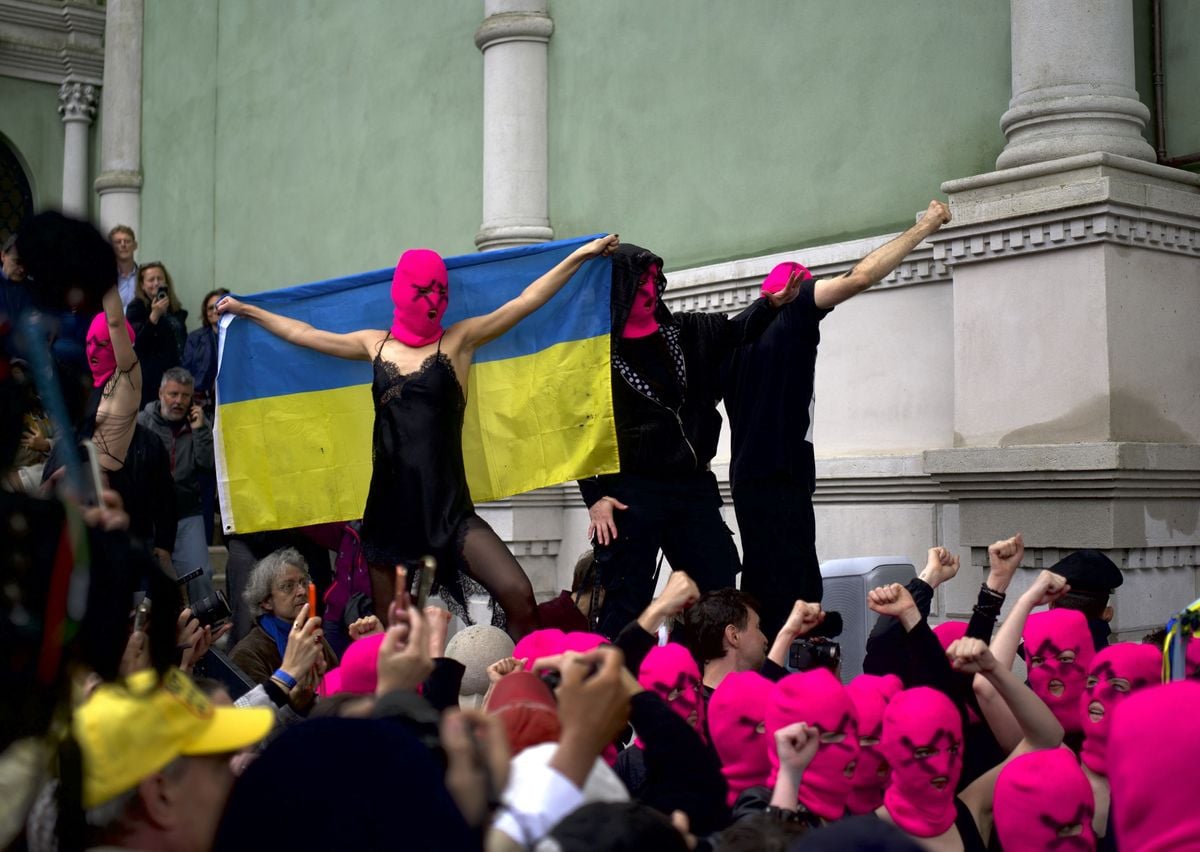
Pussy Riot protest at Venice Biennale forces Russian pavilion to briefly close

On the second day of the Venice Biennale preview, the activist group Pussy Riot staged a chaotic protest at the Russian pavilion, forcing it to temporarily close. Wearing pink balaclavas and carrying flares, about 40 activists—including members of Femen—gathered outside the pavilion, shouting slogans like "Blood is Russia's Art" and attempting to enter before being pushed back by police. Founding member Nadya Tolokonnikova led the protest, condemning Europe for allowing Russian participation despite the war in Ukraine. Separately, the Art Not Genocide Alliance (Anga) demonstrated outside the Israeli pavilion, which was locked from inside, over Israel's war in Gaza.

washington post art critic sebastian smee laid off

The Washington Post laid off approximately 30% of its newsroom staff, including Pulitzer Prize-winning art critic Sebastian Smee, as part of broader cuts to sports, local news, and international coverage. Smee, who joined the Post in 2018 after working at the Boston Globe and The Australian, confirmed his departure in a statement to ARTnews, expressing gratitude to former editor Marty Baron and solidarity with affected colleagues. Another Pulitzer-winning critic, Philip Kennicott, reportedly remains on staff. The layoffs come shortly after the release of a documentary produced by Amazon MGM Studios, owned by Post owner Jeff Bezos.

banksy mural lawsuit bethnal green

A legal dispute has erupted over a Banksy mural, *Yellow Lines Flower Painter* (2007), painted on the Bethnal Green Working Man’s Club in east London. The club’s trustees have filed a lawsuit against employee Warren Dent and others, alleging the work was illegally removed and put up for sale in the US. The mural, depicting a workman and a giant flower emerging from double-yellow lines, is currently in Colorado. The club’s former accountant claims secretary Stephen Smorthit agreed to sell the piece to Dent for £20,000 in 2019, after which art restorer Chris Bull removed it and later loaned it to his father’s gallery in Aspen. The trustees argue they never authorized the sale and are demanding the work’s return.

Seen in Venice, Bought in Venice

"In Venedig gesehen, in Venedig gekauft"

The article reports on multiple developments surrounding the Venice Biennale. Iran has withdrawn from the Biennale, citing political and economic crises, with logistical challenges such as no flights or postal service making participation nearly impossible. Artist Anish Kapoor has called for the exclusion of the United States from the Biennale, criticizing its "abhorrent policy of hate" and "ongoing warmongering." A memorial installation by Derrick Adams for the late curator Koyo Kouoh, who was set to lead the main exhibition, will be displayed near the Arsenale. Additionally, the Biennale faces a funding cut from the EU due to Russia's continued participation despite the Ukraine war, leading to the resignation of the jury and the culture minister's withdrawal.

"We are among those in the crowd who are overjoyed"

"Wir gehören zu denjenigen in der Menge, die überglücklich sind"

The Hungarian art scene is celebrating a major political shift following Péter Magyar’s electoral victory over Viktor Orbán, ending 16 years of restrictive cultural policies. Local figures, including gallerist Margit Valkó and artist János Sugár, express immense relief and hope for a future defined by institutional autonomy and international engagement after years of state-led hostility toward contemporary art.

Anti-Russia Protests Spread Beyond the Biennale and Into Venice

Protests against the reopening of the Russian pavilion erupted at the Venice Biennale and spread across the city on the second day of the 61st edition. Visual artist Shalva Nikvashvili, who grew up in post-Soviet Georgia, began a silent performance wearing a muzzle-style mask and carrying a chair, holding a sign reading “La Biennale di Venezia” and “violence.” Shortly after, a group of about 20 protesters led by Pussy Riot co-founder Nadya Tolokonnikova gathered outside the Russian pavilion, chanting against Vladimir Putin, waving Ukrainian flags, and releasing a pink smoke flare. The protests followed the Biennale's decision to allow Russia to participate for the first time since its 2022 invasion of Ukraine, despite calls from artists and politicians to exclude the country.