
filter_list Showing 2 results for "Purification" close Clear
search
dashboard All 12 museum exhibitions 6article news 2candle obituary 2article culture 1trending_up market 1
date_range Range Today This Week This Month All
Subscribe

king tut tomb clay troughs awakening osiris

A new study by Nicholas Brown, a postdoctoral fellow at Yale University, challenges the long-held interpretation of four clay troughs found in Tutankhamun's tomb. Discovered by Howard Carter in 1922, the troughs were previously dismissed as stands for gilded wooden staffs. Brown argues that the troughs' small bases could not have supported the staffs, and instead proposes they were used in the "Awakening of Osiris" ritual, holding libations of water for purification and rejuvenation in the afterlife. The study draws on material symbolism, including the Nile mud composition and the reed mats they rested on, to support this reinterpretation.
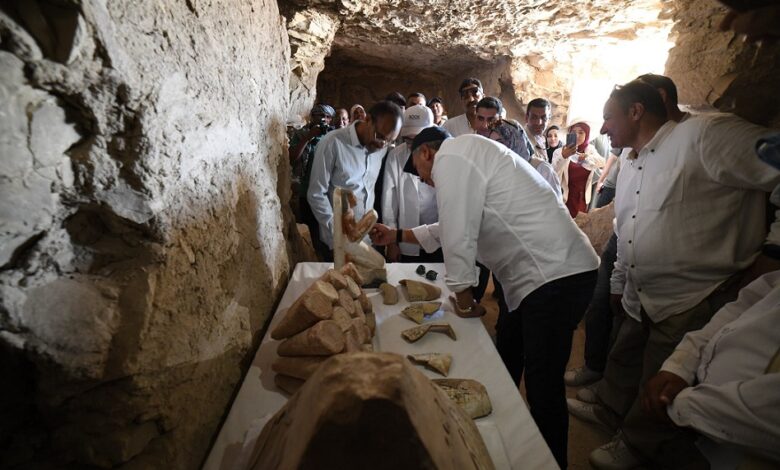
Egypt Unveils a Hidden Tomb of 3,500-Year-Old Coffins at Luxor’s Abu el-Naga

An Egyptian archaeological mission excavating at the Abu El-Naga necropolis near Luxor has uncovered a cache of ten well-preserved painted wooden coffins hidden in the courtyard shaft of the tomb of Baki. The coffins span multiple periods, including the 18th Dynasty, the Ramesside period, and the Late Period, with inscriptions naming individuals such as Merit, a chantress of the god Amun, and Padi-Amun, a priest in the Temple of Amun. The team also discovered the tomb of a purification priest named A-Shafi-Nakhtu, decorated with funerary scenes, and a burial site containing over 30 mummified cats from the Ptolemaic Period. The discoveries were announced by Egypt's Supreme Council of Antiquities, with the excavation season beginning in November 2025.