filter_list Showing 9 results for "Concept" close Clear
search
dashboard All 304 museum exhibitions 221article culture 26rate_review review 21candle obituary 9article local 8trending_up market 7article news 7person people 3article policy 2
date_range Range Today This Week This Month All
Subscribe

Georg Baselitz, German artist who turned figurative painting on its head, has died, aged 88

Georg Baselitz, the influential German painter and sculptor, died on 30 April at age 88. Born Hans-Georg Kern in 1938 in Deutschbaselitz, he grew up amid the ruins of Nazi Germany and later adopted his surname from his birthplace. Expelled from the East Berlin Academy for "sociopolitical immaturity," he moved to West Berlin, where he rejected both gestural abstraction and Expressionism. His first solo exhibition in 1963 was shut down for obscenity. In 1969 he pioneered his signature inverted paintings, turning subjects upside down to sever image from representation. He also created large carved sculptures using axes and chainsaws. His later series, from 2014 onward, are considered his most astonishing work, culminating in a sustained focus on his wife, artist Elke Kretzschmar.

Georg Baselitz, Lion of German Neo-Expressionism, Dead at 88

Georg Baselitz, the influential German Neo-Expressionist painter, printmaker, and sculptor, died on April 30 at age 88. His death was announced by Thaddaeus Ropac gallery, his longtime representative. Born Hans-Georg Kern in 1938 in Saxony, Baselitz was profoundly shaped by his childhood experience of war and the destruction of Nazi Germany. He was expelled from art school in East Berlin for "socio-political immaturity," moved to West Berlin, and adopted his pseudonym from his hometown. His first solo exhibition in 1963 was raided by police for obscenity, cementing his reputation as a provocateur. Known for his upside-down figures and fierce brushwork, he created series such as "Heroes" and "Fracture" that addressed trauma, violence, and the psychic toll of postwar life.

Remembering Bruno Bischofberger, Manuela Hoelterhoff, and Steven Durland

This week's In Memoriam column from Hyperallergic honors seven figures from the art world who recently passed away, including Swiss collector and dealer Bruno Bischofberger (1940–2026), Pulitzer-winning arts critic Manuela Hoelterhoff (1949–2026), and artist-editor Steven Durland (1951–2026). Other notable losses include British painter Ray Burgoyne, iconographer Christina Dochwat, German gallerist Jenny Falckenberg, realist painter Ward Nichols, and MoMA preparator Pamela A. Popeson. Each entry provides a brief biography and highlights their contributions to visual art, criticism, and cultural organizing.

Timm Ulrichs, Pioneering Conceptual Artist, is Dead at 86

German conceptual artist Timm Ulrichs has died at age 86. His death on April 29 in Berlin was announced by the Kunstverein Hannover, where he was the oldest member. Ulrichs studied architecture before declaring himself a “total artist” in 1961, inspired by Kurt Schwitters. His provocative works included displaying himself as a living artwork in a glass case, running naked with a lightning rod, and spending hours inside a hollowed boulder. He also created concrete poetry, computer art, and copy art, and taught sculpture at the Kunstakademie Münster from 1972 to 2005. His work appeared in Documenta 6 and solo exhibitions at the Sprengel Museum Hannover and Kunstverein Hannover.

The Prototype of an Artist

Der Prototyp eines Künstlers

Timm Ulrichs, the self-proclaimed "Totalkünstler" (total artist) known for his boundary-pushing performances—tattooing himself, locking himself inside a hollowed boulder, and running naked in thunderstorms—has died at age 86 in Berlin. A pioneer of Land Art, Body Art, concrete poetry, and endoscopic imaging, Ulrichs created works that anticipated later artists like Isa Genzken, and was invited to Documenta 6 in 1977. Despite his prolific output and influence on younger generations, he often lamented being overlooked by the international art market compared to peers like Georg Baselitz and Gerhard Richter.

Georg Baselitz, German Neo-Expressionist Painter, Dies at 88

Georg Baselitz, the German Neo-Expressionist painter known for his provocative, upside-down figurative works, has died at age 88. Along with contemporaries like Anselm Kiefer, Baselitz led a frontal assault on the dominant Minimalist and Conceptualist art movements of the 1970s, reviving expressive, gestural painting in postwar Germany.

Headfirst into Eternity

Kopfüber in die Ewigkeit

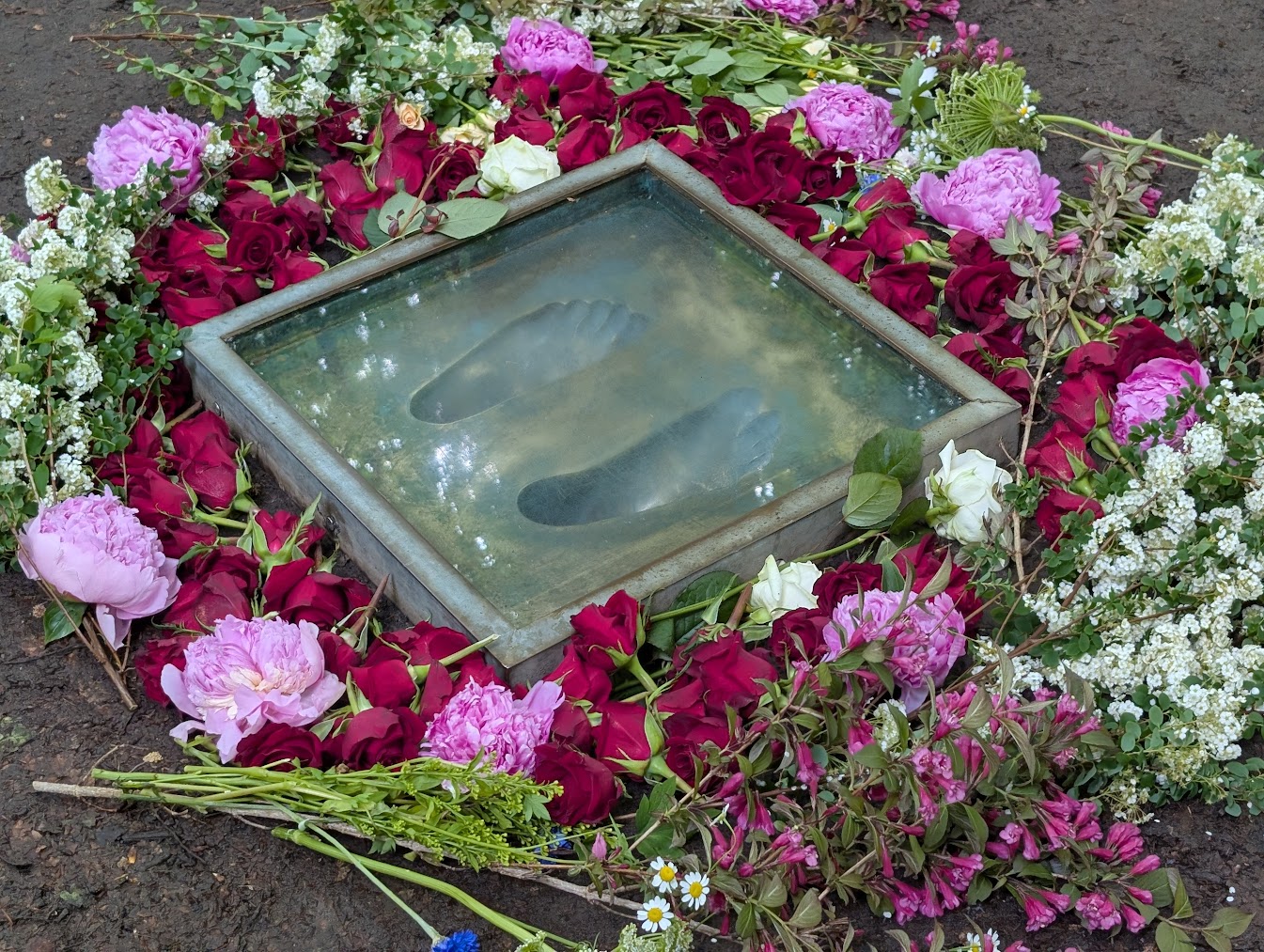
Conceptual artist Timm Ulrichs, who died on April 29 at age 86, has been buried in a self-designed grave in the Künstlernekropole (artists' necropolis) near Kassel, Germany. His tomb features a life-size bronze cast of his body buried head-first in the earth, with only the soles of his feet visible above ground. Ulrichs, a pioneer of West German postwar conceptual art known for provocative works like tattooing himself and locking himself inside a hollowed boulder, was laid to rest in the forest cemetery founded by artist Harry Kramer in 1992.

Shigeo Toya, 1947–2026

Japanese sculptor Shigeo Toya died of pneumonia in Tokyo on April 15, 2026, at age 78. Known for his conceptual approach, Toya spent five decades redefining sculpture beyond Western frameworks, creating works such as *Bamboo Grove II* (1975), the *Woods* series (shown at the 1988 Venice Biennale), and the *Minimal Baroque* series. He was a professor emeritus at Musashino Art University and received Japan's Medal of Honor with Purple Ribbon and the Order of the Rising Sun.

The Many Sheddings of Valie Export

Die vielen Häutungen der Valie Export

Valie Export, the Austrian media and performance artist known for using her body as a site of social critique, has died at age 85 in Vienna. Her final works include a black-and-white photo series of her forearm resting on a stone snake sculpture at the University of Vienna, exploring themes of skin, transformation, and mimesis. From the 1970s onward, she created iconic "Body Configurations" in which she placed her body on streets and against buildings along Vienna's Ringstrasse, tracing architectural forms to expose institutional power and patriarchal authority.