filter_list Showing 9 results for "Gibson" close Clear
dashboard All 9 museum exhibitions 4person people 2rate_review review 2article news 1
date_range Range Today This Week This Month All
Subscribe

Alma Allen Flops in Venice

Hyperallergic reports on the 2026 Venice Biennale, with Editor-in-Chief Hakim Bishara criticizing the U.S. pavilion's exhibition of Alma Allen's work as a disappointing departure from the previous editions' profound explorations of Indigenous life and Black sovereignty. Editor-at-Large Hrag Vartanian offers a positive review of the main exhibition "In Minor Keys," while Greta Rainbow covers a poetry procession honoring the late artistic director Koyo Kouoh. Additional stories include a review of the film "The Christophers" about an artist and forger, and news of workers at the American Folk Art Museum picketing for higher wages.

Alma Allen’s US Pavilion Is One of the Emptiest Shows at the Venice Biennale

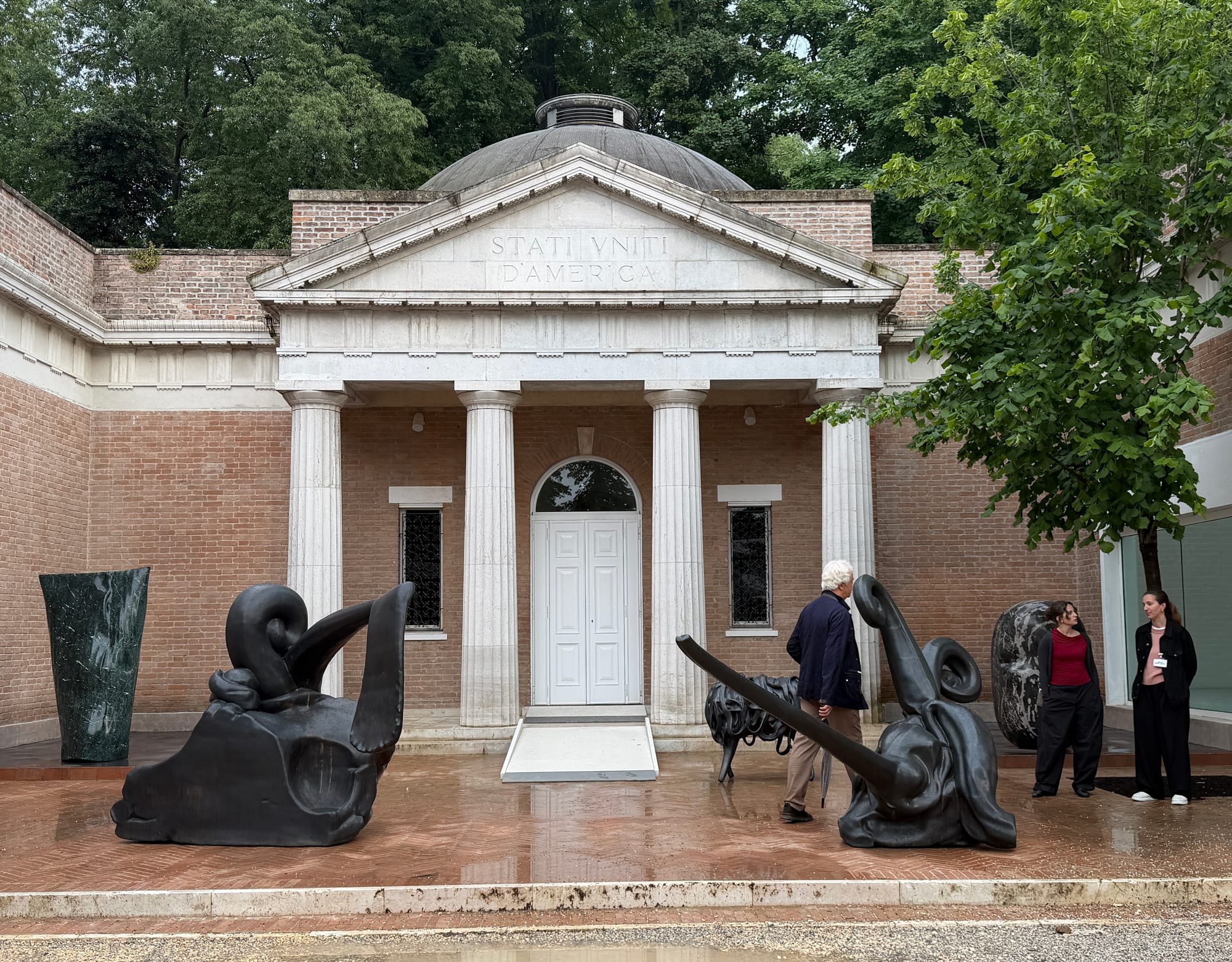
Alma Allen represents the United States at the 2026 Venice Biennale with a subdued, apolitical exhibition inside the US Pavilion. The show features roughly 25 sculptures—mostly in bronze, wood, and stone—many titled "Not Yet Titled," and deliberately avoids overt political messaging. This marks a stark departure from the previous two US pavilions, curated by Simone Leigh (2022) and Jeffrey Gibson (2024), which directly confronted colonialism and empire. The Trump administration’s call for proposals explicitly asked for work that "reflects and promotes American values," and Allen’s presentation has been criticized as safe, unremarkable, and lacking the incisive edge of contemporary American art.

Female nudity and art that stinks: key takeaways from Venice Biennale 2026

The 2026 Venice Biennale opened with 99 participating countries, including first-timers Somalia and Qatar, under the shadow of curator Koyo Kouoh's death. Her planned theme of "enhancement" and the main show "In Minor Keys" were disrupted by political protests: Pussy Riot objected to Russia's inclusion, and a strike against Israel's participation forced several national pavilions (UK, Austria, France) to close. Key takeaways include pervasive female nudity across pavilions, debates over Russia's presence, criticism of the US pavilion's lackluster art, maritime themes dominating several shows, and the rise of olfactory art.

Is the US about to be humiliated on the world’s most prestigious cultural stage?

More than 70 prominent international artists have signed an open letter demanding the exclusion of the United States, Israel, and Russia from the 2026 Venice Biennale, accusing those governments of committing war crimes and atrocities. The controversy centers on the US pavilion, which will feature Mexico-based American artist Alma Allen, whose abstract, anodyne sculptures were chosen by a last-minute commissioner with no art-world experience—a luxury pet food store owner from Florida who reportedly gained the role through connections at Mar-a-Lago. The Biennale's five-person jury has already resigned amid the furor, and Russia is returning to the event for the first time since its 2022 invasion of Ukraine.

A Whole Lot of Nothing at the US Pavilion

The US Pavilion at the 2026 Venice Biennale features sculptor Alma Allen's exhibition "Call Me the Breeze," curated by Jeffrey Uslip. The show presents untitled, amorphous sculptures in bronze, wood, and stone, including Colorado Yule marble. The selection process was controversial: after the Trump administration excluded the National Endowment for the Arts, the State Department initially picked artist Robert Lazzarini and curator John Ravenal, but that plan collapsed. The American Arts Conservancy, a new nonprofit led by Jenni Parido (a former pet food store operator with Mar-a-Lago ties), then took over, hiring Uslip, who approached Barbara Chase-Riboud and William Eggleston before settling on Allen. Donors include businessman John Phelan and fashion designer Tommy Hilfiger.

A sturdy soldier in a sequin dress

"Eine kräftige Soldatin im Paillettenkleid"

Media reviews of the Venice Biennale's opening week offer contrasting takes on the German and US pavilions. Critics describe the German pavilion, curated by Sung Tieu and Henrike Naumann, as a dense, ironic East-West narrative that layers Nazi architecture with DDR prefab construction, creating what Jörg Häntzschel calls a "shockingly seamless symbiosis." The US pavilion, featuring sculptures by Alma Allen, is panned by Maximilíano Durón in ArtNews as politically timid and empty, lacking the clear colonial critiques of previous editions by Simone Leigh and Jeffrey Gibson.

THE ASHLEY GIBSON BARNETT MUSEUM OF ART ANNOUNCES LAURA PUTNAM AS CURATOR OF EXHIBITIONS

The Ashley Gibson Barnett Museum of Art at Florida Southern College has appointed Laura V. Putnam as its new Curator of Exhibitions. Putnam, who has worked at the museum since 2013 and most recently served as Manager of Exhibitions and Adult Programs, steps into the role following the departure of former Executive Director and Chief Curator Dr. Alex Rich. She will lead the conceptualization, development, and execution of all exhibitions, including original research, artwork selection, and collaboration with artists and partner institutions.

AGB Museum promotes Putnam to Curator of Exhbitions role

Laura V. Putnam has been promoted to Curator of Exhibitions at the Ashley Gibson Barnett Museum of Art (AGB) at Florida Southern College in Lakeland. Putnam, who has worked at the museum since 2013 and previously served as manager of exhibitions and adult programs, stepped into an expanded role following the departure of former Executive Director and Chief Curator Alex Rich. She has curated recent exhibitions including "Darkroom Alchemy: Photographs by Jerry Uelsmann," "Surreal Scenarios: The Art of Susanne Schuenke," and "The Medici Dynasty: Renaissance in Florence."

Winnipeg exhibition traces the revival of Red River Métis beadwork

The exhibition 'Beading Métis Resurgence' at the University of Winnipeg's Gallery 1C03 showcases the work of renowned Métis artist Jennine Krauchi alongside four emerging Red River Métis beadworkers she has mentored. Curated by gallery director Jennifer Gibson and history professor Cathy Mattes, the show features Krauchi's centerpiece work 'The Lady'—a beaded coat, muff, hat, and boots—and explores beadwork as contemporary art, cultural knowledge, and intergenerational practice. The exhibition runs until July 10 and includes a table and chairs evoking the kitchen-table lessons where Krauchi passed down her skills.