
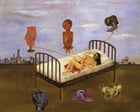
The article is a personal essay by a writer who, after undergoing a colectomy in 2023, found inspiration in Tracey Emin's unflinching self-portraiture following her 2020 cancer diagnosis. The author describes taking her own post-surgery photographs, echoing Emin's mantra "This is mine, I own it," and reflects on Emin's current work, including the Tate Modern exhibition and paintings like "I watched Myself die and come alive" (2023) and "Barbed Wire Stitches" (2024). The essay also connects Emin's approach to that of Frida Kahlo, whose retrospective is upcoming at Tate.
The piece matters because it challenges the label "confessional" often applied to women's autobiographical art, arguing instead that artists like Emin and Kahlo assert ownership and autonomy over their bodies and experiences. It reframes vulnerability as strength and positions Emin's recent work as a continuation of her decades-long project of making visible what society prefers to ignore—now centered on non-visible disability and survival. The essay also highlights how personal art can empower others facing similar health crises, creating a shared language of resilience.