
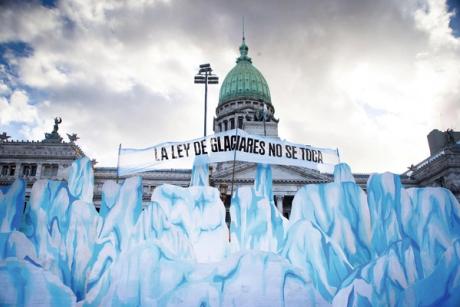
Days before Argentina’s Congress approved an amendment to the glacier law that weakens protections for glacial regions to facilitate mining, President Javier Milei’s government removed a monumental painting of the Perito Moreno Glacier from the Casa Rosada presidential palace. The work, Helmut Ditsch’s photorealist *The Triumph of Nature* (2006), had been on loan and on display since 2012. The government cited “maintenance reasons” and “structural damage,” but the artist says he was not notified and has contacted lawyers. A portrait of Juan Domingo and Evita Perón was also removed the same day, with the same vague explanation.
The removal is part of a broader pattern under Milei’s administration, which has renamed the “Women’s Hall” as the “Hall of Heroes” and replaced portraits of women with men, and rebranded the Kirchner Cultural Center as Palacio Libertad. Historian Felipe Pigna draws parallels to Argentina’s military dictatorships, calling the erasure of images a classic far-right tactic to impose a new narrative and deny uncomfortable history. The incident matters because it links cultural censorship directly to environmental policy, signaling how the government uses symbolic acts to advance a political agenda that critics say threatens both historical memory and environmental protections.