filter_list Showing 11 results for "dR" close Clear
dashboard All 642 museum exhibitions 369article local 81article culture 61article news 58trending_up market 27rate_review review 13person people 12article policy 11gavel restitution 5candle obituary 5
date_range Range Today This Week This Month All
Subscribe

Ascendant Philanthropists Make $23 Million Donation to Met

The Metropolitan Museum of Art has received a $23 million donation from newly elected trustee Jennifer Rubio and her husband Stewart Butterfield, made through the Rubio Butterfield Foundation. The principal gift will endow the museum's undergraduate and graduate internship program in perpetuity, which will be renamed after the couple starting September 2026. An additional donation supports the Met's new Tang Wing for modern and contemporary art, set to open in 2030.

How the State Supports Provenance Research

Comment l’État soutient la recherche de provenance

The French Ministry of Culture has created two specialized missions to assist museums in researching the provenance of their collections, addressing looted artworks, human remains, colonial acquisitions, and illicit trafficking. The Mission for Research and Restitution of Looted Cultural Property (M2RS), established in 2019, focuses on Nazi-era spoliations (1933-1945) with a budget of €220,000 annually, while the newer Mission "Provenance," launched in 2024 under curator Catherine Chevillot, covers human remains, colonial-era objects, and illicit goods with a €450,000 budget. These missions provide expertise, funding, and coordination with institutions like the Commission for the Restitution of Property and Compensation of Victims of Anti-Semitic Spoliation (CIVS), though most museums still only initiate provenance checks during acquisitions or donations.

Italian Culture Minister Launches Inspection of Venice Biennale’s Russian Pavilion

Italian Culture Minister Alessandro Giuli has launched an official inspection of the Russian Pavilion at the 61st Venice Biennale, just days before the exhibition opens. An inspector has been sent to Venice to review all documentation related to Russia's participation, focusing on potential irregularities such as visa issues for Russian artists and delegation members. The investigation follows the Biennale's international jury decision to exclude Russia and Israel from awards due to accusations of crimes against humanity. The Russian Pavilion will be open only during the pre-opening vernissage, after which it will close, with digital documentation displayed in its windows.

Notre-Dame : les associations attaquent le projet

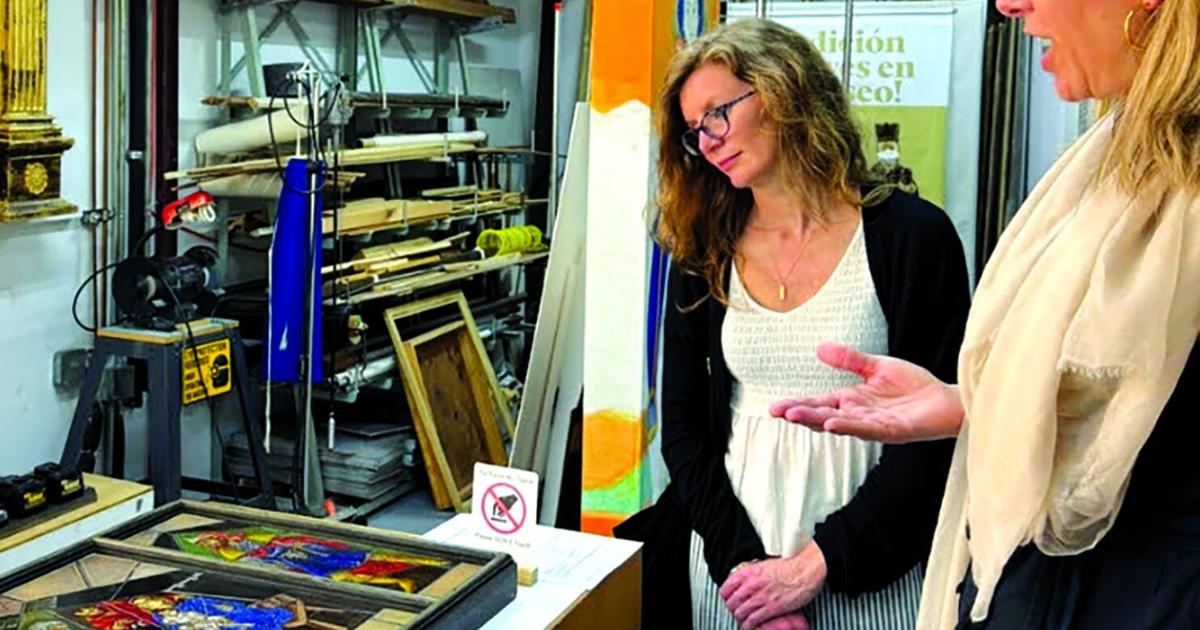
Two French heritage associations, Sites & Monuments and SOS Paris, have filed legal challenges against the project to replace the stained-glass windows of Notre-Dame de Paris. The groups have submitted requests to an emergency judge and to the administrative court, seeking to suspend the works, which have already begun and threaten to remove the original windows by Viollet-le-Duc within days. The judge will rule on whether there is a serious doubt about the legality of the decision.

Une souscription pour restaurer le réfectoire des Invalides

La Tribune de l'Art reports that a fundraising campaign has been launched to restore the refectory of the Hôtel des Invalides in Paris, specifically the salle de l'Europe. This room features 17th-century murals attributed to Michel Corneille le Jeune, depicting battles from the Franco-Dutch War (1673–1675), including the sieges of Maastricht, Huy, and Limbourg, as well as allegorical scenes of Louis XIV. The restoration is organized by the Musée de l'Armée, which manages the site.

NEW PROJECT ON PUERTO RICAN ART AND HISTORY: $200K grant will support the initiative at NBMAA

The New Britain Museum of American Art (NBMAA) has received a $200,000 grant from the Henry Luce Foundation to support a new project titled "Puerto Rico in Focus: Historical Interventions." The initiative is part of a multi-year museum effort to explore Puerto Rico’s complex relationship with the United States through exhibitions, research, and community programs.

Can the Costume Institute Survive Without the Met Gala?

The New York Times examines whether the Costume Institute at the Metropolitan Museum of Art can sustain its operations and influence without the Met Gala, its annual fundraising gala that generates millions of dollars and global media attention. The article explores the financial and cultural dependency of the institute on the star-studded event, which has become a major pop culture phenomenon, and considers alternative funding models and programming strategies that could ensure its future.

Pablo Diaz, directeur de Sciences Po Rennes : « L’acte II de l’INSEAC de Guingamp »

Pablo Diaz, director of Sciences Po Rennes, announces that the Institut national supérieur de l'éducation artistique et culturelle (INSEAC) in Guingamp has been transferred from the Conservatoire national des arts et métiers (Cnam) to Sciences Po Rennes as of January 1, 2026. The institute, which opened in 2021 and focuses on training, research, and resources for arts and cultural education, will now operate under public-sector governance with oversight from the French ministries of Culture, Education, and Higher Education. Diaz outlines plans to appoint a dedicated site director in Guingamp and establish a strategic orientation committee chaired by interministerial delegate Emmanuel Ethis, aiming to resolve past management and governance issues.

L’offre de formation se développe

French art training institutions are expanding their curricula to include provenance research, responding to a 2022 government report that identified gaps in conservator education. The Institut national du patrimoine (INP) now offers seminars on Nazi-era spoliation (1933-1945) and has added a five-day provenance research module for external competition students since 2024-2025. Paris-Nanterre University launched a master's-level diploma in 2022 covering legal, historical, and methodological aspects of provenance research. The École du Louvre now offers a specialized master's in "sensitive goods and provenance research" addressing spoliated works, human remains, colonial acquisitions, and illicit trafficking, while also integrating provenance methodology into its general curriculum from master's level one.

Cultural Observatories: Dinosaurs or Subjects Capable of Interpreting the Present?

Osservatori culturali. Dinosauri o soggetti in grado di interpretare il presente?

The Cultural Observatory of Canton Ticino has published a study on cultural observatories worldwide, including a map and list of surveyed organizations. The analysis reveals that cultural observatories are not a global phenomenon but are concentrated mainly in Europe and South America, with occasional presence in North America (especially Canada and Hispanic-oriented organizations in the US). Africa, Asia, and Oceania are almost entirely absent from the map. The study also highlights a high rate of inactive observatories: among the top 10 countries by active observatories, only Germany shows an effective activity ratio. Spain has 26 active observatories out of about 45 total, while Italy has 11 active out of over 20 inactive. The research defines observatories as non-profit organizations that combine cultural and statistical expertise to deepen and transfer knowledge about the cultural sector, and classifies as inactive those with no recent activity on web or social channels.

Aumenti salariali e welfare per i lavori della cultura. È stato firmato il nuovo Contratto Nazionale di Lavoro. L’intervista

A new national labor contract for Italy's cultural sector has been signed. The Federculture National Labor Contract, finalized on April 30, 2026, includes a 7.5% increase in minimum wages (effective December 1, 2024), doubled welfare contributions for healthcare, and a simplified job classification system. The agreement was reached between Federculture and major unions including FP CGIL, CISL FP, UIL FPL, and UIL PA, with negotiations for the 2025-2027 term set to resume on May 26.