filter_list Showing 5 results for "Origins" close Clear
dashboard All 5 museum exhibitions 4gavel restitution 1
date_range Range Today This Week This Month All
Subscribe

A Poetic and Material Institutional Critique: Gala Porras-Kim at kurimanzutto and the Venice Biennale

UNA CRÍTICA INSTITUCIONAL POÉTICA Y MATERIAL: GALA PORRAS-KIM EN KURIMANZUTTO Y LA BIENAL DE VENECIA

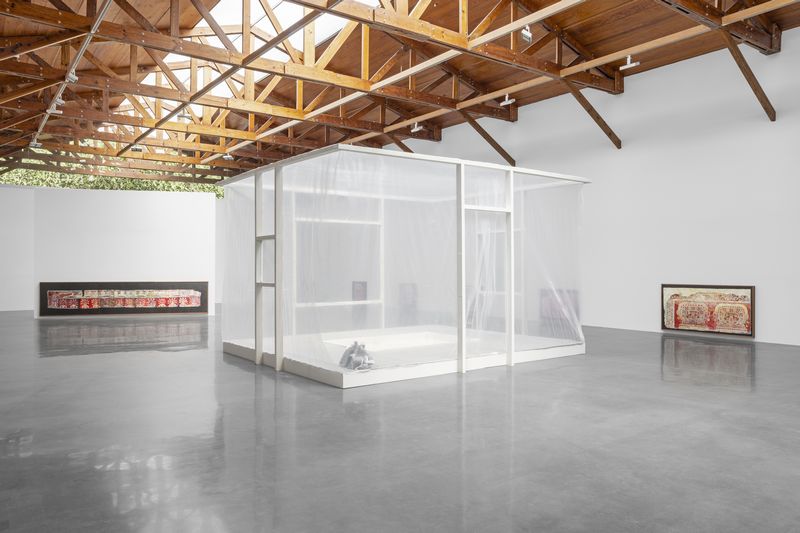
Colombian artist Gala Porras-Kim presents her first solo exhibition at kurimanzutto gallery in Mexico City, titled "Espacios del futuro replican los del pasado" (2026), alongside her participation in the 2026 Venice Biennale. The show critically examines how museum conservation protocols transform objects by detaching them from their original material, ritual, and spiritual contexts. Central to the exhibition is "The Motion of an Alluvial Record" (2024), a greenhouse that recreates the humidity and temperature of Yucatecan mangroves, allowing clay and sediment to shift continuously, resisting the linear, stratified time of Western archives and evoking cyclical Maya cosmologies. Another series, "Uprooted" (2026), reproduces fragments of looted Teotihuacan murals from Techinantitla, now held by the Metropolitan Museum of Art and the Ethnological Museum of Berlin, reinstalling them near the floor to restore their original architectural scale and orientation.
Three Venice shows everyone is talking about

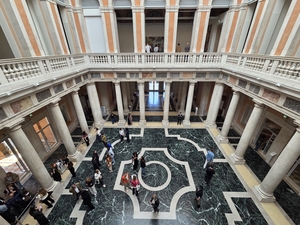
The Korea Herald recommends three must-visit museum shows in Venice during the Venice Biennale. At Palazzo Grassi, the Pinault Collection presents "Michael Armitage. The Promise of Change," featuring the Kenya-born British painter's vivid works addressing sociopolitical tensions and migration. At Gallerie dell'Accademia, "Transforming Energy" by Marina Abramovic marks her 80th birthday, creating a dialogue between her performance art and Renaissance masterpieces. The Peggy Guggenheim Collection hosts "Peggy Guggenheim in London: The Making of a Collector," revisiting her formative years and her short-lived London gallery Guggenheim Jeune.

Au musée de l’Image d’Épinal, les talents multiples de Frans Masereel, entre autres inventeur du roman graphique

The Musée de l'Image d'Épinal is presenting a comprehensive exhibition on Belgian artist Frans Masereel (1889–1972), widely credited as the inventor of the graphic novel in 1918 with his wordless narratives composed of black-and-white woodcuts. The show, curated by Samuel Dégardin, brings together loans from major institutions and a private collection to reveal the full breadth of Masereel's practice, which spanned drawing, animation, painting, theater, ceramics, tapestry, and satirical press illustration. It highlights his pacifist activism during World War I, his collaborations with writers such as Stefan Zweig and Romain Rolland, and his humanist vision of a unified Europe.

The Founders of Open Restitution Africa (ORA) on Their New Open Data Platform

On March 31, the research initiative Open Restitution Africa (ORA) launched the ORA Open Data Platform, a database providing information on the restitution of African artifacts and ancestral remains. Developed over six years by ORA’s all-woman, pan-African team, the site uses case histories and AI-powered tools to offer practical insights into the return process, available in French and English. It presents 25 case histories spanning 200 years, using data visualizations, essays, and interactive tools to help individuals and communities develop their own restitution strategies. ARTnews interviewed founders Chao Tayiana Maina and Molemo Moiloa about the project's origins and goals.

S&M-inspired Greek Pavilion in Venice confronts its fascist chains

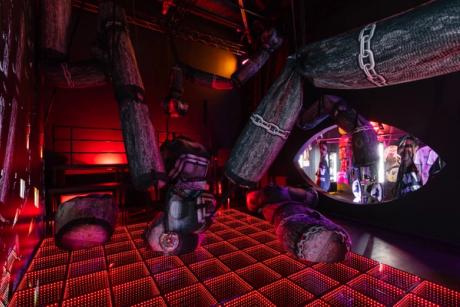
The Greek Pavilion at the 2026 Venice Biennale, titled "Grecia" and conceived as a drag artist, presents an S&M-inspired installation by artist and architect Andreas Angelidakis. The immersive space features a red neon-lit floor, soft sculptures resembling beanbags, fragmented marble columns wrapped in chains, and souvenirs bearing images of queer artists and the late activist Zak Kostopoulos (Zackie Oh). The pavilion aims to deconstruct the idea of a fixed national identity, exploring themes of queerness, fascism, and historical trauma.