
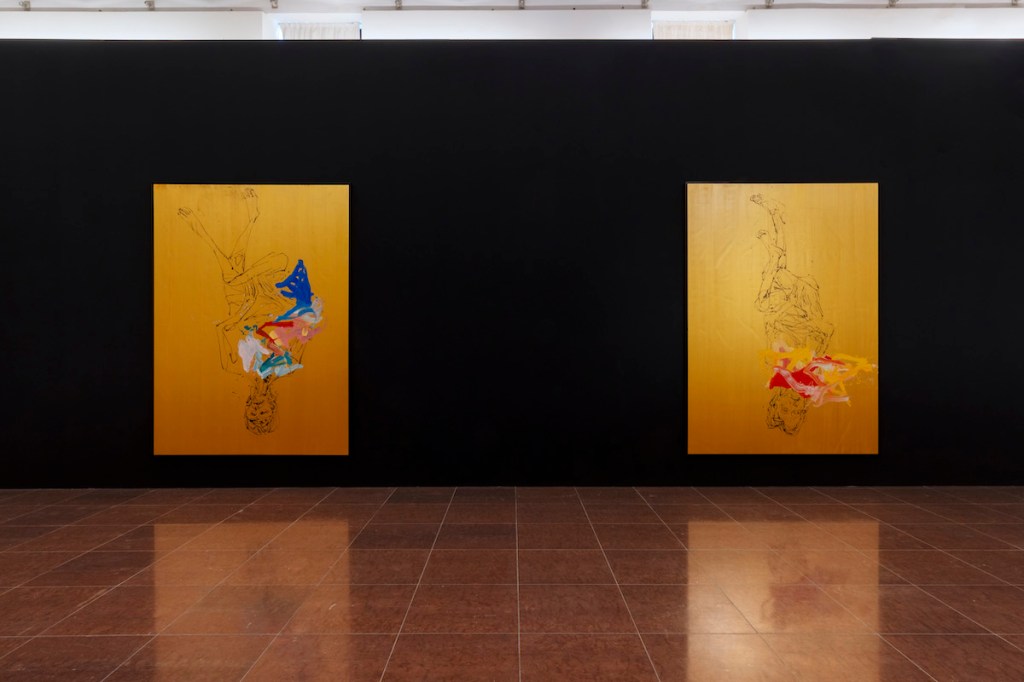
Six days after Georg Baselitz's death, his dealer Thaddaeus Ropac opened "Eroi d'Oro" ("Heroes of Gold") at the Fondazione Giorgio Cini in Venice. The exhibition features the final paintings Baselitz made before he died in April at age 88. In a prerecorded film, Baselitz calls these works his "last paintings," intended as a summation of his six-decade career. The large-scale, gold-ground paintings depict thin, ink-like figures of himself or his wife Elke lying horizontally, floating in undefined space. Baselitz connected the gold grounds to Fayum mummy portraits, Sienese altarpieces, and Byzantine icons, using them to absorb space and create a shadowless, eternal condition.
This exhibition matters because it represents the final chapter of one of Germany's most provocative contemporary artists, who built his reputation on disruption—from scandalous early figurative works to his signature upside-down paintings and the broken-monument figures at the 1980 Venice Biennale. Yet his last show is more a quiet distillation than another controversy. Art historian Eric Darragon notes the paradox: it is an ending that behaves like a beginning, reflecting Baselitz's constant need to start afresh. The show offers a rare moment of finality from an artist who refused good taste, and it may reshape how his legacy is understood.