filter_list Showing 27 results for "Venice" close Clear
dashboard All 101 museum exhibitions 48article news 27article policy 11person people 5article culture 4rate_review review 2article event 1trending_up market 1candle obituary 1article local 1
date_range Range Today This Week This Month All
Subscribe

Venice, Here We Come

Hyperallergic's newsletter previews the upcoming 61st Venice Biennale, noting the charged political climate that may overshadow the art. It highlights the main exhibition "In Minor Keys" conceived by the late Koyo Kouoh, and includes a guide to national pavilions, collateral events, and notable exhibitions in Venice. The edition also features a studio visit with 93-year-old artist Joan Semmel, an interview with Lebanese artist Tania El Khoury about her "revenge art," and news about Barbara Chase-Riboud declining to represent the US at the Biennale, a $116M gift to the National Gallery of Art, and the death of Argentine painter Ides Kihlen at 108.
The soap opera continues. Minister Giuli will boycott the inauguration of the Venice Biennale

La telenovela continua. Il Ministro Giuli diserterà l’inaugurazione della Biennale di Venezia

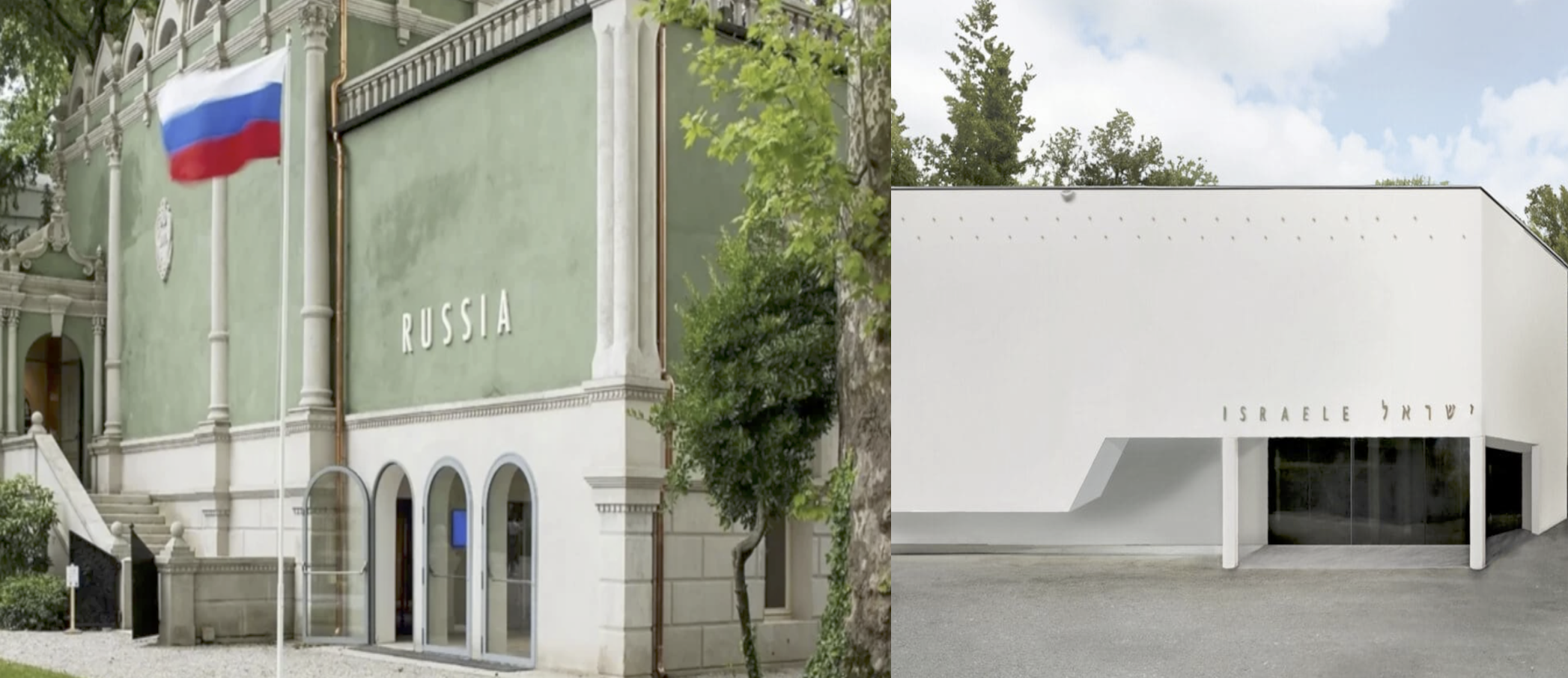
Alessandro Giuli, Italy's Minister of Culture, has announced he will boycott the pre-opening and inauguration ceremony of the 61st Venice Biennale on May 9, 2026, escalating a political and cultural crisis. The dispute began when Biennale president Pietrangelo Buttafuoco allowed the Russian pavilion to reopen, absent since 2022 due to the Ukraine invasion, citing artistic freedom. Giuli demanded the removal of ministry representative Tamara Gregoretti from the Biennale board for failing to oppose the decision. Tensions flared during the Italy Pavilion press conference, where journalists were confined to a separate streaming room and questions were restricted. The European Commission condemned the Russian pavilion's reopening, cutting €2 million in funding and issuing a 30-day ultimatum, while 22 European countries signed a letter pressuring the institution. The Biennale's international jury, led by Solange Oliveira Farkas, then excluded Russia and Israel from award consideration, citing ethical guidelines against countries whose leaders face International Criminal Court charges for crimes against humanity.

Venice Biennale’s Prize Ban on Israel and Russia Falls Short for Critics

The jury of the 2026 Venice Biennale has ruled that Israel and Russia will be ineligible for the Golden and Silver Lion prizes, citing International Criminal Court charges of crimes against humanity against their leaders. The decision follows years of activism and political pressure, with the European Union withdrawing €2 million in funding from the event in protest of Russia's participation. While groups like Art Not Genocide Alliance praised the move as an unprecedented step, critics argue it falls short of a full ban on participation. Israel's artist representative, Belu-Simion Fainaru, condemned the policy as discriminatory, and an open letter signed by 70 artists and curators called for excluding all regimes committing war crimes, including the United States.

"Etwas zaghaft, etwas ängstlich, etwas sicher"

The article surveys recent art-world commentary, focusing on a critical review of the Turner Prize shortlist in The Guardian, where Eddy Frankel calls the selection "timid, anxious, safe" and laments a self-perpetuating, elitist system. It also covers a Hyperallergic essay by Lisa Siraganian questioning whether artworks can possess personhood, sparked by Pierre Huyghe's Venice exhibition. Additionally, it reports on controversy at the Venice Biennale, where the jury preemptively excluded countries whose leaders are sought by the International Criminal Court—namely Russia and Israel—drawing sharp criticism from Die Welt's Marcus Woeller. A podcast interview with US sculptor Alma Allen, selected for the US Pavilion, rounds out the coverage.

Taiwanese Indigenous artist stripped of national prize after sexual assault conviction

Taiwan has revoked the National Award for Arts from Indigenous artist Sakuliu Pavavaljung after his sexual assault conviction was upheld by the Supreme Court. The Ministry of Culture and the National Culture and Arts Foundation announced the withdrawal on 17 April 2025, and Pavavaljung must return the NT$1 million prize. The conviction stems from a February 2021 incident involving a woman under his artistic mentorship; he was sentenced to four years and six months in prison. Allegations first surfaced in December 2021 via social media, prompting further accusations. Pavavaljung had previously been dropped from representing Taiwan at the Venice Biennale and suspended from Documenta 15.

Venice Biennale jury ‘will not award artists from countries facing war crimes charges’

The jury of the Venice Biennale has announced it will not award prizes to artists from countries whose leaders face charges of crimes against humanity by the International Criminal Court, a decision widely seen as targeting Russia and Israel. The five-member jury, appointed by the late curator Koyo Kouoh, stated its commitment to human rights and will exclude artists from nations whose governments are under ICC investigation when selecting winners of the Golden and Silver Lion awards for the 2026 edition, which opens on 9 May. The move follows controversy over Russia’s participation in the biennale, with the European Commission threatening to suspend a €2m grant due to Russia’s involvement, and Italy’s far-right government opposing the decision.

Venice Biennale Jury Bars Israel and Russia from Official Prizes

The international jury of the 61st Venice Biennale announced on April 23 that it will not consider the Israeli and Russian pavilions for official prizes, including the Golden Lion for national participation. The five-member, all-women panel—comprising Solange Farkas, Zoe Butt, Elvira Dyangani Ose, Marta Kuzma, and Giovanna Zapperi—said it would exclude countries whose leaders are currently charged with crimes against humanity by the International Criminal Court, a criterion that applies to Israel and Russia due to ICC arrest warrants for Benjamin Netanyahu and Vladimir Putin. The decision comes amid mounting controversy over the Biennale's decision to host both pavilions, with Russia returning after its artists withdrew in 2022 over the Ukraine invasion and Israel reopening after its 2024 pavilion remained closed pending a Gaza ceasefire. The European Commission had also threatened to suspend a €2 million grant over the Russian pavilion's reopening.

Gearing Up for Venice

The 2026 Venice Biennale's awards jury has announced it will not consider artists from countries whose leaders are charged with crimes against humanity by the International Criminal Court, specifically naming Israel and Russia. In other news, satellite imagery confirms Azerbaijan demolished an Armenian church in Artsakh, the World Press Photo of the Year was awarded to Carol Guzy for an image of ICE detaining a father, and Argentine abstract painter Ides Kihlen died at age 108. Hyperallergic also published a guide to the Biennale by Hrag Vartanian and reported on Lynda Roscoe Hartigan's appointment as director of the Smithsonian American Art Museum.

Venice Biennale jury to avoid artists from nations with ICC-charged leaders

The jury for the Venice Biennale International Art Exhibition announced on April 24, 2026, that they will not consider artists from countries whose leaders face charges at the International Criminal Court, an apparent reference to Israel and Russia. The five jury members, tasked with selecting Golden and Silver Lion winners among 110 participants, stated they felt compelled to commit to the defense of human rights. The ICC has issued arrest warrants for Russian President Vladimir Putin and Israeli Prime Minister Benjamin Netanyahu for alleged war crimes. The decision follows criticism of the Biennale for allowing Russia to reopen its pavilion after its 2022 invasion of Ukraine.

Russia and Israel cannot win any prizes at the next Venice Art Biennale 2026. The jury takes a stand

Russia e Israele non potranno vincere nessun premio alla prossima Biennale Arte di Venezia 2026. La giuria prende posizione

The international jury for the 61st Venice Biennale, led by Solange Farkas, has unanimously declared it will not consider countries whose leaders are currently accused of crimes against humanity by the International Criminal Court. This means Russia and Israel are excluded from competing for the Golden Lion awards, including Best National Participation and Best Artist. The jury's statement, published on e-Flux Notes, emphasizes the Biennale's historical role as a platform connecting art with contemporary urgencies and acknowledges the complex relationship between artistic practice and state representation.

Nations Charged With Crimes Against Humanity Will Not Be Considered for Venice Biennale Awards

The jury for the 2026 Venice Biennale announced it will not consider contributions from countries whose leaders are charged with crimes against humanity for the Golden and Silver Lion awards, effectively excluding Israel and Russia. The decision, framed as a commitment to human rights and aligned with curator Koyo Kouoh's vision, comes amid broader controversy over participating pavilions, including American artists declining to represent the US and the EU withdrawing a $2.3 million grant over Russia's involvement.

Biennale Jury Will Not Consider Countries with ICC Allegations

Biennale-Jury will Länder mit IStGH-Vorwürfen nicht berücksichtigen

The jury of the Venice Art Biennale has announced that it will not consider countries whose heads of state or government face allegations of crimes against humanity from the International Criminal Court (ICC) when awarding prizes this year. The jury, led by Brazilian art historian Solange Farkas, cited its commitment to defending human rights. While no specific countries were named, the ICC currently has arrest warrants against Russian President Vladimir Putin for alleged war crimes in Ukraine and Israeli Prime Minister Benjamin Netanyahu for alleged war crimes in Gaza. The Biennale leadership stated the jury acted in full autonomy and independence.

Venice Biennale Awards Jury Won’t Consider Russia and Israel

The international awards jury for the 61st Venice Biennale has announced it will not consider countries whose leaders are charged with crimes against humanity by the International Criminal Court (ICC) for prizes. The all-women jury, chaired by Solange Farkas, published a statement on e-flux declaring this policy, which implicitly targets Russia and Israel, whose leaders Vladimir Putin and Benjamin Netanyahu face ICC warrants. The jury is responsible for awarding Golden Lions for the best national pavilion and best artist in the central exhibition. A majority of artists in the main show issued an open letter supporting the decision, while the Biennale Foundation faces criticism for allowing both nations to participate in 2026.

Venice Biennale Jury Says It Won’t Consider Countries Charged with Crimes Against Humanity, Including Israel and Russia

The Venice Biennale's jury announced it will not consider nations whose leaders are charged with crimes against humanity by the International Criminal Court, effectively excluding Israel and Russia from competing for top honors. The jury, led by Videobrasil founder Solange Farkas, stated this decision aligns with curator Koyo Kouoh's vision and the Biennale's historical role as a platform connecting art to urgent issues. The ICC has issued arrest warrants for Israeli Prime Minister Benjamin Netanyahu and Russian President Vladimir Putin, while other indicted leaders like Sudan's Omar al-Bashir and Afghan officials lack Biennale pavilions.

Venice Golden Lion jury won’t consider Russian and Israeli pavilions

The jury for the Golden and Silver Lion awards at the 61st Venice Biennale has announced it will not consider the national pavilions of any country whose leaders are currently charged with crimes against humanity by the International Criminal Court. This decision specifically excludes Russia, whose president Vladimir Putin is charged with unlawful deportation of Ukrainian children, and Israel, whose prime minister Benjamin Netanyahu is charged with targeting Palestinian civilians and using starvation as a weapon. The jury, presided over by Solange Oliveira Farkas and including Zoe Butt, Elvira Dyangani Ose, Marta Kuzma, and Giovanna Zapperi, issued a full statement explaining their commitment to human rights and alignment with the curatorial vision of the late Koyo Kouoh.

At the ‘art world Olympics,’ Team USA is chaotic

The US Pavilion at the 2026 Venice Biennale, often called the 'art world Olympics,' is mired in controversy and delays under the Trump administration. Curator Jeffrey Uslip insists the process has been smooth and artistically autonomous, but the selection of sculptor Alma Allen and commissioner Jenni Parido—a former pet supply shop owner with a new nonprofit—has raised eyebrows. The usual vetting process by the National Endowment for the Arts was disrupted, new language banning diversity, equity, and inclusion efforts was added to applications, and a government shutdown left only six months to fundraise and plan the exhibition, which coincides with the US's 250th anniversary.

Alma Allen Speaks Out on Backlash Over U.S. Pavilion Commission: ‘A Little Stressful’

Sculptor Alma Allen has spoken out for the first time about the backlash he faced after accepting the commission to represent the United States at the Venice Biennale. In a rare interview on the podcast *Time Sensitive*, recorded at his home in Tepotzlán, Mexico, Allen described the response as “a little stressful” but said he never hesitated when curator Jeffrey Uslip invited him last fall. His selection sparked controversy because the State Department’s requirement that proposals “reflect and promote American values” while not promoting DEI initiatives led higher-profile artists like William Eggleston and Barbara Chase-Riboud to refuse. Allen’s former galleries, Mendes Wood and Olney Gleason, dropped him after he accepted, though he has since joined Perrotin. He also hinted that his exhibition, “Call Me the Breeze,” will include work about conflict and surveillance.

"Du bist nun in die ewigen Jagdgründe der Kunst entschwunden"

This week's art news roundup covers several stories: Jonathan Meese publishes an obituary for his mother Brigitte Meese in Der Spiegel, describing her as a central figure in his life and work. Pussy Riot seeks to take over the Russian Pavilion at the Venice Biennale. The European Media Art Festival (EMAF) in Osnabrück faces controversy over antisemitism allegations linked to Palestinian-American filmmaker Basma al-Sharif, leading the city and state government to distance themselves from the festival. In the NZZ, Christian Wildhagen reports on conflicts over official political portraits, citing examples like Swiss councilor Martin Neukom rejecting paintings and Donald Trump criticizing his portrait. Art historian Horst Bredekamp pays tribute to Italian philosopher Federico Vercellone (1955–2026) in the FAZ, highlighting his theory of the 'self-activity of form.'

Statement of Intention by the International Jury of the 61st International Art Exhibition In Minor Keys of La Biennale di Venezia

The international jury for the 61st International Art Exhibition of La Biennale di Venezia, titled "In Minor Keys," has issued a statement declaring their intention to exclude from consideration any countries whose leaders are currently charged with crimes against humanity by the International Criminal Court. The jury, chaired by Solange Farkas and including members Zoe Butt, Elvira Dyangani Ose, Marta Kuzma, and Giovanna Zapperi, was selected by artistic director Koyo Kouoh to award the Golden and Silver Lions among the 110 artists in the exhibition.

What You Need to Know About the Venice Biennale’s Russian Pavilion Controversy

The Russian pavilion is set to return to the Venice Biennale for the first time since the 2022 invasion of Ukraine, presenting an exhibition titled 'The tree is rooted in the sky.' This has sparked significant controversy, with artists, curators, and politicians from Ukraine and several European nations calling for the pavilion's exclusion, citing the ongoing war and sanctions. The Biennale organizers have refused to remove Russia, stating they lack the authority to exclude a state recognized by Italy and emphasizing the event's role as a neutral space for cultural dialogue.

Monet, the Great Traveler

Monet, grand voyageur

The publishing house Cinabre has launched a new book series called 'Partance' that explores the influence of travel on artists' work. The inaugural volume, 'Partance. Claude Monet,' published in 2026, marks the centenary of Claude Monet's death by comprehensively tracing all of his foreign travels for the first time and analyzing their impact on his art.

There Has Never Been an Apolitical Venice Biennale

"Es hat niemals eine unpolitische Venedig-Biennale gegeben"

The Venice Biennale is embroiled in political controversy, with the US Pavilion's selection process criticized for bypassing traditional curatorial expertise in favor of a politically connected outsider. Simultaneously, a collective of artists and academics is protesting Russia's return to the Biennale, arguing it uses art as a political instrument to normalize its actions amid the war in Ukraine. An analysis in ArtReview contends the Biennale has never been apolitical, serving as a stage for geopolitical power plays since its inception.

How Pussy Riot Is Challenging Russia’s Return to the Venice Biennale

The feminist art collective Pussy Riot is campaigning to replace the official Russian exhibition at the 2024 Venice Biennale with their own show, "Resistance Imprisoned." The alternative exhibition features art created by nearly 30 current and former political prisoners in Russia, using improvised materials like envelopes, bedding, and blood. The collective's founder, Nadya Tolokonnikova, aims to expose the country's repressive system, drawing from her own experience in a penal colony.

Barbara Chase-Riboud Says She Declined US Pavilion Offer Because It Was ‘Not the Moment’

Sculptor Barbara Chase-Riboud has revealed she declined an offer to represent the United States at the 2025 Venice Biennale, stating that for her, "this was not the moment." The offer was made by the American Arts Conservancy, the nonprofit organization commissioning the US Pavilion. The revelation comes amid ongoing scrutiny of the selection process that ultimately led to artist Alma Allen being chosen, following reports that the Trump administration removed diversity language from application materials.

America’s Venice Biennale artist was scorned by tastemakers — he says he’s misunderstood

American sculptor Alma Allen, a self-taught artist with an unconventional background, has been selected to represent the United States at the 2025 Venice Biennale. His selection was made by the American Arts Conservancy, a new nonprofit with no art-world track record, which was awarded the commission through a State Department process that removed diversity requirements and emphasized art reflecting "American values."

Unpacking the Venice Biennale controversies and highlights

The 2026 Venice Art Biennale is proceeding with a posthumous main exhibition, "In Minor Keys," curated by the late Cameroonian-born artistic director Koyo Kouoh, who died in May 2025. The event features 100 national participations, including seven first-time countries, and has reinstated Russia's pavilion after its voluntary withdrawal following the 2022 invasion of Ukraine.

The Pet Food Store Owner Behind the Venice Biennale’s US Pavilion, 400-Year-Old Pendant in English Painting Resurfaces, and More: Morning Links for April 20, 2026

The New York Times profiled Jenni Parido, the 37-year-old commissioner of the upcoming US Pavilion at the Venice Biennale, who has no professional arts background and previously ran a luxury pet food store in Florida. She selected Jeffrey Uslip as curator, and artist Alma Allen will represent the US after other artists reportedly declined.