
filter_list Showing 7 results for "inah" close Clear
dashboard All 7 article news 6museum exhibitions 1
date_range Range Today This Week This Month All
Subscribe

Prehistoric Stone Altar with Human Remains Discovered in Central Mexico

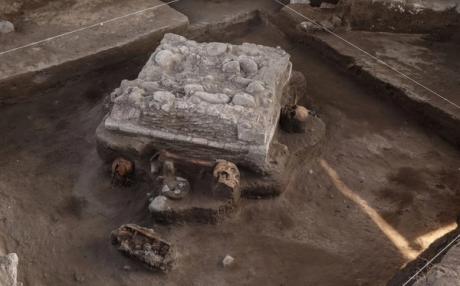
Archaeologists conducting salvage work for a new passenger train line between Querétaro and Mexico City have unearthed a 1,000-year-old Toltec stone altar. Located within the Tula Archaeological Monument Zone in Hidalgo, the three-level structure was found alongside four human skulls, long bones, a black ceramic bowl, and obsidian blades. Preliminary assessments by the National Institute of Anthropology and History (INAH) suggest the remains belong to individuals offered as ritual sacrifices.
1,000-year-old Toltec altar with four human skulls found in Mexico

Archaeologists from Mexico’s National Institute of Anthropology and History (INAH) have discovered a 1,000-year-old Toltec altar during salvage work for a new high-speed rail line between Mexico City and Querétaro. The stone structure, known as a momoztli, dates back to AD 900-1150 and was found with four human skulls and leg bones arranged at its base, suggesting ritual or sacrificial use. Located near the ancient site of Tula Chico, the find also included ceramic objects and obsidian artifacts within a compound likely belonging to the local elite.

Petroglyphs and cave paintings, some more than 4,000 years old, discovered in Mexico

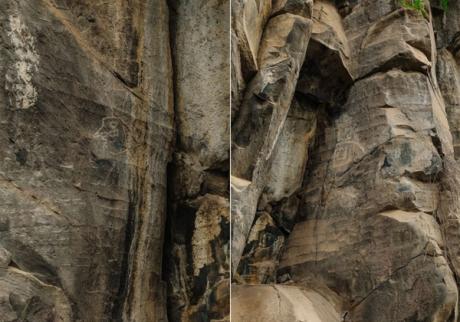
Archaeologists from Mexico’s Instituto Nacional de Antropología e Historia (INAH) have identified 16 petroglyphs and cave paintings near the Tula River in Hidalgo. The artworks span over 4,000 years, ranging from prehistoric times through the Mesoamerican Postclassic period and into the early colonial era. The discovery, which includes depictions of the rain god Tláloc and various anthropomorphic figures, was made during archaeological salvage work for a new passenger rail line connecting Mexico City and Querétaro.

Oman announces artist, concept for Venice Biennale

Haitham Al-Busafi will represent Oman at the 61st Venice Biennale, serving as both artist and curator. His installation, titled "Zinah," transforms the tradition of Omani silver horse adornment (Al-zaanah) into an immersive environment of sand, suspended metal, and collectively generated sound. Located in the Arsenale Artiglierie and commissioned by Oman's Ministry of Culture, Sports and Youth, the work was developed through a community workshop in Muscat where participants inscribed marks into silver forms. The exhibition runs from May 9 to November 22, 2025.

bad bunny backlash artifact mexico museum 1234768524

Bad Bunny, the Puerto Rican musician, touched a Mayan stela on display at the National Museum of Anthropology in Mexico City and posted an image of the act on Instagram. Mexico’s National Institute of Anthropology and History (INAH) publicly reprimanded him, stating that physical contact with archaeological property is prohibited and that security staff had repeatedly warned him. The post has since been deleted.

ancient limestone face carving discovered controversial maya train project excavation 1234761994

Archaeologists working on the controversial Maya Train construction project in Mexico's Yucatan Peninsula have uncovered a 2,000-year-old limestone face carving. The 18-inch-tall artifact was found in Sierra Papacal, near Mérida, during construction of the Mérida-Progreso Railway Bypass, part of the Maya Train's freight infrastructure. The carving, which features deep-set eye sockets, a flat nose, and a cleft lip, is believed to represent an elderly man and was positioned as a marker or entrance to a building with an ovoid floor plan. The discovery was announced by Mexico's National Institute of Anthropology and History (INAH) on November 10, and the artifact will be transported to a laboratory for conservation and analysis.

ancient limestone face carving discovered controversial maya train project excavation 1234761994

Archaeologists working on the controversial Maya Train project in Mexico's Yucatán Peninsula have discovered a 2,000-year-old limestone face carving. The 18-inch-tall sculpture, featuring deep-set eye sockets, a flat nose, and a cleft lip, was found in Sierra Papacal near Mérida during construction of the Mérida-Progreso Railway Bypass. The carving was attached to the foundation of an ovoid building with a west-facing entrance, suggesting it served as a ceremonial marker. Mexico's National Institute of Anthropology and History (INAH) is overseeing the excavation of 15 other nearby structures, and the artifact will be transported to a laboratory for conservation.